Solfa for Praise and Worship Songs: 3 Tricky Bits Fixed
Solfa for praise and worship songs made clear: how to write repeated choruses, syncopated rhythms and key changes so your choir reads them first time.
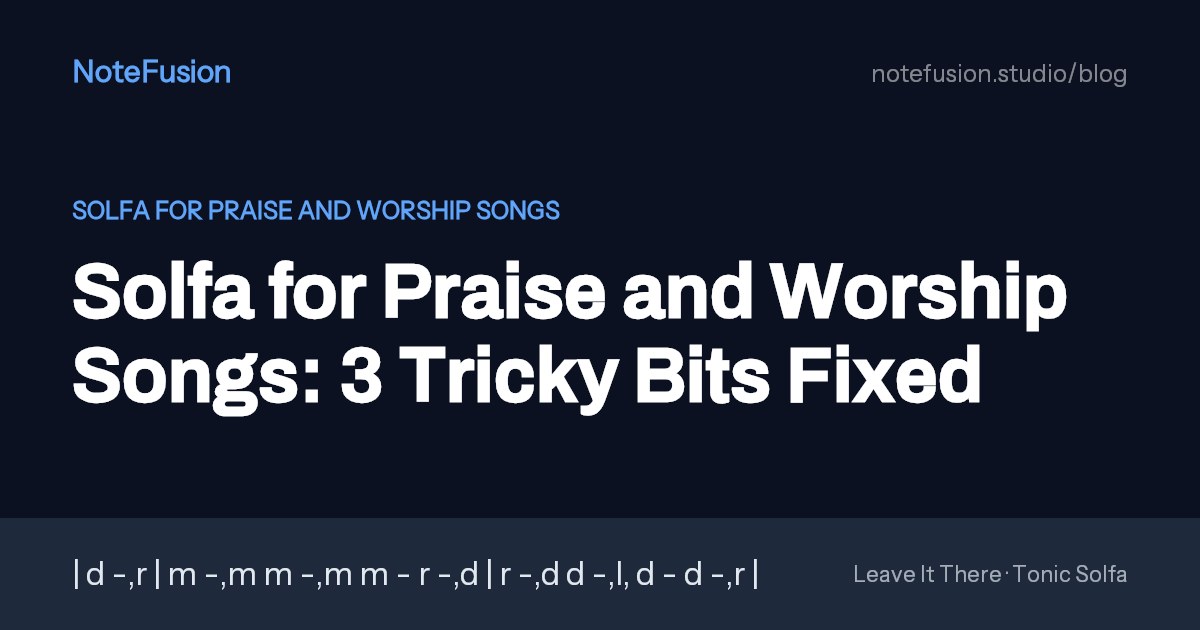
The worship leader sends a YouTube link on Thursday, the song is on Sunday, and the only notation anyone has is the recording. You sit down to write it out for the choir and quickly hit three snags: the chorus comes round five times with small differences, the rhythm pushes ahead of the beat everywhere, and two-thirds of the way through the whole song lifts up a step.
To write solfa for praise and worship songs, find doh from the recording, write each section once (verse, chorus, bridge) with a clear road map, notate the choir's version of syncopated rhythms rather than the lead singer's, and mark every key change with a new "Doh is…" line and a pivot note.
That is the short version. Below I walk through each of those three snags as I handle them for my own choir, with hymn excerpts so you can see exactly how the notation behaves.
Why do worship songs look messy in solfa?
They look messy because they were built for a band and a recording, not for a page. A hymn like "Amazing Grace" gives you four lines, a fixed rhythm and the same tune for every verse. A contemporary song is shaped by an arrangement: an intro, a verse, a pre-chorus, a chorus sung several times, a bridge that builds, sometimes a lift into a new key, and a lead singer who rarely sings the same phrase the same way twice.
If you try to copy every bar of the recording in order, you end up with three pages of solfa where most of the lines are near-copies of each other. The choir cannot see the shape of the song, and they spend rehearsal hunting for where they are. The goal is the opposite: one clear page that shows the tune once and tells the singers how to travel through it.
If you have never written a song out from a recording before, start with my step-by-step guide on how to transcribe a song into Tonic Solfa. This post assumes you know the basics and focuses on the habits of modern worship songs.
Got a recording? Get it in solfa →
Step one: find doh before you write a single note
Everything else depends on getting doh right. With worship recordings this is harder than with a hymn book, because there is no key signature to read and the band may be tuned to suit a particular lead singer.
My routine:
- Listen to the end of the chorus, not the start of the verse. Choruses usually land firmly on the home note.
- Hum that resting note and hold it while the song plays. If it sounds settled, it is likely doh (or lah, if the song feels minor).
- Check it against the bass line. In many worship songs the bass sits on the home note at the strongest moments of the chorus.
- Sing up the scale from your note, d r m f s l t, and see whether the melody fits inside it without awkward clashes.
If you are still unsure, my article on how to find the doh of a song goes through the key signature method, the ear method and the checks for minor keys and starting notes in more detail.
One warning: if the song has a key change, find doh for the opening section only. You will deal with the new doh when you reach it.
How do you write a repeated chorus without rewriting it?
Write each section once, label it, and give the choir a road map at the top of the page. This single habit does more for a worship song sheet than anything else.
Here is the labelling I use:
| Label | Section | What I write |
|---|---|---|
| V | Verse | Melody once, with verse 1 words; other verses' words underneath if the tune is the same |
| PC | Pre-chorus | Melody once |
| C | Chorus | Melody once, with the words |
| B | Bridge | Melody once; note how many times it repeats |
| Tag | Final repeated line | Only the line itself, with "x3" or similar |
Then the road map goes in a box at the top: for example, "Intro – V1 – C – V2 – C – B x4 – C – C (new key) – Tag x3". The choir reads the box, then reads the sections. Nobody has to scan three pages.
When a repeat is not really a repeat
The trap is the chorus that changes slightly. Common examples:
- The last chorus is sung quietly, then loudly. That is not a notation change; write "C (soft)" and "C (full)" in the road map.
- The final line of the last chorus goes up instead of down. Write only that line out again, labelled "C ending, last time".
- One chorus has a different word fitted to the tune, so a note splits in two. Write that bar again under the chorus with a small label rather than copying the whole chorus.
My rule is simple: if the melody or rhythm changes, write the changed bars; if only the volume or feel changes, write a word in the road map.
Ignore the ad-libs
The lead singer will decorate, slide, and sometimes sing a completely different line over the last chorus. Your choir does not need any of that. Write the melody that the congregation would sing if the band stopped playing. If a section of the choir is going to take a harmony or a high line, write that as its own short section, the same way you would treat a hymn descant.
How do you write syncopation in solfa?
Write the rhythm your choir will actually sing together, using the half-beat and uneven-beat marks of the solfa grid, and simplify anything a group of voices cannot place cleanly. Syncopation is where worship songs differ most from the hymn book, but solfa handles it well once you see how the grid divides a beat.
Older gospel songs are a good bridge here, because they already use the long-short patterns that modern songs lean on. Look at the opening of "Leave It There":
| dIf-,rthe | mworld-,mfrommyou-,mwith-mhold-rof-,dits |
Notice the marks like "-,r" and "-,m" inside the beats. The comma splits a beat unevenly: the note before it is held, and the note after it is short and lands just before the next beat. That long-short shape is the same push you hear all over contemporary worship, where a word arrives a fraction before the beat you expect.
When I write a syncopated line, I work in this order:
- Tap the beat first. Play the recording and tap a steady pulse on the table. Mark where the strong beats fall in the words.
- Find which syllables land on the beat and which land just before it. The early ones are your syncopations.
- Decide whether the choir needs the push. If the lead singer anticipates a word but the choir would sound tidier landing on the beat, write it on the beat. Twenty voices pushing slightly differently sound muddier than twenty voices landing together.
- Keep the pushes that define the song. If the hook of the chorus depends on an early word, keep it, and make it the first thing you rehearse.
In rehearsal, I clap the rhythm of a syncopated line on its own before anyone sings a syllable. Then we speak the words in rhythm. Only then do we add the solfa. If your choir is still uneasy with half beats and held notes, my guide to reading rhythm in Tonic Solfa is worth handing round first, and many worship verses also begin on a pickup note, so check where the first word falls.
Writing key changes in solfa for praise and worship songs
This is where movable doh earns its keep. When a song lifts into a new key, the tune usually stays exactly the same; only the pitch of doh moves. So in solfa the syllables do not change at all. What changes is the "Doh is…" line.
Here is the opening of "Shall We Gather at the River?" in its printed key, with doh on D:
| mShall-mwe-mgath--,rermat-,fthe | sriv----mer,--- |
And here are the same bars lifted a semitone, the kind of lift you often hear before a final chorus:
| mShall-mwe-mgath--,rermat-,fthe | sriv----mer,--- |
The solfa is identical. A singer who knows the chorus in one key already knows it in the other; they just need to hear the new doh. That is why I never rewrite a lifted chorus. I write a new line in the road map, "C (Doh is Eb)", and a small note on the page where the change happens.
Give the choir a pivot note
The hard part is not the new key; it is the moment of moving into it. Singers need something to hold on to across the join. I give them a pivot: the last note of the old key, named in the new one.
- Up a semitone (D to Eb, for example): the old doh becomes the new t, just below the new doh. Tell the choir "our last doh is now ti, so lean up to the new doh."
- Up a whole tone (D to E, for example): the old soh becomes the new fah. If the old section ended on soh, that is a natural place for the choir to feel the shift.
Write the pivot in brackets at the change, for example "(old s = new f)". It takes a few seconds to write and saves a lot of fumbling at the most exciting moment of the song.
Check the new key fits your choir
A lift that sounds thrilling on a recording may put your sopranos above their comfortable range for the whole final chorus, and repeated choruses make it worse because they stay up there. Before you commit, check the highest and lowest notes of the chorus in the new key. If it is too high, move the whole song down and keep the lift, rather than dropping the lift. My guide on how to choose the right key for your choir covers how to judge this for each part.
What about minor-key worship songs?
Write them la-based, exactly as you would a minor hymn. Find the relative major, call that note doh, and treat lah as home. A song in A minor has doh on C; the verse will often settle on lah and the chorus may brighten towards doh. Many worship songs move between the two, and la-based solfa shows that movement beautifully, because the syllables tell singers whether they are leaning towards lah or doh without any change of key.
If you hear a raised seventh, often at the end of a minor phrase, write it as se rather than inventing a new doh. The "Doh is…" line should only change when the song genuinely moves to a new key.
A one-page layout your choir can read on Sunday
Before I print or share a worship song sheet, I check it against this list:
- Road map box at the top, with every section and its repeats in order.
- "Doh is…" at the start, and again at every key change, with a pivot note.
- Each section written once, labelled V, PC, C, B or Tag.
- Only changed bars written twice, with a clear label for when they apply.
- Rhythm simplified where the choir needs to land together; defining pushes kept.
- Octave marks checked: s, for low notes and d' for high ones, so tenors and sopranos are not guessing.
- Words under every note, especially where one syllable stretches over two notes.
If the sheet fits on one page, the choir can hold it in one hand and look up at the director. That alone makes rehearsal calmer.
Doing this faster
Writing out a worship song by ear is a good skill, but on a Thursday evening with a Sunday deadline, speed matters. In NoteFusion you can paste the YouTube, Spotify or Apple Music link the worship leader sent, and it writes the melody in movable-doh Tonic Solfa with staff notation. When the tune could sit in two keys, it asks "Which doh is it?" so you choose rather than guess, and it writes minor songs la-based.
You can then play a tricky syncopated chorus back on a piano, slower or looped, until the rhythm is clear, use "Transpose for my choir" to check whether the lifted final chorus sits comfortably for each part, and share the sheet with your singers by link. It works in the browser and as an Android app. Try it with this week's song at NoteFusion.
Frequently asked questions
Can you write modern worship songs in Tonic Solfa?
Yes. Any song with a melody can be written in movable-doh solfa. The work is in finding doh from the recording, simplifying the rhythm to what the choir actually sings, and laying out the repeated sections clearly.
How do I write a key change in solfa?
Start a new line, write the new 'Doh is…' at the start of it, and carry on writing the tune from the new doh. Add a pivot note so singers know which syllable the last note of the old key becomes in the new one.
Should I write every repeat of the chorus out in full?
No. Write the chorus once, label it, and give the choir a road map such as V1, C, V2, C, B, C, C. Only write a chorus out again if its melody, rhythm or key changes.
How do I notate syncopation for a choir in solfa?
Write the version the choir will sing together, not every push and slide from the lead vocalist. Use the half-beat and uneven-beat marks of the solfa rhythm grid, then clap the rhythm with the choir before they sing it.
What if a worship song is in a minor key?
Write it la-based: find the relative major, call that note doh, and let lah be the home note. A song in A minor has doh on C and ends on lah.