All the Way My Saviour Leads Me Tonic Solfa: 3 Rehearsals
All the Way My Saviour Leads Me tonic solfa in G major: phrase-by-phrase notes, the repeats that save rehearsal time and a breathing plan for long lines.
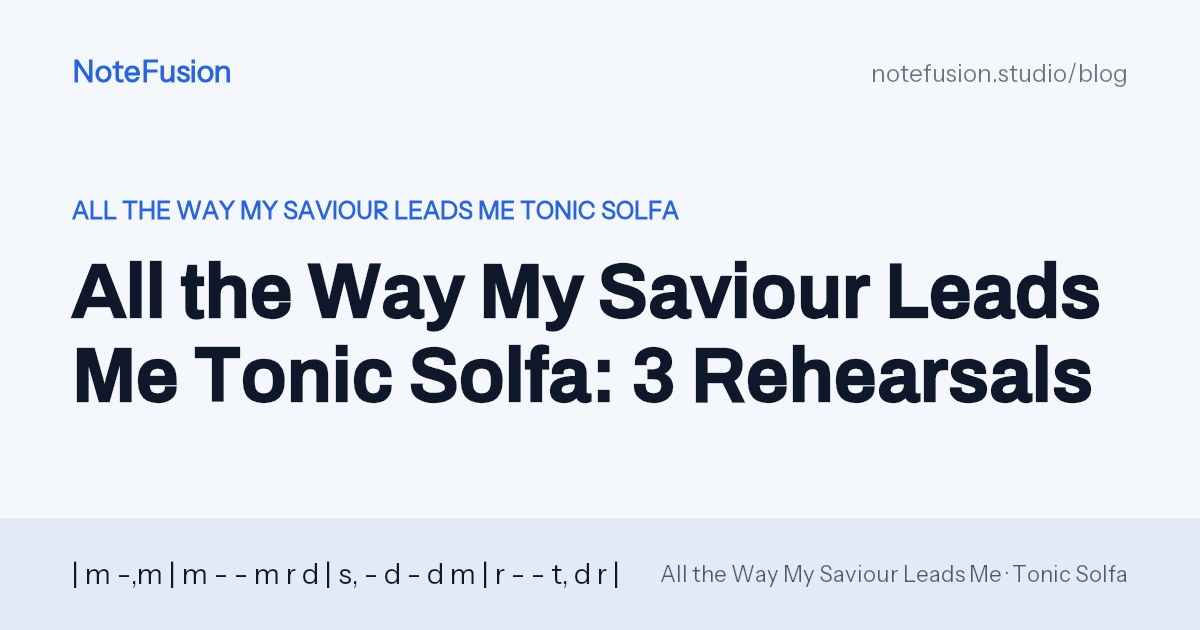
Someone has asked for All the Way My Saviour Leads Me on Sunday, the choir knows the words but not the notes, and you have one rehearsal and a bit. The good news is that this tune asks the choir to learn far fewer new bars than its length suggests.
Here is the direct answer. The all the way my saviour leads me tonic solfa on our page is in G major (doh is G), in 3/4 time, 21 bars long. It begins on a one-beat pickup on me and opens with m m m r d, dropping to s, on "leads". Learn the opening line well and much of the hymn follows from it.
In this post I walk through the G major page phrase by phrase, show you how to spot what repeats so your choir is not learning the same shape three times, and give you a breathing plan for those long, rest-free lines.
The all the way my saviour leads me tonic solfa at a glance
The full sheet is on our All the Way My Saviour Leads Me in Tonic Solfa page. Fanny Crosby wrote the words and Robert Lowry the tune, and it moves gently in three. Before anything else, here are the first five bars, which carry the first line of words and the pickup into the second:
| mAll-,mthe | mway--mmyrSav-dior | s,leads-dme,-dWhatmhave | rI--t,todaskrbe- | mside?---mCan-,mI |
Read it slowly and notice four things:
- The pickup is dotted. "All the" is a long me followed by a short me. Sing it as one lazy, lilting gesture, not two equal notes, or the whole hymn will sound stiff.
- The opening sits on one note. "All the way my" stays on me. The first real movement is the step down m r d on "Saviour".
- Two low notes appear early. s, on "leads" and t, on "to" are below doh. Altos singing the tune and anyone with a lighter voice need to aim these confidently rather than let them fade.
- The line ends on a long me. "Beside" is held for two beats, and then the dotted pickup "Can I" arrives on me again, exactly as the hymn began.
That last point is the key to learning the hymn quickly.
Got a recording? Get it in solfa →
Where do the phrases repeat in All the Way My Saviour Leads Me?
The second line starts with the same dotted me pickup as the first, so the choir begins line two from a shape it already knows. Look at the end of bar 5: "Can I" is written m -,m, identical to bar 1.
My advice is to treat the hymn as a few musical units rather than 21 separate bars:
- Unit A: the opening line (bars 1-5). Learn this until it is secure. It is the shape everything else is measured against.
- Unit B: the answering line ("Can I doubt His tender mercy"). It starts the same way as Unit A. Ask the choir to sing it and listen for the moment it parts company with the first line. That is the only new material they need to learn in that line.
- Unit C: the middle line ("Heavenly peace, divinest comfort"). This is usually where the tune lifts and feels most different. Give it the most rehearsal time.
- Unit D: the closing line ("For I know whate'er befall me, Jesus doeth all things well"). The words of this line are sung twice, which is why the tune runs to 21 bars rather than a tidy 16.
Before rehearsal, open the hymn page with a pencil and a printed copy. Draw a bracket over every bar that matches something earlier, and circle the bars that do not. When I do this with a new hymn, the circled bars become my rehearsal list. Everything bracketed gets one run-through, not ten.
For the repeated closing words, check carefully whether the melody is the same both times or whether the second ending lands differently. A choir that has drilled the first ending will happily sing it again in the wrong place, so point out any difference before anyone forms a habit.
How do you find doh for All the Way My Saviour Leads Me in G?
Doh is G because the key signature has one sharp (F sharp), and one sharp always means G major. Here is the scale with letter names so your accompanist and singers are on the same page:
| dG-rA-mB-fC- | sD-lE-tF♯-d'G- |
From the scale you can work out the notes this hymn opens on: me is B, ray is A, doh is G, low soh (s,) is the D below, and low te (t,) is the F sharp below.
To pitch it without an instrument, or to check your keyboard player's introduction, try this:
- Sing doh (G) and the chord d m s on "loo".
- Sing down from me: m r d. That is "my Saviour".
- Jump from doh down to s, and back up to doh. That is "leads me".
- Now sing the first line on solfa, then on words.
If altos or second sopranos lose the low s, and t, in bar 3 and bar 4, sing d s, d and d t, d slowly a few times. Both are small, familiar moves once they are isolated.
A breathing plan for the long lines
The biggest danger in this hymn is not the notes; it is running out of air. Each pair of lines is one long sentence, there are no printed rests between lines, and the gentle tempo makes every phrase longer in seconds than it looks on the page.
Here is the plan I use:
- Breathe only at line ends. "All the way my Saviour leads me, what have I to ask beside?" is one breath. Resist the urge to gulp after "leads me"; the comma there is for the words, not the lungs.
- Take the breath from the held note. "Beside" is held for two beats. Sing it for one and a half, then breathe in the last half beat before the dotted pickup "Can I". Do the same at the end of every line.
- Breathe low and early. Because the breath is short, it must be quick and deep. Practise a silent, open-throated breath on the conductor's upbeat.
- Stagger the doubled ending. When the closing words come round a second time, the choir has already sung a long stretch. Ask singers to take a quiet catch-breath at different points within their own section so the sound never drops out. Tell them never to breathe on the same beat as their neighbour.
- Mark it in pencil. A tick above the last half beat of each held note is enough. If it is not marked, it will not happen on Sunday.
A simple test: have the choir sing the first two lines on "loo" at performance speed. Anyone who is gasping by "Who through life has been my guide" is breathing in the wrong place, or not taking the full half beat.
How to teach All the Way My Saviour Leads Me over three rehearsals
If you want the general method, my post on how to teach a choir a new song sets it out in detail. Here is how it applies to this hymn specifically.
Rehearsal 1: the tune and the repeats
- Everyone learns Unit A on solfa, then words. Spend real time on the dotted pickup.
- Sing Unit B and let the choir discover for themselves where it differs from Unit A.
- Read through Unit C slowly. Do not polish it yet.
- Finish by singing the whole first verse in unison, with breaths marked.
Rehearsal 2: the middle line and the parts
- Start on Unit C, the least familiar line, while voices are fresh.
- Then turn to the choir parts. If your hymn book prints all four parts, teach them in the same units. Basses and altos often have fewer moving notes than the tune; let them hear how their line fits under Unit A before you move on.
- Run the doubled closing line with all parts and listen for the endings.
Rehearsal 3: breath, words and verses
- Sing through all verses with the breathing plan.
- Check the words of each verse against the tune; later verses sometimes put extra syllables under the dotted pickup.
- Rehearse the start and the very last held note. A clean first note and a clean release are what the congregation remembers.
Between rehearsals, the fastest home practice is hearing one line again and again. NoteFusion plays any tune back on a piano, slower or looped, so a chorister can loop the middle line on the bus without needing a recording of the whole choir.
Should you sing it in G or move doh?
G major suits most mixed choirs for this hymn: the opening sits in a comfortable middle area and the low notes in the first line are not too deep. But if your sopranos are tired, or your congregation is joining in at an early service, dropping doh to F lowers every note by a tone. The solfa does not change at all, which is the beauty of movable doh:
| mAll-,mthe | mway--mmyrSav-dior | s,leads-dme,-dWhatmhave | rI--t,todaskrbe- | mside?---mCan-,mI |
The trade-off is that s, and t, in bar 3 and bar 4 get lower too. If you have a light-voiced alto section singing the tune, check those bars before you commit. Going the other way, a choir with strong high voices and few men may prefer A flat. Make the decision before you print copies, so no one learns the hymn in one key and sings it in another.
If you are weighing up keys, "Transpose for my choir" in NoteFusion moves the doh and shows whether each part sits comfortably, which saves a lot of guessing at the piano.
You can try it with this hymn, or hum any tune your choir needs to learn, in the NoteFusion app. It writes the melody in Tonic Solfa with staff notation and lets you share the sheet with your choir by link.
Frequently asked questions
What key is All the Way My Saviour Leads Me in?
Our solfa page has it in G major, so doh is G. The time signature is 3/4 and the tune starts on a one-beat pickup on me.
What is the first note of All the Way My Saviour Leads Me in solfa?
It starts on me, which is B in G major. Give the choir the doh chord first, then sing me alone so everyone hears the starting note.
Where should the choir breathe in All the Way My Saviour Leads Me?
There are no printed rests between lines, so take the breath out of the long held note at the end of each line. Cut that note short by half a beat and breathe before the dotted pickup.
Can All the Way My Saviour Leads Me be sung in a lower key?
Yes. Moving doh down to F lowers every note by a tone while the solfa stays identical, which helps sopranos on a tired evening without losing the basses.
How long does it take to teach All the Way My Saviour Leads Me to a choir?
It depends on your singers, but because several lines share the same opening shape and the closing words are sung twice, most of the work is in a handful of new bars. Spreading it over three rehearsals keeps each session short.