At the Cross Hymn Tonic Solfa for Choir: Refrain First
At the Cross hymn tonic solfa for choir in E flat: find doh, drill the refrain your choir sings after every verse, then add the verse in one rehearsal.
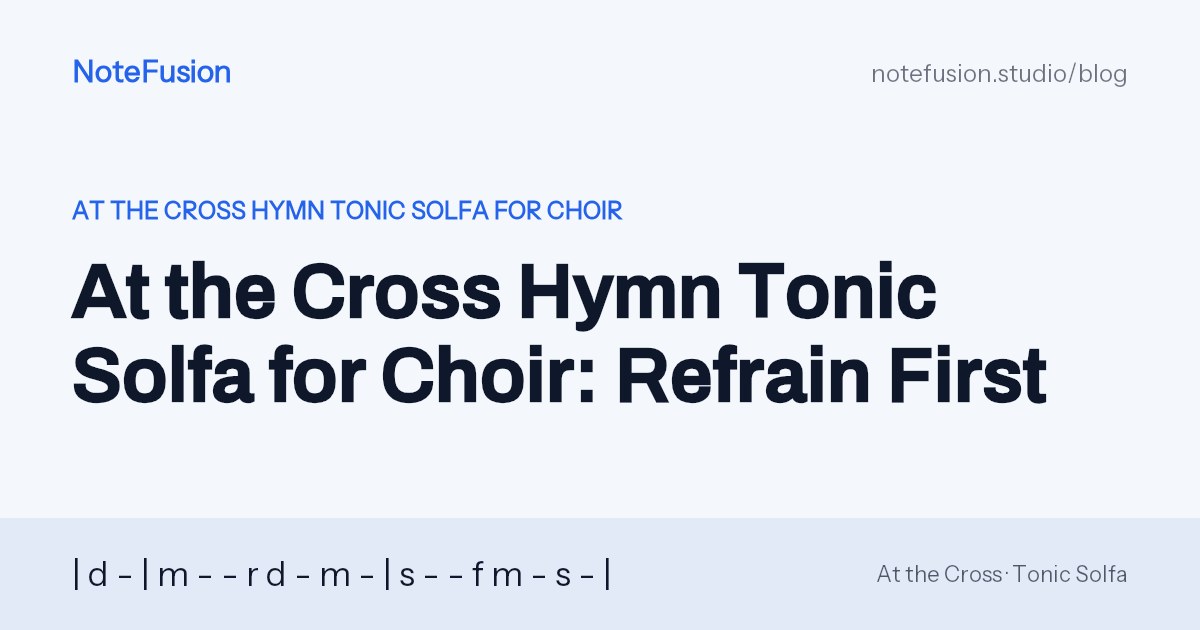
Your choir knows the tune of At the Cross from years of singing it, yet the moment you ask for the solfa, the refrain falls apart: some sing it the way the congregation does, some follow the organ, and the altos drift. Because that refrain comes back after every verse, a shaky refrain means a shaky hymn from start to finish.
Here is the short answer. At the cross hymn tonic solfa for choir is written in E flat major, so doh is E flat. The hymn opens on doh as a pickup and climbs to me and soh. Teach the refrain first, because it is sung after every verse, then add the verse, which repeats one dotted rhythm.
In this post I will show you where doh sits, give you the opening bars and the refrain in solfa, and lay out a rehearsal order you can use at your next practice. The full sheet is on the At the Cross hymn page.
Where doh sits in At the Cross in E flat
At the Cross in E flat has three flats in the key signature: B flat, E flat and A flat. Three flats always means E flat major, and in movable doh the key note is doh. If you are not sure how to read a key signature quickly, my guide to key signatures explained for singers walks through every common key.
Here is the E flat major scale with the letter names underneath, so your keyboard player and your singers are looking at the same thing:
| dE♭-rF-mG-fA♭- | sB♭-lC-tD-d'E♭- |
Three things are worth pointing out to the choir before they sing a note:
- Doh is E flat, not C. A singer who has learned this hymn by ear has never needed to know that, but the moment you give a starting note it matters.
- Soh is B flat, a fifth above doh. When you pitch the hymn, play E flat, sing doh, then sing up to soh so everyone hears the frame of the key.
- Low soh (s,) is the B flat below doh. Basses and altos will spend time around here, and the comma below the s tells them which octave.
My advice is to have the whole choir sing up and down this scale once on solfa before you touch the hymn. It takes thirty seconds and settles the key in their ears.
Got a recording? Get it in solfa →
Why drill the refrain first?
Drill the refrain first because it is the part of the hymn your choir will sing most often in a single service. A verse is sung once; the refrain is sung after every verse. If the refrain is secure, every verse lands somewhere safe, and the choir's confidence grows with each repetition instead of shrinking.
There is a second reason. The refrain is the part people know best by ear, which is exactly why it goes wrong. Singers fill in what they remember from the congregation rather than what is on the page. Reading it on solfa replaces that half-memory with something exact.
The words of Ralph E. Hudson's refrain, sung after each of Isaac Watts's verses, are:
At the cross, at the cross, where I first saw the light, And the burden of my heart rolled away, It was there by faith I received my sight, And now I am happy all the day!
At the cross refrain solfa: a step-by-step drill
The at the cross refrain solfa makes up the second half of the 17 bars on the hymn page. The block below shows bars 9 to 17. If your copy marks the start of the refrain a bar earlier or later, begin your drill from that bar instead.
| dI?-----dAtrthe | mcross,-mat-,mthemcross-fwheremI |
| mfirstr_rsaw-,dtherlight,-rAndmthe | fbur-fdenfof-,fmyfheart-srolled-,fa- |
| mway,-----mItmwas | fthere-fby-l,faith-fIfre- |
| mceived-mmyr_dsight,-mAnd- | rnow-rIdamt,hap-fpymall-,rthe |
| dday!----- |
Here is how I would drill it with a choir that has fifteen minutes:
- Speak the rhythm on one note. Have everyone chant the refrain words in time, on a single pitch, while you tap the beat. This separates rhythm problems from pitch problems.
- Sing the first line on solfa, slowly. Half speed, solfa syllables only, no words. Stop at the end of the line and check that everyone finished on the same note.
- Repeat line one with words. As soon as it is clean on solfa, swap in the words at the same slow speed.
- Add line two, then sing lines one and two together. Always join the new line to the one before, so the choir practises the join as well as the line.
- Do the same for lines three and four. By the time you reach the last line, the first two have been sung several times without anyone noticing it was repetition.
- Sing the whole refrain at full speed, twice. The second time, ask them to watch you rather than the page.
If a particular line keeps going wrong, do not run the whole refrain again. Isolate the two or three notes where it slips, sing them on solfa until they are clean, then put them back into the line.
Alas and did my Saviour bleed: learning the verse
The verse, alas and did my Saviour bleed at the cross, is the easier half once the refrain is in place. Here are the opening bars:
| dA-- | mlas!--randddid-mmy- | sSa---fviourmbleed,-sAnd- |
Look at what happens in those bars:
- The pickup. The hymn starts before the first full bar, on doh for 'A-'. Count the choir in so they breathe together and land on '-las' on the first strong beat. My post on the pickup note explains how to count this in cleanly.
- The dotted rhythm. '-las' is sung on me and held, then 'and' is a short ray before falling back to doh on 'did'. The same long-short pattern comes again on 'Sav-iour': soh held, then a short fah, landing on me for 'bleed'.
- The climb. Across those bars the tune rises from doh to me to soh. Sing just those three syllables, doh, me, soh, as held notes before the hymn and the opening will be in tune.
That long-short pattern is the main thing to teach in the verse. Clap it once, then sing it on solfa. When the long note is properly long, the short note falls into place. When singers rush the long note, the whole line gets jumpy.
Once the first line is secure, the rest of the verse follows the same shape and rhythm, so you can usually teach it faster than the refrain.
How do you teach At the Cross hymn tonic solfa for choir in parts?
Teach every section the melody first, then give each part its own line from your hymn book. The NoteFusion hymn page shows the melody, so treat it as the shared foundation: when the altos, tenors and basses know the tune, they hear where their harmony sits against it.
A practical order for parts:
- Everyone sings the refrain melody on solfa. Basses and tenors sing it an octave lower where it sits comfortably.
- Sections split for the refrain only. Give each section a few minutes on its own line from your four-part copy, using the same step-by-step method as above.
- Put two parts together. Sopranos with basses first, because the outer parts give the clearest frame. Then add altos and tenors.
- Return to the verse in parts. By now the choir has the key in their ears, and the verse rhythm is the same long-short pattern for everyone.
For the week between rehearsals, send singers home with the refrain and ask them to practise their part daily. My guide on how to learn your choir part at home gives them a routine they can follow in ten minutes a day, with slow playback and looped bars.
What if E flat is too high or too low for your choir?
If E flat does not suit your singers, move doh. Every solfa syllable stays the same; only the starting pitch changes. That is the whole point of movable doh, and it is why a solfa sheet is easier to transpose than a staff score.
Two quick tests to run in rehearsal:
- Listen to the sopranos on the highest notes of the refrain. If they sound pinched or are pushing, try at the cross in D major instead of E flat. Doh moves down a semitone to D and the hymn becomes a little more relaxed.
- Listen to the basses on the lowest notes. If they disappear, going lower will make it worse, so stay in E flat or even try going up.
Whichever key you choose, tell the organist or keyboard player before Sunday, and write the new doh at the top of the choir's copies. Nothing unsettles a choir faster than a key change they discover during the first chord.
This is where NoteFusion can save you some guesswork: "Transpose for my choir" moves the doh and shows whether each part sits comfortably in the new key, so you can compare E flat and D before you commit.
A 30-minute rehearsal plan for At the Cross
If you only have half an hour for this hymn, here is how I would spend it:
| Minutes | Task |
|---|---|
| 0–3 | Sing the E flat scale on solfa; pitch doh, me and soh as held notes |
| 3–15 | Refrain drill: rhythm on one note, then line by line on solfa, then words |
| 15–22 | Verse one: count in the pickup, clap the long-short rhythm, sing on solfa then words |
| 22–27 | Sections on their own refrain lines, then outer parts together |
| 27–30 | Sing verse one and the refrain straight through, eyes on the director |
At the next rehearsal, start with the refrain again before anything else. If it comes back clean, you know the choir has kept it, and you can spend the time on the remaining verses and on blend.
To get the choir practising before then, open the At the Cross page and share it, or bring your own recording or YouTube link to NoteFusion: it writes the melody in movable-doh solfa with staff notation, plays it back slower or looped so singers can drill the refrain, and lets you save the sheet and send it to the choir as a link.
Frequently asked questions
What key is At the Cross in for tonic solfa?
The NoteFusion hymn page sets At the Cross in E flat major, so doh is E flat. The key signature has three flats: B flat, E flat and A flat.
Is At the Cross the same hymn as Alas and Did My Saviour Bleed?
Yes. At the Cross uses Isaac Watts's verses beginning 'Alas! and did my Saviour bleed' with a refrain added later by Ralph E. Hudson. Some hymn books print Watts's words to a different tune with no refrain, so check which version your choir is singing.
Why should a choir learn the refrain of At the Cross first?
The refrain is sung after every verse, so it is the music your choir will sing most often in the service. Securing it first means every verse ends on familiar ground, and the verse can be added afterwards.
How do I find doh in At the Cross?
Look at the key signature. Three flats means E flat major, and in movable doh the key note E flat is doh. The first note of the hymn is that doh, sung as a pickup on 'A-' of 'Alas'.
Can I sing At the Cross lower than E flat?
Yes. Move doh down to D and the whole hymn drops a semitone while every solfa syllable stays the same. Choose the key that suits your sopranos on the highest notes and your basses on the lowest.