Funeral Hymns in Tonic Solfa: 12 Picks and a 2-Day Plan
Funeral hymns in tonic solfa for choirs with little notice: 12 public-domain choices, gentle keys, a two-day rehearsal plan and how to sing with feeling.
The call comes midweek: the funeral is on Friday, the family want "something everyone knows", and your choir has one rehearsal, maybe two. Half your singers knew the person who died. You need hymns that are right for the moment, quick to learn and steady enough to hold together when voices wobble.
Choosing funeral hymns tonic solfa choirs can learn quickly comes down to three things: pick familiar public-domain hymns with a calm, stepwise tune, lower the key a tone so tired voices stay relaxed, and rehearse the melody and bass first. Abide with Me, The Day Thou Gavest and Amazing Grace all meet these tests.
Below you will find a shortlist matched to each moment of the service, a two-day rehearsal plan, advice on keys, and the small habits that let a choir sing with real feeling without falling apart.
Which hymns are best for a funeral?
The best funeral hymns are the ones the mourners can sing along with, whose words speak of rest, hope and God's faithfulness rather than celebration or battle. A congregation that is grieving sings quietly, so the choir's job is to carry the tune and let others lean on it.
Think about where each hymn falls in the service:
- Entrance or opening: something steady and confident that gathers people, such as O God, Our Help in Ages Past.
- After the readings or tributes: something reflective and personal, such as It Is Well with My Soul or The King of Love My Shepherd Is.
- Committal or closing: something that looks forward with hope, such as Abide with Me or The Day Thou Gavest, Lord, Is Ended.
Always ask the family first. A favourite hymn of the person who died outranks any list, and if it is in the hymns index you will already have the solfa.
Got a recording? Get it in solfa →
A funeral hymns tonic solfa shortlist: twelve that work
All of these are old enough that the original words and tunes are out of copyright. The key and doh shown are those of the versions in our library.
| Hymn | Key (doh) | Time | Why it suits a funeral |
|---|---|---|---|
| Abide with Me | Eb major (Eb) | 4/4 | Slow, stepwise, widely known |
| O God, Our Help in Ages Past | C major (C) | 4/4 | Strong opening hymn, short verses |
| The Day Thou Gavest, Lord, Is Ended | G major (G) | 3/4 | Gentle evening imagery of rest |
| It Is Well with My Soul | Db major (Db) | 4/4 | Words of peace in sorrow |
| The King of Love My Shepherd Is | G major (G) | 4/4 | Psalm 23 paraphrase, easy tune |
| Amazing Grace | G major (G) | 3/4 | Known almost everywhere |
| Lead, Kindly Light | Ab major (Ab) | 3/4 | Quiet, prayerful |
| Nearer, My God, to Thee | G major (G) | 6/4 | Long notes, easy to breathe |
| Asleep in Jesus | D major (D) | 3/2 | Written for mourning |
| In the Sweet By and By | G major (G) | 4/4 | Hopeful gospel chorus |
| Shall We Gather at the River? | D major (D) | 4/4 | Reunion theme, singable chorus |
| God Be with You Till We Meet Again | C major (C) | 4/4 | A natural farewell to close |
If the choir wants something the congregation will not sing, so it can be offered as a piece on its own, look in the library at less familiar texts written for these occasions, such as Why Do We Mourn Departing Friends or Forever with the Lord.
A word on copyright
The hymn itself being old does not make every printed version free. A modern harmonisation, descant or arrangement can still be protected. My advice: sing the melody and the traditional four-part harmony, and if you photocopy from a recent book, check whether the arrangement is new. The solfa in our library is the melody, which keeps you on safe ground.
How do you prepare a choir for a funeral at short notice?
Start with melody and bass, and only add inner parts once those two are secure. With limited time, a strong tune over a firm bass sounds dignified; four shaky parts do not.
Here is a plan for two days:
- Day one, morning: choose and confirm. Agree two or three hymns with the family and the minister. Send the solfa links to every singer straight away so they can listen and look before rehearsal.
- Day one, evening: home practice. Ask everyone to sing the melody through twice on solfa, then twice on words. Our guide to learning your part at home has a simple routine.
- Day two, rehearsal, first 15 minutes: whole choir sings the melody in solfa, in unison, for each hymn. Fix any wrong intervals now.
- Next 15 minutes: basses learn their line while everyone else hums the tune quietly. Then sopranos and basses together.
- Next 20 minutes: altos and tenors add their parts on the verses that matter most, usually the first and last. On middle verses they may sing the melody if their part is not ready.
- Last 10 minutes: sing each hymn straight through on words, at funeral tempo, standing as you will stand on the day.
If you need more on drilling quickly, see how to teach a choir a new song fast.
Find the hard bar before it finds you
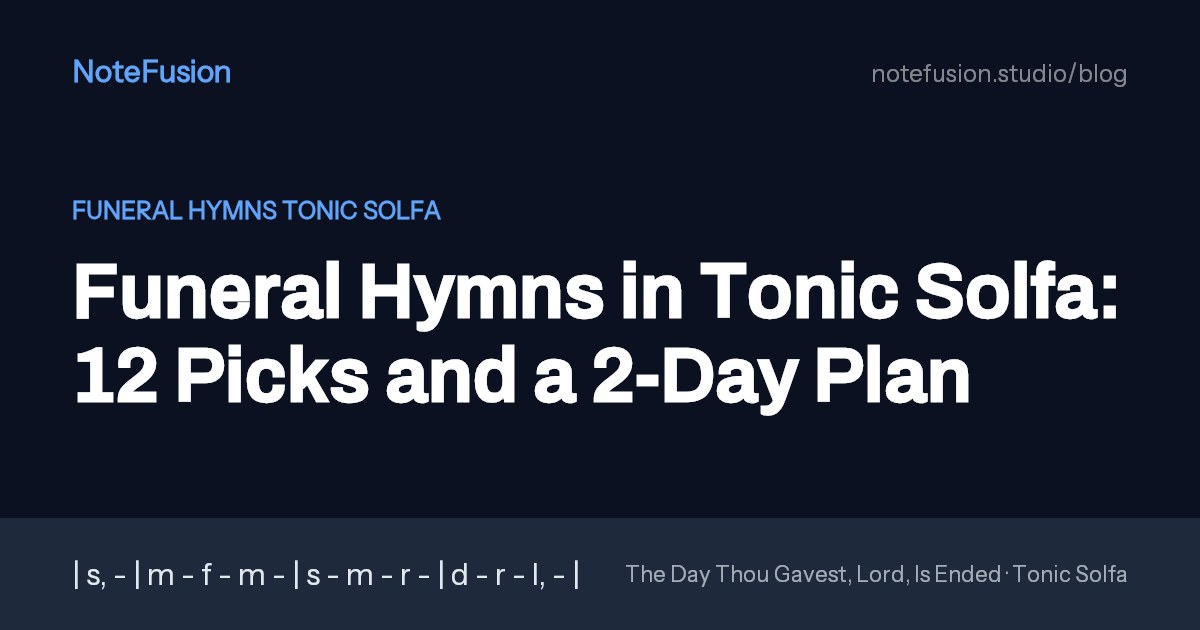
Every hymn has one spot that trips people. In The Day Thou Gavest it is the very first leap:
| s,The- | mday-f_-mThou- | sgav--m_-rest,- | dLord,-r_-l,is- | dend--t,ed,-l,The- |
The tune starts on low soh (s,) and jumps up a sixth to me. Sing that leap on solfa five times before you sing the words, and notice how the opening line later dips to lah below doh (l,). Once singers can feel low soh and low lah as the floor of the tune, the rest is stepwise.
What key should funeral hymns be sung in?
Most funeral hymns are best sung a tone lower than the hymn book key. Grief tightens the throat, many singers will have been crying, and a funeral is often in the morning when voices are still cold. A lower key keeps the top notes relaxed, which is what lets the sound stay soft.
The catch is the bass line. Lower the key too far and basses disappear into a growl. Check both ends: the highest soprano note should feel easy for your least confident soprano, and the lowest bass note should still carry. Our guide on how to choose the right key for your choir walks through this.
Because solfa uses movable doh, changing key does not change a single syllable. Here is Amazing Grace, written in G in our library, moved down a tone to F:
| s,A-- | dmaz----mingd_ | mgrace!---rhow- | dsweet---l,the- | s,sound,---s,That- |
The singers read exactly the same soh, doh, me, ray, lah as before; only the organist or keyboard player needs to know that doh is now F. That is why a solfa choir can change key the night before a funeral without relearning anything. For a closer look at teaching this tune, see our Amazing Grace tonic solfa guide.
Singing funeral hymns with feeling
Feeling at a funeral is mostly restraint. The congregation does not need a performance; they need a sound they can rest inside.
Shape each phrase towards its end. Look at the opening of Abide with Me:
| mA----mbide-rwith- | dme;---sfast--- |
The line falls gently from me through ray to doh, then lifts to soh on "fast". Let the falling notes get slightly quieter, and give the lift to soh a touch more warmth rather than more volume. Done across the whole choir, that one habit makes the hymn sound tender instead of plodding.
Breathe by the line, not the bar. Choose a tempo where each line of words fits one breath. If singers are gasping mid-line, you are too slow. Mark the breaths in pencil on the solfa so everyone takes them together.
Agree the volume plan. A simple rule works: first verse moderate, middle verses softer, last verse fuller. In It Is Well with My Soul, the final verse looks to hope, so it can open out; the earlier verses sit in quiet trust.
Sing the consonants. Grief makes people mumble. Ask for clear final consonants on words such as "rest", "light" and "God", so the words reach the back of the room even when the sound is soft.
Plan for tears. Some singers may not get through a verse. Seat a steady voice next to anyone close to the family, and agree beforehand that if a section falters, the rest simply carry on. A choir that keeps going is a comfort in itself.
On the day: small things that prevent big problems
- Give the starting note clearly. Have the organist play the first line, or give doh and the first note yourself. If there is no instrument at the graveside, read how to give a choir the starting note and practise pitching the hymn's doh beforehand.
- Check the key with the accompanist. If you lowered a hymn, make sure the organist has the same key written down. Mismatched keys are the most common avoidable disaster.
- Count verses. Write the number of verses being sung on each singer's copy. Families sometimes cut verses at the last minute.
- Know the cue. Agree who signals the choir to stand and when the introduction starts, especially at a crematorium or graveside where timings are tight.
- Bring a spare copy for the minister. It helps them follow and join in.
When you have more time between funerals, it is worth building a small "ready list" of four or five hymns the choir can sing at short notice in two keys each. Rehearse them once a term, and the next phone call becomes far less stressful.
If the family asks for a hymn you cannot find in a book, NoteFusion can help: paste a YouTube, Spotify or Apple Music link, or sing the tune, and it writes the melody in movable-doh Tonic Solfa with staff notation. "Transpose for my choir" moves the doh and shows whether each part sits comfortably, and you can share the sheet with your singers by link. Try it at NoteFusion.
Frequently asked questions
What are the most common hymns sung at funerals?
Abide with Me, The Lord's My Shepherd settings, O God, Our Help in Ages Past, It Is Well with My Soul, The Day Thou Gavest, Lord, Is Ended and Amazing Grace are widely used across many traditions. All of these older texts and tunes are long out of copyright, so choirs can print the solfa freely.
Can a choir learn a funeral hymn in one rehearsal?
Yes, if you choose a tune the congregation already half-knows and keep harmony simple. Teach the melody in solfa first, add the bass line, and let altos and tenors join in unison for any verse that is not secure.
What key should a funeral hymn be in?
Usually a tone lower than the hymn book key works well, because voices are tired and emotions tight the throat. Keep the highest soprano note no higher than is comfortable for an untrained singer and check that basses can still be heard on the lowest notes.
Are hymns like Abide with Me public domain?
The original words and tunes of older hymns such as Abide with Me and O God, Our Help in Ages Past are out of copyright. A modern arrangement, descant or reharmonisation of those tunes may still be protected, so check the source of any printed version you copy.
How slowly should funeral hymns be sung?
Slightly slower than on a Sunday, but never so slow that singers run out of breath mid-phrase. Choose a tempo where each line can be sung on one breath, which keeps the hymn calm without dragging.