Guide
Tonic Solfa vs staff notation
The short answer
Staff notation shows the exact pitch of every note on five lines; Tonic Solfa shows where each note sits in the key, with syllables (d r m f s l t). Staff is the language of instruments and a fixed key. Solfa is quicker for singers to learn and reads the same in any key. Many choirs use both: solfa to learn their parts, staff for the instruments.
Side by side
| Tonic Solfa | Staff notation | |
|---|---|---|
| Pitch is shown as | A syllable: its step in the key (d r m f s l t) | A note's place on five lines and the clef |
| Changing the key | Nothing changes but the doh at the top | Every note moves and the key signature changes |
| Rhythm is shown by | Bar lines, colons, dots and dashes between syllables | Note shapes, flags, beams and rests |
| Learning to read it | Days to start singing from it | Months to read fluently |
| Best for | Singers, choirs, sight-singing, ear training | Instruments, conductors, exact printed keys |
| Choir parts | Four lines of solfa under one doh | Two or four staves |
| Typing and sending | Plain text: easy to type and share | Needs notation software or a photo |
What staff notation does better
- An instrumentalist plays the written note at once, without working out the key.
- Long, chromatic or fast-changing music stays readable, where solfa fills up with fe, ta and key changes.
- Almost all published music for instruments, and most of the world's choral music, is printed in it.
What Tonic Solfa does better
- A singer reads how a note sounds against the key, which is how a voice finds it.
- The same hymn reads the same in any key, so a choir can move it up or down for its voices without re-learning it.
- It is quick to teach a whole choir, and quick to write out by hand or type into a message.
Moving between them
From staff to solfa: read the key signature, call its key note doh (lah for a minor key), and name every note by its step from doh. From solfa to staff: put doh on the key note and write each syllable at its step above it. NoteFusion reads a photo or PDF of staff notation and writes the solfa, or a page of solfa and writes the staff, and every transcription it makes has both, one under the other.
Or paste a song link
Links work for many songs, not all: YouTube sometimes blocks our downloads. If yours fails, upload the audio file instead.
Your first 30 seconds right here, with no account; an uploaded file is cut to its first 30 seconds. Create a free account for 1 full transcription, then 1 every week, saved to your library.
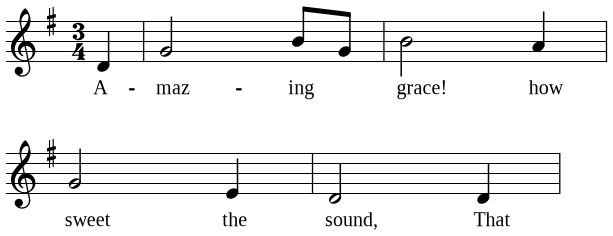
Amazing Grace
| s,A-- | dmaz----mingd_ | mgrace!---rhow- | dsweet---l,the- | s,sound,---s,That- |
Questions
Is Tonic Solfa easier than staff notation?
For singers, usually yes: most people sing simple tunes from solfa within days, because each syllable says how the note sounds in the key. Staff notation takes longer but says more, especially for instruments.
Can a piano or keyboard player use Tonic Solfa?
Yes, once they know the key: doh is the key note, so in G doh is G, ray is A, and so on. Many church keyboardists play from solfa this way.
Should a choir learn both?
Many do. Solfa lets the singers learn their parts fast; staff lets them read published music and work with the band. A sheet with both, like NoteFusion's, teaches one through the other.
More guides
- What is Tonic Solfa? Tonic Solfa writes music with the syllables d r m f s l t, doh always the key note.
- How to convert a song to Tonic Solfa How to convert any song to Tonic Solfa.
- Tonic Solfa apps Which music apps write Tonic Solfa? What to look for in one (movable doh, la-based minor, chromatics, octave marks) and how the transcription apps compare..
Written by the NoteFusion team, 17 November 2026.