A Charge to Keep I Have Tonic Solfa: 4-Part Choir Plan
Master A Charge to Keep I Have tonic solfa in C major. Learn the melody, drill SATB choir parts, and prepare your choir for a commissioning service.
Your choir has a service coming up this Sunday, rehearsal time is short, and your altos and tenors are hesitant when reading unfamiliar notation. When introducing multi-part choral harmony or testing sight-reading skills, you need music that strips away unnecessary technical hurdles while carrying spiritual gravitas.
Here is your quick summary: a charge to keep i have tonic solfa is set in C major (where doh is C), written in triple time (3/4), and begins with a one-beat pickup on soh. The melody moves primarily in stepwise motion and small thirds, providing an accessible foundation for teaching four-part harmony across all voices.
Whether you are preparing this classic Wesley text for a regular Sunday morning or selecting a solemn piece for an induction, this hymn provides an ideal classroom for reading solfa.
Why start teaching four parts with A Charge to Keep I Have tonic solfa?
You should start with this hymn because C major contains no sharps or flats, allowing choristers to focus entirely on interval relationships without decoding key signature accidentals. When beginners see doh anchored directly on C, the mental connection between the printed syllable and vocal pitch is immediate.
Many conductors run into difficulty because they introduce part-singing using hymns with complex modulations or extended ranges. If your choir is still building confidence, starting with selections from our list of easy hymns for a new choir establishes strong foundational habits. This setting of Charles Wesley's text moves predictably through the bare scale "d r m f s l t".
Because the piece is structured with balanced two-bar and four-bar phrases in 3/4 time, singers can tap their feet to the three-beat pulse while chanting the syllables. There are no sudden syncopations, chromatic shifts like fe or se, or unexpected leaps. It serves as an unclouded mirror for vocal production, pure vowel matching, and chordal balance. Teaching a charge to keep i have tonic solfa in your very first sight-reading session gives choristers an early win that carries over into more complex anthems later in the year.
Got a recording? Get it in solfa →
Melody and rhythm: reading the opening phrase
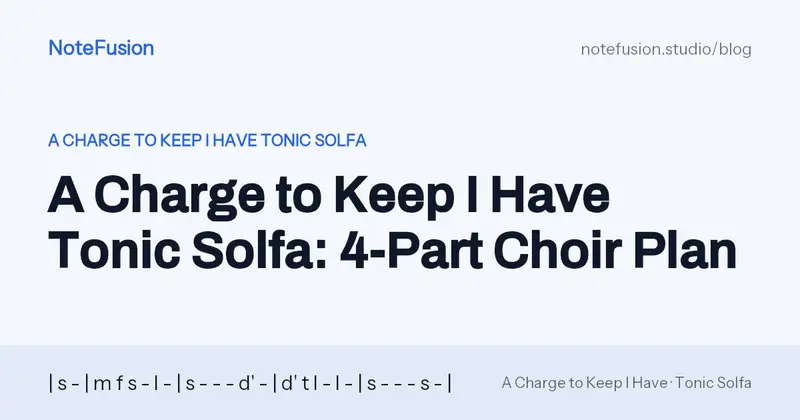
The soprano melody enters on the third beat of an incomplete measure, using soh to launch the musical sentence towards me and fah.
| sA- | mchargeftoskeep-lI- | shave,---d'A- | d'Godttolglo--lri-- | sfy,---sA- |
Notice the rhythmic layout in this excerpt from our full score for A Charge to Keep I Have in Tonic Solfa. The tune begins with an upbeat on soh, stepping directly to me on the downbeat of bar 2, before rising smoothly through fah to soh and lah.
When conducting this opening, avoid letting the choir rush the pickup. The syllable on the upbeat should be delivered with steady breath support so that the jump to bar 2 lands cleanly on pitch without scooping. In bar 3, the line rises to upper doh, held for three beats, before descending through te and lah. This octave relationship between starting soh and high doh provides an instant vocal tuning drill for your sopranos.
Have the entire choir sing this soprano melody together in unison using solfa syllables before splitting into sections. When basses and tenors sing the melody an octave lower, it fixes the tune in everyone's ear, making it much easier to hold inner harmonies later.
How do you rehearse each voice in A Charge to Keep I Have choir parts?
You rehearse each voice by isolating its solfa line completely before attempting to combine sections against the soprano melody. Teaching a charge to keep i have choir parts succeeds when singers know their exact anchor notes within the home triad.
If your choristers are unsure which vocal group best matches their natural tone and tessitura, review our guide to SATB parts explained. Here is the specific rehearsal strategy for each section:
1. Soprano Line
- Starting Note: Soh (G4 in C major).
- The Challenge: Controlling the leap up to high doh at the end of the second phrase without pinching the throat.
- The Drill: Have the sopranos sing the climb from soh up to high doh several times on pure vowels ("oh" and "ah"). Remind them to keep the soft palate raised as they ascend so high doh remains round and does not drive the choir sharp.
2. Alto Line
- Starting Note: Me (E4) or Doh (C4), depending on your arrangement.
- The Challenge: Altos often feel pulled toward the soprano line because the melody sits only a third or fourth above them.
- The Drill: Have the altos sing their line accompanied solely by a sustained doh drone from the basses. Emphasise every movement between me and fah. When the alto section masters its movement while hearing doh underneath, their pitch will remain rock solid.
3. Tenor Line
- Starting Note: Doh (C4) or Soh (G3).
- The Challenge: Navigating the fourth bar where tenors often provide the third of the dominant chord (te) to lead back to the tonic.
- The Drill: Drill the cadence from te up to doh with the tenors in isolation. Ensure they place te cleanly without flattening, as a sagging leading note undermines the entire choir's harmonic tuning.
4. Bass Line
- Starting Note: Doh (C3) or low soh (s,).
- The Challenge: Maintaining rhythmic authority on beat one of each measure.
- The Drill: The bass line defines the harmonic progression. Have your basses sing their line while speaking the solfa syllables with crisp consonants. They should feel the strong downbeat of the 3/4 meter on every bar line.
To keep rehearsals efficient and prevent singers from waiting around while one section drills notes, follow the pacing outlined in how to run sectional rehearsals.
A Charge to Keep I Have as a hymn for commissioning service programmes
This hymn is uniquely qualified as a hymn for commissioning service occasions, ordination rites, elder appointments, and choral inductions because the text focuses directly on duty, sacred trust, and perseverance. Written by Charles Wesley and based on Leviticus 8:35 ("keep the charge of the Lord, that ye die not"), the poetry demands reverent, crisp, and intentional choral delivery.
When singing this hymn during a liturgical commissioning, tempo and text delivery are paramount:
- Adopt a Dignified Tempo: Do not let the 3/4 time signature become a jaunty waltz. Aim for approximately 84 to 92 beats per minute. Each crotchet (quarter note) should carry weight without dragging.
- Enunciate Plosive Consonants: Words like charge, keep, and glorify must be shaped with clear diction. Instruct your singers to end the word "keep" with a unified, soft "p" on the rest before the next word.
- Dynamic Architecture: Sing verse one ("A charge to keep I have, A God to glorify") at a firm mezzo-forte. Drop to piano for reflective verses that dwell on human weakness, building to a resolute forte on the final stanza.
When a choir sings all four parts cleanly from tonic solfa during a commissioning, the harmonic richness adds solemnity to the vows being taken.
How do you pitch A Charge to Keep I Have hymn in C without an instrument?
You pitch a charge to keep i have hymn in c without an instrument by sounding a C tuning fork or pitch pipe, establishing that note as doh, and having the choir arpeggiate up and down the tonic chord before humming their starting pitches.
Singing unaccompanied tests your choir's internal pitch centre. If you have no keyboard or guitar available, follow this step-by-step sequence:
| Step | Director Action | Choir Response |
|---|---|---|
| 1. Sound the Keynote | Sound C with a fork, pipe, or bell | Listen in total silence |
| 2. Establish Doh | Sing "doh" on C (middle C / C4) | All voices sing "doh" together |
| 3. Build the Triad | Signal the common triad | Choir sings the arpeggiated triad from doh up to soh in unison |
| 4. Distribute Notes | Point to each section in order | Basses find doh or s,, Tenors find doh or soh, Altos find me, Sopranos sing soh |
| 5. Check the Chord | Hold hands out to balance volume | All four parts sustain the starting harmony for four seconds |
Because this piece sits in C major, middle C provides an immediate home base for the whole choir. Sopranos and tenors hearing middle C can easily locate soh a fourth below or a fifth above. Altos find me a third above, and basses drop an octave to low doh.
Once the starting chord is ringing true, breathe with the choir and give an unambiguous prep beat on beat two, inviting the sopranos and tenors to enter precisely on beat three. Practising a charge to keep i have tonic solfa without an instrument trains your singers to rely on their inner ear rather than keyboard support.
A 4-step rehearsal plan to assemble all four voices
Putting four parts together can cause confusion if you merge everyone at once. Use this systematic four-step plan to assemble the choir smoothly within a 20-minute rehearsal window.
Step 1: Speak the Solfa in Rhythm (3 Minutes)
Have the entire choir, in all four parts, clap the 3/4 pulse and speak their individual solfa lines in rhythm. Do not sing yet. This separates pitch difficulties from timing problems. If the tenors cannot speak their solfa syllables in time, they will certainly stumble when singing them.
Step 2: Combine the Outer Voices (5 Minutes)
Have only the sopranos and basses sing their parts together using solfa. The soprano melody provides the top line, while the bass provides the harmonic root. Listening to this outer frame teaches both sections how the boundaries of the harmony function. Once the soprano-bass duet stays in tune across two full verses, move to the inner voices.
Step 3: Layer the Inner Harmony (6 Minutes)
Add the altos to the sopranos and basses. Because the alto line often fills the third of the chord, listen closely to ensure they hold pitch against the melody. Finally, introduce the tenors. By entering last into a stable three-part texture, tenors can hear exactly where their notes slot into the chords.
Step 4: Transition from Solfa to Text (6 Minutes)
Once the choir can sing the four-part harmony cleanly using solfa syllables, make the transition to Wesley's words. Do not jump straight to verse one at full volume. Sing verse one on a neutral syllable like "loo" or "dah" first, keeping vowels uniform. Then sing the actual text. Remind the choir to retain the exact vowel shapes they used when singing each solfa syllable.
Perfecting choral tuning and cadence points
In short meter hymns (6.6.8.6), like this setting, cadences occur every two lines. Watch out for two common tuning pitfalls in this hymn:
- The Dominant Cadence at the Halfway Mark: The second line ends on a dominant chord (soh chord). Choristers who do not read carefully tend to pull this cadence toward the tonic. Ensure your tenors hold ray and your basses stay firmly on soh so the music feels poised before launching into line three.
- The Final Resolution: In the closing bar, the harmony resolves to a complete doh chord. Have your basses and sopranos sustain their final doh while altos and tenors hold me and soh. Instruct the choir to listen inward: the third of the chord (me in the alto) must be sung with bright, lifted placement. If the third is even slightly flat, the entire closing cadence will sound dull.
By treating these cadence points as resting pillars, your singers learn to tune chords horizontally as the music moves forward, rather than second-guessing notes after they leave their mouths.
If you want to practice your choir's vocal lines at home, NoteFusion makes learning part-music straightforward. You can paste a link to any hymn recording or hum each part into your browser or phone, and the app writes out clean movable-doh Tonic Solfa alongside staff notation. You can play back your choir's specific lines slower or looped, check voice ranges, and share practice sheets directly with your singers before the next rehearsal.
Frequently asked questions
What key is A Charge to Keep I Have written in?
The standard choral setting is pitched in C major, where doh is C, meaning singers read with no sharps or flats in the key signature.
What is the starting note of the melody in tonic solfa?
The soprano melody begins on soh below high doh as a one-beat upbeat before the first full measure.
Why is this hymn useful for sight-reading practice?
It sits in C major with predictable diatonic motion and clean rhythms, making it an ideal first piece for choristers learning to read solfa notation.
What service is A Charge to Keep I Have best suited for?
Charles Wesley's text makes it an ideal hymn for commissioning service programmes, ordination events, church officer installations, and watchnight gatherings.