What Does a Colon Mean in Tonic Solfa?
Learn what a colon means in Tonic Solfa. Discover how colons, bar lines, and dots mark beats and accents in hymns like Amazing Grace.
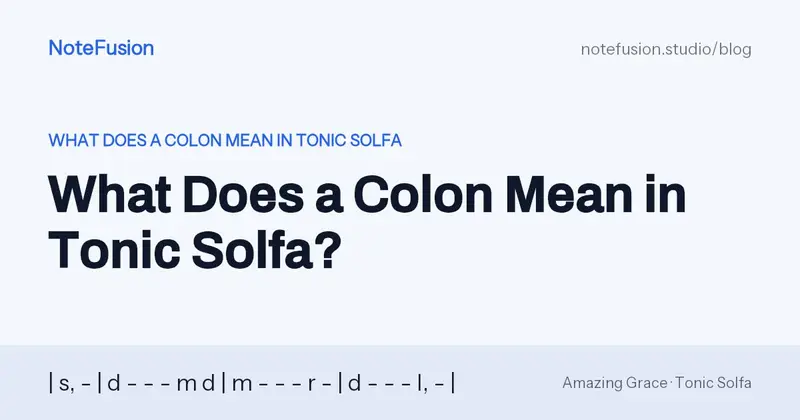
When you open an unfamiliar hymn sheet and stare at a line of solfa syllables peppered with vertical dots and dashes, finding the rhythm can feel like decoding a puzzle. If you have ever wondered what does a colon mean in tonic solfa, the answer is simple: a colon is a beat marker that divides time, telling your choir exactly where each pulse falls. Along with short and long vertical lines, these symbols create a clear grid that keeps every singer moving together.
Understanding how these beat markers work changes how you learn a new piece. Instead of guessing how long a syllable lasts or rushing through a tricky passage, you can read the rhythmic framework at a glance. Let us walk through how colons, bar lines, and time structures operate in practice so you can run a smoother rehearsal tonight.
What Does a Colon Mean in Tonic Solfa?
A colon in Tonic Solfa acts as a beat separator, dividing the measure into equal temporal pulses so singers can maintain a steady tempo. When you see solfa syllables separated by a colon, each colon represents the click of a metronome or the tap of a foot. It tells you that the first note has finished its allocated beat and the next note begins right on the subsequent pulse. If no new note is written after the colon, a dash is usually placed to show that the previous note continues to sound across that beat.
To see how this looks in a familiar tune, let us examine the opening bars of a standard four-beat hymn:
| s,A-- | dmaz----mingd_ | mgrace!---rhow- | dsweet---l,the- | s,sound,---s,That- |
Notice how the colons space out the syllables evenly across the measure. They give the eye a reliable grid. If you are teaching a choir that struggles to keep a steady speed, my advice is to tap your finger on every colon rather than on every note. This physical pulse grounds the rhythm before you even worry about pitch. For a deeper look at how duration and pulses interact, take a moment to review how to read rhythm in tonic solfa.
Got a recording? Get it in solfa →
Bar Lines in Tonic Solfa: Short and Long Markers
While colons mark individual beats within a measure, bar lines organize those beats into structured groups. Tonic Solfa uses two main types of vertical lines to map out the music: short bar lines and full bar lines. A short vertical line often appears halfway through a measure to show a secondary accent, while a full vertical line marks the heavy downbeat where a brand-new measure begins.
In staff notation, these are your standard bar lines. In solfa, they provide the exact same structural roadmap. Here is how they appear in a piece with a steady three-beat pulse, where the full bar line resets the count on every third beat:
| sA- | mchargeftoskeep-lI- | shave,---d'A- | d'Godttolglo--lri-- | sfy,---sA- |
When your choir rushes or drags, the culprit is almost always ignored bar lines. Choristers look at the notes and forget the container holding them. Whenever I introduce a new piece, I have the choir speak the rhythm names or clap while I point strictly at the full bar lines on the board. Once their feet feel where the heavy beat lands, the notes fall into place naturally. You can explore more about meter in time signatures for choir singers to see how different meters shape these lines.
Double Bar in Tonic Solfa and Section Breaks
Beyond regular beat and measure markers, you will frequently encounter heavier vertical markings. A double bar in tonic solfa serves as a major structural signpost. It tells the choir that a distinct musical phrase has ended, a new section is beginning, or the entire hymn has reached its final cadence.
Unlike a single bar line, which simply ticks off the passing beats, a double bar often accompanies repeat signs, key changes, or major rest points. When conducting a rehearsal, treat a double bar as an opportunity for a collective breath. It is the musical equivalent of a comma or period at the end of a poetic line.
If you want to understand how smaller subdivisions like fractions of a beat fit between these structural markers, check out what does a comma mean in tonic solfa, which covers quarter beats and octave placements in detail. Combined with colons, these commas ensure every fractional note has a precise home.
Counting Through a 4/4 Hymn Line
Let us put the colon and bar line system to work by counting through a complete line of music in common time. In a 4/4 hymn, each measure contains four beats, separated by three internal colons, with a full bar line closing the group.
Here is how the beats look and feel in motion:
| s,All- | dhail-dthe-mpow’r-mof- | rJe--dsus’-rname!-mLet- |
If you break down bar one, you have four distinct pulse slots. The first syllable sits on beat one, a colon separates it from beat two, and so forth. When a note is held across a beat, you will see a dash taking the place of a syllable after the colon. This tells the singer to sustain their air without re-attacking the vowel. If your tenors or altos are re-attacking notes incorrectly, check the colons to see whether the note is supposed to be tied or broken.
Counting Through a 3/4 Hymn Line
Triple time shifts the accent pattern entirely, moving the weight firmly to the first beat of every three. The colons adapt to this by dividing the measure into three segments instead of four.
Consider how the pulse feels when we look at a three-beat melody line:
| sCome,-mThou-dal-- | rmight--d_-t,y- | dKing,----- | dHelp-rus-mThy- |
In 3/4 time, the colon distribution creates a natural swaying motion. Beat one receives the primary weight, while beats two and three feel lighter, stepping gracefully toward the next bar line. When teaching a waltz-time hymn, instruct your singers to make a gentle physical gesture or lean slightly on the syllable immediately following the full bar line. This immediately cures the robotic, heavy-footed singing that ruins lyric flow.
Fixing Common Rhythm Mistakes Using Colons
Voluntary choirs often stumble over rhythms because they treat every solfa syllable as having equal length, ignoring the silent spaces and held beats indicated by colons and dashes. If your sopranos tend to clip a dotted note short or rush past a rest, turn your attention straight to the beat grid.
- Point to each colon on a chalkboard or whiteboard while the choir speaks the rhythm aloud.
- Ensure that when a dash follows a colon, the voice maintains full volume and pitch without fading.
- Verify that any empty space between colons receives a silent, counted beat rather than a hurried jump to the next note.
For a complete refresher on reading notation fundamentals from the ground up, refer back to how to read tonic solfa. Mastering these foundational marks means your rehearsals will spend less time untangling rhythm errors and more time building a beautiful, blended choral tone.
If you have a complex recording, a YouTube link, or a hummed tune that needs to be turned into a clean, readable Tonic Solfa sheet with accurate colons and bar lines, try NoteFusion in your browser today.
Frequently asked questions
What does a colon mean in Tonic Solfa?
A colon acts as a beat separator. It divides the space between vertical bar lines to show the steady pulse of the music, much like the beats within a bar in staff notation.
What is the difference between a colon and a short bar line?
A colon marks a standard beat within a measure. A short vertical bar line marks a secondary accent, while a full vertical bar line marks the main downbeat at the start of a new bar.
How do you count colons in 4/4 time?
In 4/4 time, a measure is written with notes separated by colons to represent four steady beats per bar, such as beat one, beat two, beat three, and beat four.
Do rests use colons in Tonic Solfa?
Yes. A blank space between colons indicates a silent beat or rest, ensuring the underlying rhythmic grid remains completely steady while the choir pauses.
How do double bar lines work in Tonic Solfa?
A double bar line shows the end of a section or the end of the entire hymn, signaling to the choir where phrases conclude.