All Creatures of Our God and King Tonic Solfa: 5 Drills
All Creatures of Our God and King tonic solfa in D major, line by line, with the alleluias drilled first so every section learns its part faster.
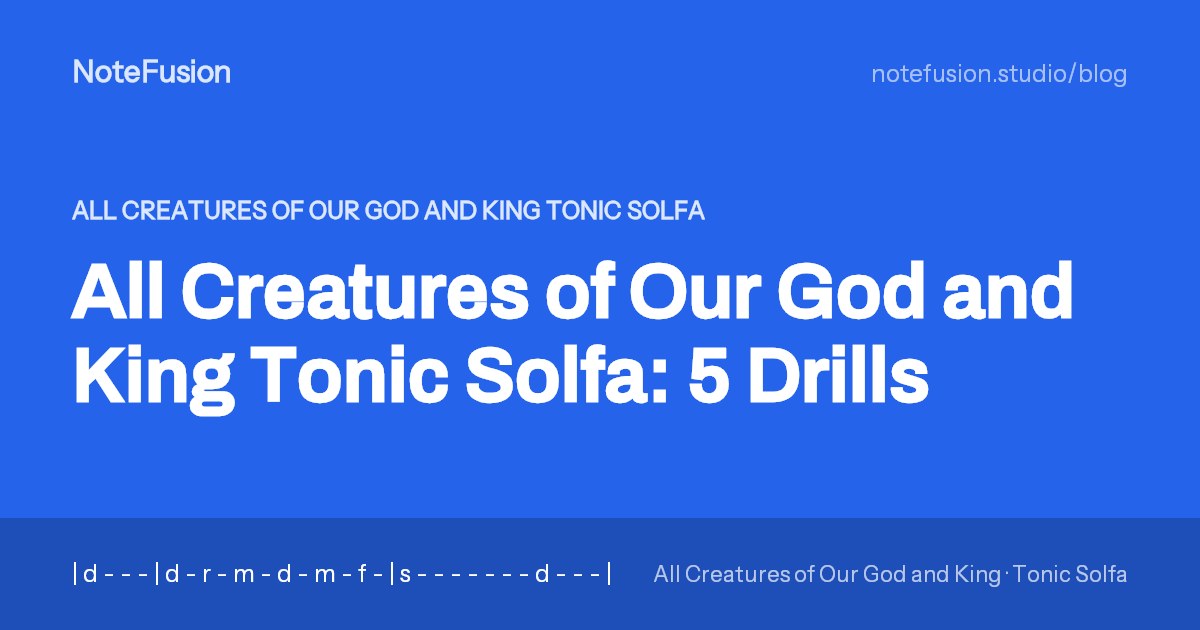
Your choir has All Creatures of Our God and King on the list for Sunday, the sopranos already half-know the tune from childhood, and everyone else keeps tripping over the alleluias. The verses change every time; the alleluias do not. That is the key to learning it quickly.
All Creatures of Our God and King tonic solfa is written in D major, so doh is D, in 6/4 time. The melody opens on doh, climbs step by step to soh on "King", and drops back to doh for "Lift". Learn the repeated alleluias first: they carry the same notes in every verse, so drilling them once covers a large part of each verse.
In this post I work line by line from the D major solfa on our All Creatures of Our God and King hymn page. You will get the opening line explained beat by beat, a note on the key, five drills that isolate the alleluias, a sectional plan for the parts, and the slips I would listen for at your next rehearsal.
All Creatures of Our God and King tonic solfa: the opening line
Here are the first three bars as they appear on the site:
| dAll--- | dcrea--rtures-mof-dour-mGod-fand- | sKing-------dLift--- |
Read it slowly, because almost everything about singing this hymn well is already in these three bars.
- Bar 1 is a pickup. "All" sits on doh and lasts two beats. It is not a full 6/4 bar, so do not count six beats before the choir comes in. Give the beat, breathe together, and sing "All" as a lead-in.
- Bar 2 moves on every beat. "Creatures of our God and" is six syllables on six beats, one note each. The line steps upwards, dips back to doh once on "our", and keeps climbing. That small dip is where singers drift: they hear the climb coming and rush it. Keep each beat the same length.
- Bar 3 holds and releases. "King" lands on soh and is held for four full beats. Then "Lift" drops back to doh for the last two beats, which act as the pickup into the next line, exactly like "All" did.
That pattern, a two-beat pickup on doh, a steady climb, a long held note, then a fresh pickup, gives the hymn its broad, swinging feel. If your choir can sing these three bars with the held soh full to the end and "Lift" placed cleanly on beat five, you have solved the rhythm of the whole first half.
Got a recording? Get it in solfa →
What key is All Creatures of Our God and King in?
The all creatures of our god and king key on the hymn page is D major, with doh on D. Here is the scale your singers are working in:
| dD-rE-mF♯-fG- | sA-lB-tC♯-d'D- |
Some hymn books print the tune a semitone higher in Eb. If your organist plays from one of those, nothing in the solfa changes; doh simply moves from D to Eb. This is the same opening line shown in Eb, so you can see that the syllables are untouched:
| dAll--- | dcrea--rtures-mof-dour-mGod-fand- | sKing-------dLift--- |
Which should you choose? My advice is to look at who is singing the melody and how tired they are. D sits slightly lower and suits an early service or a choir with few strong sopranos. Eb gives more brightness if your top line is fresh. Before you decide, scan the sheet for apostrophes (high doh and above): those are the notes that will feel the half-step most. If you want a fuller method, see how to choose the right key for your choir.
Why drill the alleluias first?
The words of each verse change: burning sun, silver moon, rushing wind, flowing water. The alleluias never do. In most versions of the text, every verse has a pair of alleluias after the second line, a short "O praise him" passage, and a longer run of alleluias to close the verse.
That structure has three practical consequences for a choir with limited rehearsal time:
- The alleluias are where the music repeats most. Time spent on them is repaid in every verse you sing.
- They are where choirs come apart. The verse lines follow the rhythm of the words, so they almost sing themselves. The alleluias stretch one word across many notes, and without words to lean on, singers guess.
- They give confidence. Once a section owns the alleluias, it knows it will land safely at the end of each verse, and it sings the verse lines with more conviction.
So turn the usual order around. Learn the refrain before the verse.
How do you isolate the alleluia refrain solfa? Five drills
Open the solfa on the hymn page and work through these in order. Each one takes a few minutes.
Drill 1: Mark the map
Print the sheet or put it on a screen and highlight every bar where "Alleluia" appears under the solfa. Use one colour for the short pair after the second line and another for the closing alleluias. Your singers can now see at a glance how much of the hymn is refrain. Many choirs are surprised at how much of the page lights up.
Drill 2: Solfa only, no words
Sing the highlighted bars on solfa syllables, all voices together on the melody, at a slow pace. Solfa gives each note a name, which is exactly what "Al-le-lu-ia" cannot do. Where the alleluias reach up to a high note, check for the apostrophe and have the choir name it out loud before singing it.
Drill 3: Hold and step
Pick any note in the alleluias that singers keep missing. Hold the previous note as a long, quiet tone, then step to the problem note and hold that too. This slow-motion version lets everyone hear whether they are landing on the pitch or sliding to it. Then put the bar back into tempo.
Drill 4: Swap in the word
Once the solfa is secure, sing the same bars on "Alleluia". Keep the vowels open and matched: a tall "ah" on the first syllable, a bright "ee" on "lu" without pinching. If the pitch slips the moment the word comes back, return to solfa for one more round.
Drill 5: Refrain into verse
Now join each alleluia passage to the bar just before it. The danger point in this hymn is not usually the alleluia itself but the moment of arrival, where the verse line hands over. Sing the last bar of the verse line plus the alleluias, then the alleluias plus the start of the next line. These joins are where entries get late.
All creatures of our god and king choir parts: a sectional plan
The melody solfa gets everyone singing together, but the harmony parts need their own time. If your hymn book prints the four-part harmony, have each section sing its own line on solfa, using the same alleluia-first order. If you only have the melody, you can write simple alto, tenor and bass lines yourself; how to harmonise a hymn in four parts with solfa shows the method with three chords.
Here is the order I would use across a single rehearsal:
- All together, melody only, alleluias. Ten minutes on Drills 1 to 4 so everyone knows the shape of the tune.
- Split into sections. Each group drills its own line through the highlighted alleluia bars only. Section leaders keep it slow and on solfa. For a working structure, see how to run sectional rehearsals.
- Pairs. Put sopranos with basses, then altos with tenors, on the alleluias. Outer voices hear the bass line under the tune; inner voices learn to hold their own between each other.
- All four parts, alleluias only. Sing every highlighted passage in harmony, back to back, skipping the verse lines entirely.
- Verse one in full. Only now add the verse lines. Because the refrain is secure, you should find the choir needs far fewer stops.
For home practice, send each section the bars they struggled with. Singers who learn from recordings do best with short, looped passages rather than the whole hymn; how to learn your choir part at home covers that in detail.
Then sing the verses line by line
With the alleluias in place, the verse lines are straightforward. Take them one line at a time and treat each like the opening three bars:
- Find the pickup. Each new line starts with a short lead-in on the last beats of the previous bar, just as "Lift" leads out of bar 3. Mark them, and practise breathing before them, not on them.
- Count the held notes. Long notes at the end of lines, like the four-beat soh on "King", are where tempo sags. Count them in your head, or have the choir tap the three pairs of beats lightly while singing.
- Fit the new words. The notes of the verse lines are the same from verse to verse; only the syllables move. Where a verse puts two syllables on one note or a word falls awkwardly, speak the words in rhythm once before singing.
If your choir is new to compound-feeling time, the guide to time signatures for choir singers explains how to count 6/4 without losing the pulse.
Common slips and quick fixes
| What you hear | Why it happens | Fix to try tonight |
|---|---|---|
| "All" comes in ragged | Singers count a full bar before the pickup | Give one clear breath on beat five, then sing doh on six |
| "King" dies away early | Breath runs out on the four-beat soh | Breathe deeper before "creatures" and sing through to beat four |
| "Lift" is late | The choir treats it as the start of a new bar | Practise bar 3 alone, landing "Lift" on beat five |
| Alleluias go flat | Singers slide up to higher notes | Return to Drill 3 and hold each note before stepping |
| Verse two falls apart | New words distract from settled notes | Speak verse two in rhythm, then sing it on solfa first |
When you want to move on to another hymn, the full collection is in our hymns in Tonic Solfa index, and the same alleluia-first habit works for any hymn with a fixed refrain.
If your choir learns from a recording of a different arrangement, you can upload it or paste the link into NoteFusion, which writes the melody in movable-doh solfa with staff notation and plays it back slower or looped, so each section can drill its alleluias at home. If you need it in Eb instead of D, "Transpose for my choir" moves the doh for you. You can try it in the browser at NoteFusion.
Frequently asked questions
What key is All Creatures of Our God and King in tonic solfa?
The solfa on NoteFusion's hymn page is in D major, so doh is D. Some hymn books print it a semitone higher in Eb. The syllables are identical in both keys; only the starting pitch changes.
What is the first note of All Creatures of Our God and King in solfa?
It starts on doh, on the word "All", as a two-beat pickup. The line then climbs to soh on "King" and drops back to doh for "Lift".
What time signature is All Creatures of Our God and King?
It is in 6/4, six crotchet beats to the bar. Many choirs find it easier to feel the six beats as three pairs, which keeps the long held notes steady.
How do I teach the alleluia refrain to a choir?
Mark every bar where "Alleluia" appears and drill those bars on solfa before touching the verses. Because the alleluias carry the same notes in every verse, learning them once pays off all the way through the hymn.
Can I get the alto, tenor and bass parts in solfa?
Use the four-part harmony from your hymn book if it has one, and have each section sing its line on solfa. If you only have the melody, you can write simple lower parts yourself using basic three-chord harmony.