All Hail the Power of Jesus Name Solfa: Build the Climb
All Hail the Power of Jesus Name solfa in G major: read the opening, follow the 'crown Him' build, learn your part and rehearse the climb without tiring.
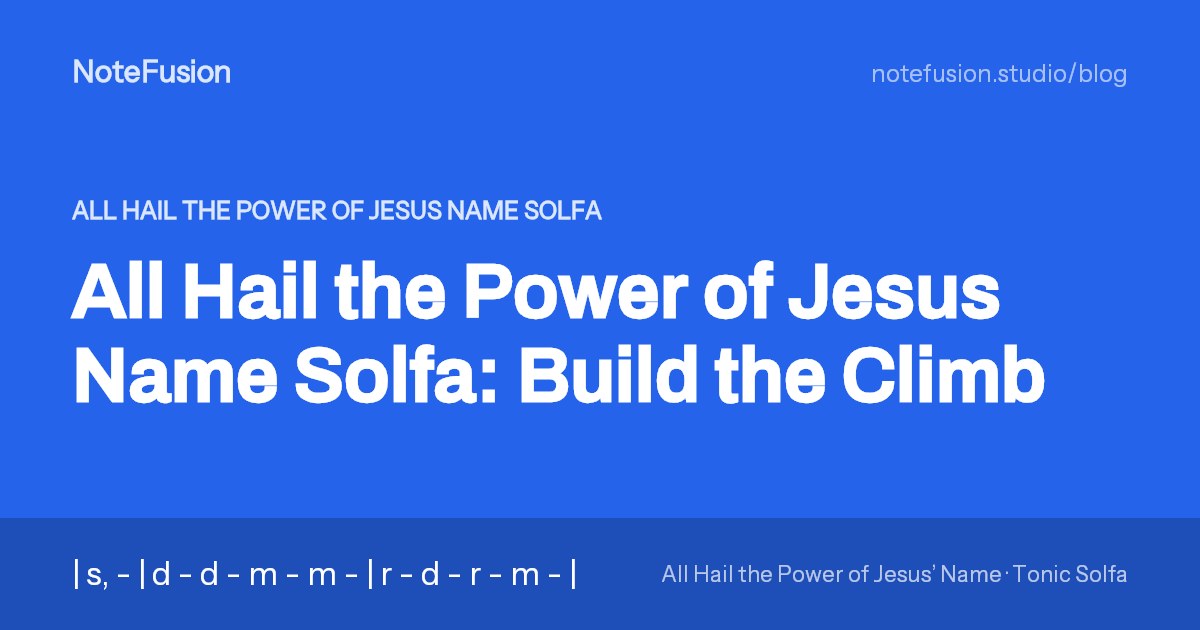
By the fourth verse of All Hail the Power of Jesus' Name, many choirs have nothing left for the line that matters most: the sopranos push, the tenors go thin, and "crown Him Lord of all" arrives tired and flat. The hymn is not hard to read. It is hard to pace.
The all hail the power of jesus name solfa on our hymn page is in G major, so doh is G, in 4/4 time. The tune starts on a pickup on low soh (s,), rises to doh, and builds through repeated "crown Him" phrases to the final line. Learn the opening shape first, then rehearse the climb quietly before singing it full.
Below I show the opening, how the repetitions build, how to mark where your part moves and holds, and a short rehearsal plan you can use this week.
All Hail the Power of Jesus Name Solfa: the Opening in G Major
Here are the first three bars from the All Hail the Power of Jesus' Name solfa page:
| s,All- | dhail-dthe-mpow’r-mof- | rJe--dsus’-rname!-mLet- |
Three things to notice before anyone sings:
- The pickup. The first note, s, on "All", sits before the first bar line. It is a single beat leading into the strong beat on "hail". If your choir tends to come in late or heavy, read our guide to pickup notes and count "three, four, ALL hail" aloud before the first try.
- The comma below. That s, is the soh below doh, not the one above it. In G major, doh is G, so low soh is the D a fourth beneath it. Sopranos who see the comma and still pitch high will start a whole octave out of place.
- Repeated notes and steps. The opening phrase repeats notes and moves mostly by step after the first leap up to doh. That makes it easy to learn and easy to sing lazily. Ask for the repeated notes to be sung on the same pitch, not drifting downwards.
If your choir is used to older printed books with colons and dots between beats, our guide on how to read hymn book solfa explains how that layout maps onto the bar-and-dash layout above.
Got a recording? Get it in solfa →
Which Tune Is in Your Hymn Book?
Before you rehearse anything else, check you are learning the right tune. These words are sung to more than one melody. Coronation, Diadem and Miles Lane are all well known, and different hymn books and traditions favour different ones.
Here is a quick check that takes a minute:
- Look at the first line in your hymn book or on your organist's copy.
- Compare it with the three bars above: does your tune also start on a low pickup and lift to doh on "hail"?
- If the shape is clearly different, you have a different tune. Learn that one instead, or agree with your organist which one the congregation knows.
Teaching the choir one tune while the congregation sings another is a mistake you only make once. The rest of this article follows the G major version on our page.
How Do the 'Crown Him' Repetitions Build?
The 'crown Him' repetitions build by repeating the same words while the music keeps moving towards the final line, so each repetition needs a little more energy than the one before. The danger is singing every "crown Him" at full strength, which leaves nothing for "Lord of all".
Here are the closing bars of the hymn, where the "crown Him" lines and the final "Lord of all" sit. Follow the words under the solfa to see exactly where each repetition falls:
| lLord---sof-fe_- | sall.-----mBring- |
| sforth-mthe-droy--mal- | rdi-d_ra-m_rdem,-dAnd- |
| scrown---fHim--- | mLord--f_r_-rof- |
| dall.----- |
Read this section with your choir before singing it. Ask them to point to each "crown Him" and say which way the tune goes on it: up, down or level. That quick look does two things. It shows singers the shape of the climb, and it stops them guessing the notes from memory of a recording.
Then give the repetitions a dynamic plan. Mine is simple:
- First "crown Him": comfortable, firm, about mezzo-forte.
- Each further "crown Him": one notch more, with crisp consonants rather than more weight.
- "Lord of all": the full sound, with breath saved for it.
Write the plan in pencil above the bars. A choir that knows where the loudest moment is will save itself for it.
Where Do the Parts Enter and Hold?
In a four-part hymn arrangement, each part usually sings the same words at the same time, but the parts do not all move in the same way. Some lines move on almost every syllable; others hold one note while the tune climbs above them. Knowing which you are doing in the "crown Him" section is what keeps the build steady.
Arrangements differ between hymn books, so I will not tell you what your altos or basses have on each bar. Instead, give every section this task with their own copy:
- Find your long notes. Circle any note in your part in the closing bars that lasts two beats or more. Those are your holds.
- Find where you move against the tune. Mark any bar where your notes change while the melody holds, or the other way round.
- Plan breath around the holds. Never breathe in the middle of a held note in the climb. Breathe before it, and stagger breathing across the section if a hold is long.
- Listen up while you hold. A held note under a rising tune is where tuning slips. Altos and basses should listen to the sopranos while holding, not sing louder to cover the gap.
If some of your singers are unsure which line is theirs, or you are moving a light tenor to alto for this hymn, our guide to SATB parts explained covers typical ranges and what each part usually does in a hymn.
How Do You Rehearse the Climb Without Tiring the Choir?
You rehearse the climb by learning it slowly and quietly first, then adding volume only once the notes and breaths are secure. Most tiredness on this hymn comes from singing the last line loudly before it is learnt.
Try these steps in order:
- Speak the words in rhythm. Say the "crown Him" lines to a steady four, with the consonants clear. This fixes rhythm without using any voice.
- Sing the closing bars on solfa, softly. Every part sings its own syllables at half volume, slower than the service tempo.
- Hum the held notes. Sections with holds hum their long notes while the sopranos sing the tune on solfa. The holders learn to listen; the sopranos hear the harmony they climb over.
- Add words, still quietly. Keep the volume down until the whole choir sings the last line twice without a slip.
- Add the dynamic plan once. Sing the build from the first "crown Him" to the end, full only at "Lord of all". Then stop. Repeating the loud version five times is how voices tire before Sunday.
- Sing the whole verse from the top. Only now link the climb to the opening, so the choir feels how much is left in reserve.
If the pitch sags during the climb, stop and check whether it is breath or tuning on the upward steps. Our article on why choirs go flat has a drill for weak upward steps.
Choosing a Key for Your Choir
G major suits many choirs, but if your sopranos strain on the top of the climb, or your basses vanish at the bottom, move doh. In movable-doh solfa the syllables stay the same in any key, so nobody has to relearn anything.
Here is the same opening with doh moved down to F:
| s,All- | dhail-dthe-mpow’r-mof- | rJe--dsus’-rname!-mLet- |
The solfa is identical; only the letter names change. That whole tone lower can make a real difference by the last verse, when voices are tired. Check that the lowest bass note still sounds in the lower key before you commit. Our guide on choosing the right key for your choir walks through that check, and agree the key with your organist or keyboard player well before the service.
A 20-Minute Plan for Your Next Rehearsal
If you only have a slot of twenty minutes for this hymn, this order works:
| Minutes | Task | Who |
|---|---|---|
| 0-3 | Check the tune against your hymn book; agree the key | Director and organist |
| 3-6 | Read and sing the opening three bars on solfa, pickup counted | Everyone |
| 6-9 | Mark long notes and breaths in the closing bars | Each section with its own copy |
| 9-14 | Steps 1 to 4 of the climb: speak, soft solfa, hum holds, quiet words | Everyone |
| 14-17 | One run of the build with the dynamic plan | Everyone |
| 17-20 | One full verse from the top, then stop | Everyone |
Send singers home with the hymn page link so they can practise their own part before the next rehearsal. Our guide on learning your choir part at home gives them a routine for that.
If your choir learns from a recording of a different arrangement, you can paste the link or upload the file into NoteFusion to get the melody in movable-doh solfa with staff notation, play it back slower or looped on piano, and use "Transpose for my choir" to see whether each part sits comfortably before you share the sheet with a link.
Frequently asked questions
What key is All Hail the Power of Jesus' Name in Tonic Solfa?
The version on the NoteFusion hymn page is in G major, so doh is G. It is in 4/4 and opens with a pickup on low soh (s,).
What is the first note of All Hail the Power of Jesus' Name in solfa?
In the G major version the tune starts on low soh, written s, with a comma below. It is a pickup before the first full bar, so it comes on the last beat of a bar.
Why does my hymn book have a different tune for All Hail the Power?
The words are sung to more than one tune, including Coronation, Diadem and Miles Lane. Compare the opening bars on the hymn page with your book before rehearsal so the choir learns the right one.
How do I stop my choir tiring on 'crown Him Lord of all'?
Plan the dynamics so the repeated 'crown Him' phrases grow in steps rather than all being sung at full volume. Rehearse the closing line slowly and quietly first, mark breaths, and sing every verse in a key where the top note is comfortable.
Can I sing All Hail the Power of Jesus' Name in a lower key?
Yes. In movable-doh solfa the syllables stay the same when you move doh, so the choir reads the same sheet. Moving doh from G down to F lowers every part by a whole tone.