And Can It Be Tonic Solfa for Choir: 2-Rehearsal Plan
And Can It Be tonic solfa for choir in F major: the opening phrase, the 'Amazing love' refrain, planned breaths and a two-rehearsal teaching order.
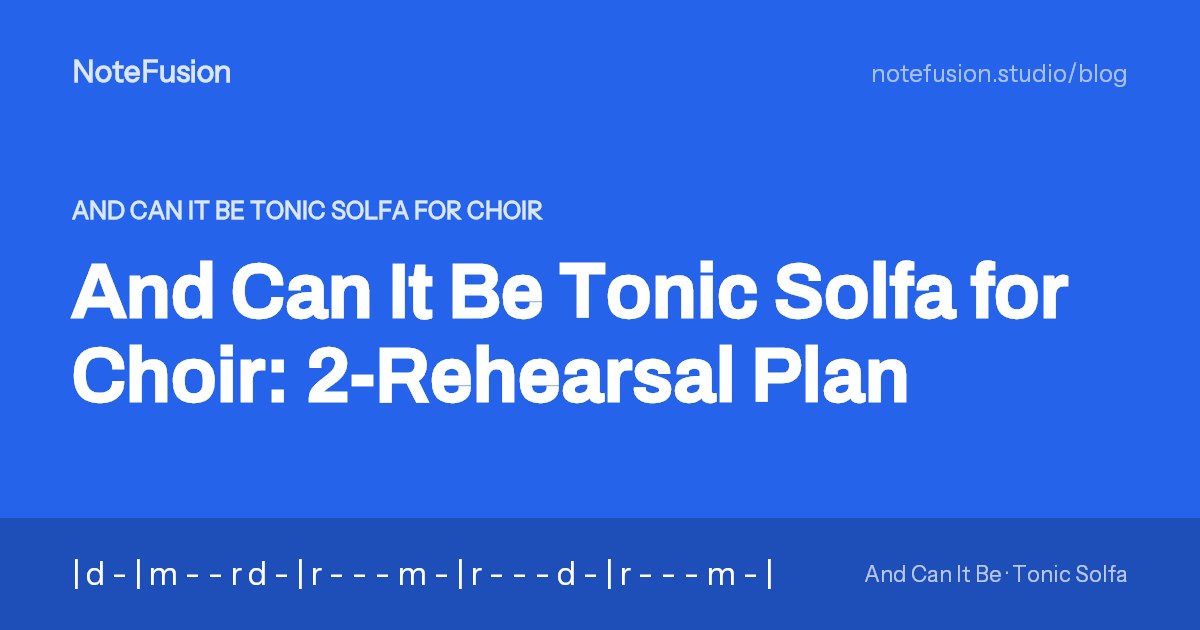
Your minister has chosen And Can It Be for Sunday. The congregation knows it and expects the choir to lead it with confidence. The trouble is that half your singers know it only by ear. They sail through the opening, then scramble for air when the tune climbs into "Amazing love! how can it be".
Here is the short answer. And Can It Be tonic solfa for choir is set in F major, so doh is F, in 3/4 time across 25 bars. The verse opens on a pickup doh and stays close to d, r and m. The repeated "Amazing love" refrain is the part to drill first, with breaths marked before you sing it.
Below I work from the site's F major page, isolate the refrain, mark the breaths in the long lines, and set out a teaching order that fits into two ordinary rehearsals.
And Can It Be Tonic Solfa: the F major page at a glance
The full melody is on the And Can It Be in Tonic Solfa page. Before you print it, note four facts and share them with your choir:
| Detail | What it means for singers |
|---|---|
| Key: F major | Doh is F. Give the choir F and sing "doh" together before anything else. |
| Time: 3/4 | Three beats a bar. Many notes are held for two beats, so count them. |
| Length: 25 bars | Longer than most hymn tunes. Stamina and breath matter. |
| Pickup: doh | The first word comes before bar one's strong beat. Bring the choir in on the upbeat. |
Charles Wesley wrote the words. Most hymn books pair them with a tune that gives the end of each verse a long, rising refrain. If your book prints a different tune, check it against the page before rehearsal so nobody learns the wrong one.
Got a recording? Get it in solfa →
How does And Can It Be begin in solfa?
It begins on a pickup doh and spends its first bars moving between doh, ray and me. Here are the first five bars as they appear on the page:
| dAnd- | mcan--r_dit- | rbe---mthat- | rI---dshould- | rgain---mAn- |
Three things stand out once you see it written down:
- The range is tiny. The opening line uses only d, r and m. That is good news for nervous singers. It also means the line can sag in pitch, because voices relax on small steps. Ask the choir to think upward on every ray.
- Long notes on ray. Ray is held for two beats in several places. Singers tend to cut held notes short and rush to the next word. Have them count "one-two" silently on each long ray.
- The next line starts inside bar 5. The word "An" opens the second line, so the breath after "gain" has to be quick. Snatch it in time and don't stop the beat to take it.
If your altos or tenors lose the doh during the verse, play this excerpt and have everyone hum it before adding words.
Where is the "Amazing love" refrain, and why teach it first?
The refrain sits in the closing stretch of the tune, and it is the passage to teach first because it ends every verse. Here are the final bars from the page, with the words printed under them, so you can see exactly where "Amazing love" begins in this setting:
| msued?-r_-dA-- | mma---r_dzing- | rlove!---mHow- | rcan---dit- |
| rbe,---mThat- | sThou,---smy- | sGod,-l_-sshouldst- | mdie---rfor- |
| dme?--- |
Compare this with the opening. The verse keeps to a narrow space, while the refrain lifts the music higher and holds it there longer. Choirs come unstuck in three ways:
- They start the refrain too loud. "Amazing love" invites a big sound. If the choir starts at full volume, it has nowhere to go and runs out of breath before the end. Start at a firm medium level and grow towards the final line.
- They go sharp or flat on the climb. Rising lines tempt singers to push. Ask for a light, open "ah" on the highest notes. Don't let them shout.
- They breathe in different places. In a long phrase, every singer runs out of air at a different moment, and the line breaks apart. The cure is to plan the breaths.
If you want the choir to hear the refrain as a tune they already half know, play it once on a single line at the start of rehearsal. Ask them to raise a hand when the melody reaches its highest point. It's a small game, but it fixes the shape in their ears before they read a single syllable.
Plan the breaths in the long lines
And Can It Be has more long lines than most hymns, and a 25-bar tune leaves little slack. My advice is to decide every breath before the first full run-through and have singers mark them in pencil with a tick.
Use these rules to place them:
- Breathe at line ends, even when the next word comes straight away. In the verse, take a quick breath before the pickup word of each new line, as with "An" in bar 5.
- Never breathe in the middle of a word or between an adjective and its noun. "Amazing / love" with a gap in it sounds broken.
- In the refrain, mark one breath and no more within each long phrase, and make it the same for every part. Sing the phrase through on "noo" first to find where the air genuinely runs out, then move the breath to the nearest comma before that point.
- Stagger breathing on the last held note. On the final long note, ask singers in each section to breathe at different moments, never all together, so the sound never drops.
Try this tonight. Sing the refrain on one vowel, with breaths only where you have marked them. If singers gasp, the tempo is too slow for your choir's breath, so move it on slightly. A steady three in a bar, with the beat felt in one, often makes the long lines easier than a heavy three.
A two-rehearsal teaching order
This order assumes about twenty to thirty minutes on the hymn in each of two rehearsals. For the general method behind it, see how to teach a choir a new song.
Rehearsal one: refrain first, then the verse shape
- Find doh (2 minutes). Give F. Sing d r m r d together so the choir feels the opening's home.
- Hear the refrain (3 minutes). Play the closing bars twice. Don't sing yet; just listen and find the highest point.
- Sol-fa the refrain (8 minutes). Sing it slowly on solfa syllables, two bars at a time, then join the pieces. Sopranos lead; everyone else learns the tune before parts are added.
- Mark the breaths (5 minutes). Agree the breath points and pencil them in. Sing the refrain on "noo" using only those breaths.
- Add the words to the refrain (5 minutes). Sing "Amazing love! how can it be" with words, still slowly.
- Read the verse opening (5 minutes). Sol-fa bars 1 to 5, counting the held rays. Stop there. Leave them wanting the rest.
Rehearsal two: the whole verse, then parts
- Recall the refrain (3 minutes). Sing it from memory on words. If it has slipped, sol-fa it once.
- Finish the verse (8 minutes). Sol-fa the bars between the opening and the refrain, then sing the whole tune through on solfa.
- Words for verse one (5 minutes). Put the words in. Check the quick breaths at line ends.
- Add parts (10 minutes). Teach alto, tenor and bass lines against the melody, one section at a time, while the sopranos hum. If time is short, have the lower parts sing the tune in the verses and their own lines only in the refrain.
- Full run (4 minutes). Sing two verses as you will on Sunday, with the organist or pianist at performance tempo.
Between the two rehearsals, ask singers to practise their own line at home. How to learn your choir part at home has a routine you can hand out.
Check the key before Sunday
F major suits many choirs, but not every one. The refrain is where the voices reach highest, so test it there. Sing the closing bars on an open vowel and watch your sopranos and tenors. If shoulders rise and faces tighten, move doh down a tone and try again. The solfa stays exactly the same in the new key; only the starting pitch changes. That is the beauty of movable doh.
If you'd like to hear the scale your singers are working in, here is F major with the letter names under the syllables:
| dF-rG-mA-fB♭- | sC-lD-tE-d'F- |
NoteFusion's "Transpose for my choir" moves the doh and shows whether each part sits comfortably, which saves guessing when you're choosing between F and a lower key.
More Wesley hymns in solfa to pair with it
Once your choir can manage And Can It Be, other Wesley hymns in solfa come more easily, because his texts often have the same energy. These are all in the NoteFusion library:
- O for a Thousand Tongues, a natural partner for a service of praise.
- Jesu, Lover of My Soul, set in D minor, so it reads la-based with doh on F. That is the same doh as And Can It Be, which makes a useful lesson in how minor keys work.
- Love Divine, All Loves Excelling and Rejoice, the Lord Is King, both regulars in many churches.
- Soldiers of Christ, Arise and Christ, Whose Glory Fills the Skies.
Browse the full list on the hymns in Tonic Solfa index to build a Wesley set for your next service.
If your choir learns from a recording, you can paste a YouTube, Spotify or Apple Music link, or hum the tune, into NoteFusion. It writes the melody in movable-doh Tonic Solfa with staff notation and plays it back on a piano, slower or looped, so singers can drill the "Amazing love" refrain at home before your next rehearsal.
Frequently asked questions
What key is And Can It Be in on the NoteFusion hymn page?
The page gives it in F major, so doh is F. It is in 3/4 time and runs to 25 bars, starting with a single pickup note on doh.
How do I find the first note of And Can It Be?
Find F, sing it as doh, then sing up d r m and back to d so the choir hears the narrow space the opening line moves in. The first word, 'And', is sung on doh.
Where should the choir breathe in And Can It Be?
Breathe at the ends of lines and mark them in pencil. The verse lines run straight into the next line's first word, so those breaths have to be quick. The refrain needs its breaths agreed in advance, because singers who breathe wherever they run out of air break the phrase in different places.
Should I teach the verse or the refrain of And Can It Be first?
Teach the refrain first. It comes back at the end of every verse, so time spent on it pays off in every verse, and singers who know the ending relax through the rest.
Is And Can It Be too high for my choir in F major?
It depends on your singers. Sing the highest bars of the refrain on a vowel and watch the sopranos and tenors. If they strain, move doh down a tone and check again before Sunday.
What other Charles Wesley hymns are in Tonic Solfa?
The NoteFusion hymn library includes O for a Thousand Tongues, Jesu, Lover of My Soul, Love Divine, All Loves Excelling, Hark! The Herald Angels Sing, Rejoice, the Lord Is King and Soldiers of Christ, Arise, among others.