What Does a Comma Mean in Tonic Solfa? 2 Jobs Explained
What does a comma mean in tonic solfa? Learn its two jobs, quarter beat and low octave, plus the colon and dot, with hymn bars and a drill for tonight.
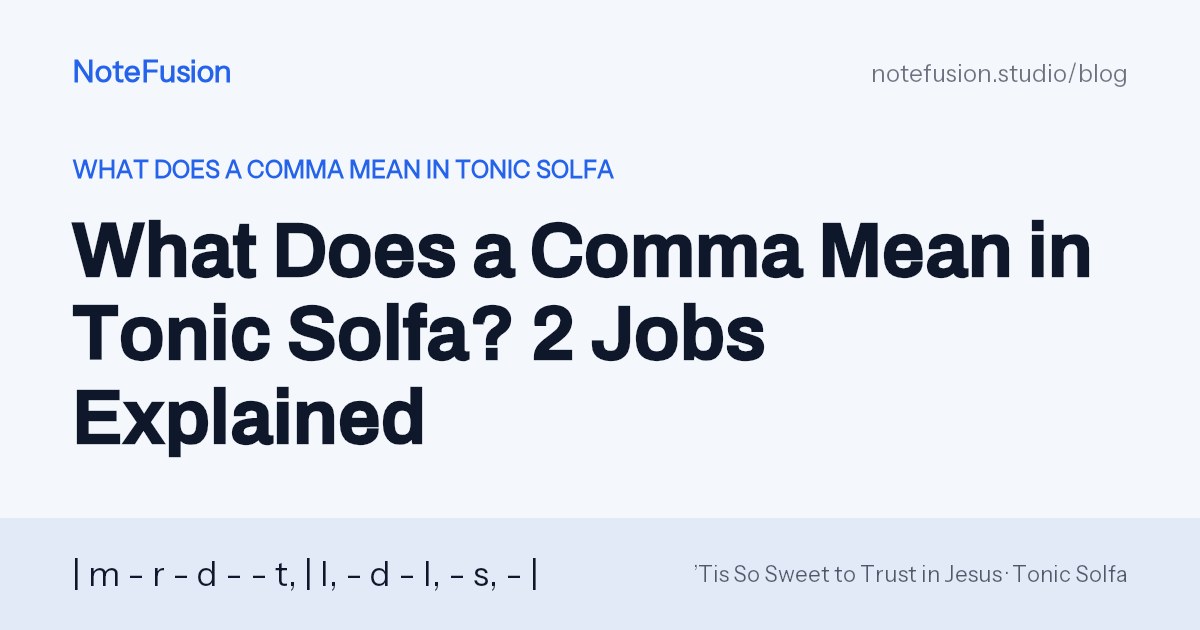
You are following your line in the hymn book, the notes make sense, and then a small comma appears between two of them and half the section lurches. Someone says a comma means a low note. Someone else says it means a short note. Both are partly right, which is exactly why it causes trouble.
So, what does a comma mean in tonic solfa? It has two jobs. Written straight after a note letter, as in s, it means the note sits in the lower octave. Placed between notes inside a beat, it splits a half-beat in two, so the note after it lasts only a quarter of a beat. The colon marks each beat and the dot marks the half-beat.
Below I take each mark one bar at a time, using lines from hymns your choir probably already sings. You will sing the same bar with and without the comma so you can hear what it changes, and finish with a ten-minute drill you can run at your next rehearsal.
Tonic solfa punctuation marks: the meaning at a glance
Before we look at real bars, here is the whole set in one place.
| Mark | Where you see it | What it tells you |
|---|---|---|
| Bar line | before the strong beat | a new bar starts; lean on the next note |
| Colon | between beats | a new beat starts |
| Dot | in the middle of a beat | the beat splits into two halves |
| Comma (timing) | inside a half-beat | the half splits into two quarters |
| Dash | in place of a note | keep holding the previous note |
| Empty space | in place of a note | silence |
| Comma (on a letter) | straight after the letter | lower octave |
| Apostrophe (on a letter) | straight after the letter | upper octave |
Notice how the timing marks shrink as the slices shrink: colon for the beat, dot for the half, comma for the quarter. Hold on to that ladder and most bars will read themselves.
One note about the examples on this page. A printed hymn book separates beats with colons. The examples here are drawn by NoteFusion's engine, which lays the bar out on an even grid instead: in hymns in 4/4 and 3/4, each space-separated item is half a beat, and a dash means hold. The comma does exactly the same job in both layouts, so what you learn here carries straight back to your hymn book.
Got a recording? Get it in solfa →
What does the colon mean in tonic solfa?
A colon means a new beat begins. In a four-beat bar you will see the bar line before the first beat and a colon before each of the other three. Some older books use a shorter upright line before the third beat to show its lighter accent; read it like a colon.
A note that stands alone between two colons lasts exactly one beat. If a dash fills the next beat instead of a note, the note carries on for a second beat. If the space is empty, you rest. That is all the colon does, and it is the frame every other mark hangs on. For a fuller walk through beats, dashes and rests, see how to read rhythm in tonic solfa.
What does the dot mean in tonic solfa?
The dot splits one beat into two halves. The note before the dot takes the first half; the note after it takes the second. Here is the opening of 'Tis So Sweet to Trust in Jesus:
| m’Tis-rso-dsweet--t,to | l,trust-din-l,Je--s,sus,- |
Look at "sweet to". The doh on "sweet" fills one beat and then holds through the first half of the next, and the low te on "to" takes only the last half-beat. In a hymn book you would find a dot just before that te: the dot is the moment the half-beat begins. Sing it and you will feel "to" arrive late and light, pushing you on to "trust".
Now look again at that te, and at the lah and soh in the second bar. Each has a comma after it. None of those commas has anything to do with timing. They are octave marks, and we will come back to them shortly. Keep that in mind, because it is the first sign that the comma has two jobs.
What does a comma mean in tonic solfa rhythm?
In the rhythm, the comma splits a half-beat into two quarters. On its own that sounds abstract, so here is a bar where you can hear it. This is the opening of Tell Me the Old, Old Story:
| mTell-mme-,fthesold,-sold- | lsto----sry,-sOf- |
Count the first bar beat by beat:
- "Tell" is me for one full beat.
- "me" is me again, but it holds through the dot and on past it. Then the comma appears, and fah on "the" takes only the final quarter of the beat.
- "old" is soh for one beat.
- "old" is soh again for one beat.
Beat two is the classic dot-and-comma pattern: the first note lasts three quarters of the beat, the second lasts one quarter. That is the dotted rhythm you know from countless hymns and gospel songs.
Sing the same bar with and without the comma
This is the quickest way to hear what the comma is doing.
- With the comma, as written: "me" long, "the" short and tucked in just before "old". The line lilts forward.
- Without the comma: imagine a plain dot in its place, so "me" and "the" become two equal half-beats. Sing it that way. It turns stiff and march-like, and the little word "the" suddenly gets as much weight as "me".
- Back to the comma: sing it as written again and notice how the words fall the way you would speak them.
That difference is the whole point of the mark. Choirs that ignore quarter beats do not usually sing wrong notes; they sing the right notes with the wrong lilt, and the hymn loses its shape.
When the comma appears twice in a row
Shall We Gather at the River? uses the same dotted pattern twice in its first bar:
| mShall-mwe-mgath--,rermat-,fthe | sriv----mer,--- |
The held me on "we" followed by a quick ray on "gath-", then a held me on "-er" followed by a quick fah on "at", gives the line its bounce. If your sopranos flatten these into even half-beats, it will sound like a different tune.
You will also meet beats split into four equal quarters: a dot in the middle of the beat and a comma in each half. Time names help here. Say "taa" for a whole beat, "ta-te" for two halves and "ta-fa-te-fe" for four quarters. Those are the half beat and quarter beat in solfa, said out loud, and saying them is often faster than counting.
The other comma: a low-octave mark
Go back to the 'Tis So Sweet example. The commas on te, lah and soh tell you those notes sit below doh, in the lower octave. The tune starts on me, steps down through ray and doh, and then dips under doh to low te, low lah and low soh. Without the commas, a singer could easily jump up to the te above instead and land an octave out.
This comma is written right after the letter (or below it in some books), just as the apostrophe after d' means the doh above. Bass and alto lines are full of these marks, and so is any melody that sits low around doh, as Amazing Grace does when it starts on s, below the keynote. If you want the octave marks covered in depth, read octave marks in tonic solfa explained, and you can see the whole of ’Tis So Sweet to Trust in Jesus on its own page.
How do you tell the two commas apart?
When you meet a comma, ask where it is sitting.
- Attached to a letter? It is an octave mark. It travels with that note and changes its pitch, not its length.
- In the gap between notes, after a dot or a dash? It is a timing mark. The note after it is short, usually a quarter of a beat.
- Two commas together? The first belongs to the letter before it (low octave) and the second is the timing split. This happens whenever a low note lands on a quarter beat.
- Still unsure? Count the beat. If treating a comma as timing leaves the beat with too many or too few quarters, it must be an octave mark.
- Sing it both ways. One version will match the shape of the tune and the other will leap an octave or trip over the rhythm.
The dot and comma in tonic solfa only make sense together with the colon, so always find the colons first, then fit the smaller marks inside each beat.
A ten-minute half-beat and quarter-beat drill for tonight
This works with any choir, whether they read fluently or not.
- Set a pulse. Have everyone tap a slow, steady beat on their knees. Keep it going through every step.
- Say the time names. Over the pulse, call "taa" for one beat, then "ta-te" twice, then "ta-fa-te-fe". The choir echoes each one.
- Introduce the dotted beat. Say a long "ta" that holds most of the beat with a quick "fe" at the end. Echo it until it sounds relaxed rather than jerky.
- Speak the words. Speak "Tell me the old, old story" in rhythm over the pulse, then speak it again with "me the" made even. Ask the choir which sounds right. They will hear it.
- Sing on one note. Sing the first bar of Tell Me the Old, Old Story on a single pitch, using the solfa rhythm only.
- Add the solfa. Sing the bar on its syllables, with the comma beat in place.
- Add the words, then move to the Shall We Gather bar and repeat steps 5 to 7.
If a section keeps evening out the dotted beat, have them speak just the two words on that beat four times, then put it back into the line. The fix is nearly always in the speaking, not the singing.
Reading these marks in a printed hymn book
Older printed solfa packs four parts tightly on the page, and the colons, dots and commas can be small and close together. A few habits help:
- Before rehearsal, run a pencil along your line and lightly tick every beat that contains a comma. Those are the beats to watch.
- Mark octave commas with a small downward arrow if you tend to miss them, especially in bass and tenor lines.
- Read the bar in beats first (find the colons), then halves (dots), then quarters (commas). Never start with the commas.
For the layout of four-part hymn book solfa, including key marks and how the parts are stacked, see how to read solfa in a hymn book. If you are newer to the syllables themselves, start with how to read tonic solfa. And when you want more bars to practise on, browse the hymns in tonic solfa and look for dotted lines in tunes your choir already loves.
If you are learning a song from a recording rather than a book, NoteFusion can write the melody out in tonic solfa with staff notation beneath it, and play it back on a piano slower or looped so you can hear exactly where each quarter beat falls. You can try it in your browser at NoteFusion.
Frequently asked questions
What does a comma mean in tonic solfa?
It has two meanings. Written straight after a note letter, as in s, it means the note is in the lower octave. Placed between notes inside a beat, it splits a half-beat in two, so the note after it lasts a quarter of a beat.
What does a colon mean in tonic solfa?
A colon marks the start of a new beat. A note standing alone between two colons lasts one beat, and a dash in a beat's place keeps the previous note sounding.
What is the dot in tonic solfa?
The dot splits a beat into two halves. The note after the dot starts halfway through the beat and lasts half a beat, unless a comma splits that half again.
What does a dot and comma together mean in solfa?
When a note is held through the dot and a new note comes after the comma, you get a dotted rhythm: the first note lasts three quarters of the beat and the second lasts one quarter. You hear it on 'me the' in Tell Me the Old, Old Story.
How do I tell an octave comma from a rhythm comma?
An octave comma is attached to a note letter and moves with it. A rhythm comma sits in the gap between notes, usually after a dot or dash, and the note following it is short. If you see two commas together, the first belongs to the letter and the second is timing.