All Praise to Thee My God This Night as a Round in 6 Steps
How to sing All Praise to Thee My God This Night as a round: learn Tallis's Canon in unison from solfa, then add staggered entries in 6 steps.
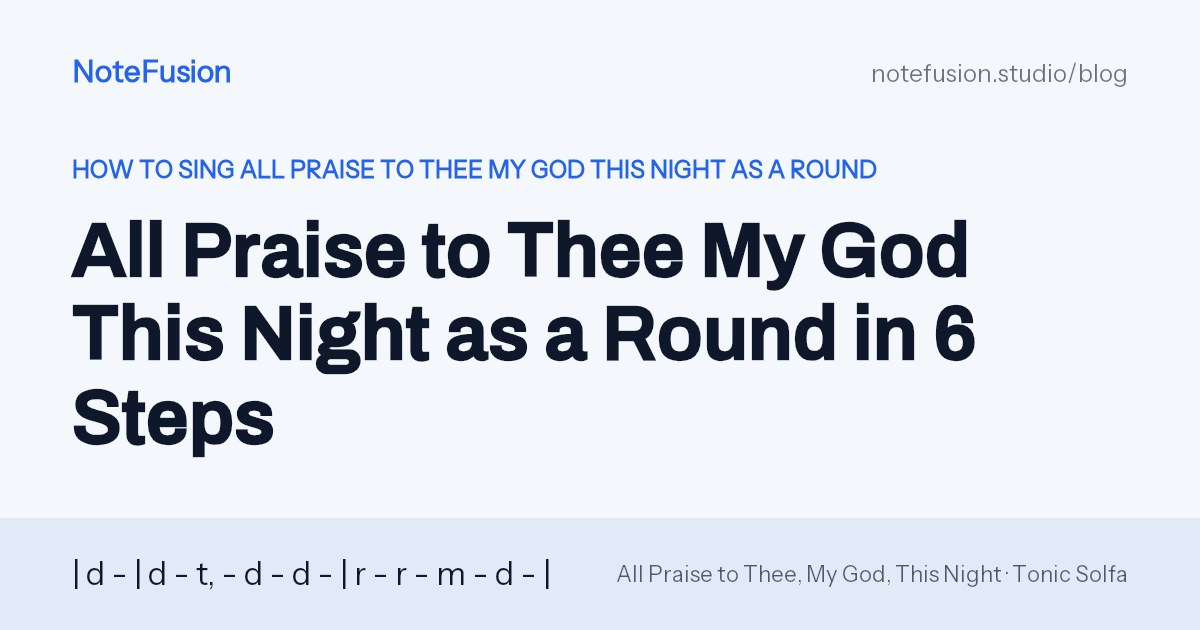
Your evening service is small and your choir is smaller. Four-part harmony feels out of reach when you have two tenors and a bass who comes when he can. This evening hymn solves that, because the tune is its own harmony.
Here is how to sing All Praise to Thee My God This Night as a round. Teach Tallis's tune in unison from the solfa until everyone can sing it without the book. Split the choir into two groups. Bring group two in when group one reaches the word "For" at the start of line two. Each group then keeps its own line to the end.
Below I take you from unison to staggered entries in a single rehearsal, using the solfa on the All Praise to Thee, My God, This Night hymn page. I have also included cues for holding your part when the group beside you is singing something different.
Why Tallis's Canon makes a good evening hymn canon for choir
Thomas Ken wrote the words as an evening hymn. They are usually sung to Thomas Tallis's tune, known as Tallis's Canon. A canon is a melody that fits against itself when a second voice starts it later. Many hymn books print the tune in the soprano with the same tune following in the tenor, so the counterpoint is built into the music. You are not bolting it on.
For a small choir, this gives you a lot for very little:
- One tune to learn. No alto part, no tenor part, no bass part. Everyone learns the same melody.
- Real counterpoint. Two lines move independently and meet in harmony, which is a sound most small choirs rarely get to make.
- A friendly opening. The first line moves by step around doh, with one note to each syllable. That makes it easy to hold when someone else is singing different words.
- It suits the season of the day. A quiet round at an evening service, a Compline or the end of a choir supper works without any accompaniment.
If your choir usually leans on the organ, this is also a good first step towards unaccompanied singing. My guide on how to train a choir to sing a cappella covers setting the key from one note and checking pitch between verses. Both habits matter here.
Got a recording? Get it in solfa →
Learning the tune first: Tallis Canon tonic solfa in G major
The hymn page sets the tune in G major, so doh is G. These are the opening bars:
| dAll- | dpraise-t,to-dThee,-dmy- | rGod,-rthis-mnight,-dFor- |
Read it with your choir before anyone sings:
- The tune starts on a pickup on doh ("All").
- On "to" it dips to t, (te with a comma below, the te just under doh), then comes straight back to doh on "Thee".
- It rises through ray to me on "night".
- It lands on doh again on "For", the first word of line two.
Remember that last doh. It is the most important note in the whole round, and I come back to it below.
Here is the whole verse so the choir can see the shape of all four lines:
| dAll- | dpraise-t,to-dThee,-dmy- | rGod,-rthis-mnight,-dFor- |
| fall-fthe-mbless--mings- | rof-rthe-dlight!-sKeep- |
| fme,-rO-mkeep-mme,- | rKing-rof-dkings,-s,Be-- |
| l,neath-t,Thine-down-mal-- | rmigh--rty-dwings.- |
Teach it in unison in three passes:
- Sing it on solfa syllables, line by line. Use hand signs if your choir knows them.
- Sing it on "noo", so the ear takes over from the eye.
- Sing it on the words, all four lines straight through.
Men sing an octave below the women throughout. That is fine in a round, because an octave apart is still the same note in solfa.
Do not move on until the choir can sing the verse with their books closed. A round fails when singers are reading, because their eyes drift to the line the other group is singing.
How to teach a choir to sing a round: 6 steps
This is the order I use. It works for a round of any length, and it fits into about twenty minutes of a rehearsal.
- Check the unison from memory. Ask everyone to sing the verse looking at you, not the page. If the tune wobbles anywhere, fix that line now.
- Split into two groups, standing apart. Use a left group and a right group, each with a mix of voices if you can. Put your most secure singer in the middle of each group as its anchor.
- Speak it as a round first. Group one speaks the words in strict rhythm while you tap the beat. Group two speaks "All praise" exactly when group one reaches "For". This trains the entry without the extra worry of pitch.
- Sing it on "noo", slowly. Take it at about two-thirds of your normal speed. Slow tempo lets each group hear where its line fits against the other.
- Sing it on the words at normal speed. Keep your conducting simple: one beat per syllable, and a clear cue for group two.
- Swap the groups. Make the second group lead the next time. Singers who have only ever entered second often lose the thread when they have to start the round themselves.
If you have time left, add a third group that enters when group two reaches "For". Listen carefully. If anything rubs or a group starts drifting, go back to two groups and make that solid first.
When does the second group come in?
The second group comes in on "For", the first word of line two, eight beats after the first group starts. Count "All" as beat one. Bar one gives four more beats, and "For" falls on the last beat of bar two in the extract above.
The best part is that the entry note is shared. Group one sings "For" on doh, and group two begins "All" on doh. Tell group two: "Your first note is the note they are singing right now." No one has to find a fresh pitch out of nowhere. They join a note that is already in the air.
As director, give two signals:
- A preparation on "night": raise your free hand towards group two and breathe with them.
- The cue on "For": a clear downward gesture to group two, with your eyes on them.
If two notes rub in the first rehearsal, the cause is almost always an early entry. Singers tend to jump in on "night" because it sounds like an ending. Speak the cue word aloud for a few rounds until the entry is automatic.
How do you hold your line while another group is singing?
You hold your line by listening to your own group first and the other group second. Only open your ears outwards once your own part is secure. Here are the cues I give singers:
- Stand in a block. Never mix the two groups together for a first attempt. Each singer needs neighbours singing the same words.
- Sing to your anchor. Watch your group's strongest singer and match their vowels and their breaths.
- Cup one ear. A hand held lightly behind one ear lets you hear yourself more clearly than the room. It looks odd and works well in rehearsal.
- Know your landmarks. In line one, that is the dip to t, on "to", the climb to me on "night" and the doh on "For". If you hit those, the notes between them follow.
- Keep the words crisp. Final consonants such as the "s" of "praise" and the "t" of "night" tell your group where the beat is. Sliding vowels are where groups drift into each other.
- Breathe at your own line ends, not theirs. Group two will want to breathe when group one does. Mark your own breath points in pencil.
- Do not sing louder to survive. Volume makes balance worse and pitch flatter. Sing at a comfortable level and trust your block.
Some singers struggle to hold a different line when they first try this. Practising against a sustained doh at home helps them stay on their own notes. My article on how to sing harmony by ear in a choir has a drone exercise that builds exactly this skill.
Ending the round and building a whole hymn
A round needs a planned ending, or it collapses into an awkward tail. Two endings work well:
| Ending | How it works | Best for |
|---|---|---|
| Groups finish in turn | Group one stops at the end of the verse, and group two sings the final line alone | A quiet close at an evening service |
| Round inside the hymn | Sing verse one in unison, the middle verses as a round, and the last verse in unison | Using the full text without tiring the choir |
The second shape suits this hymn especially well. Ken's text closes with the doxology "Praise God, from whom all blessings flow", and a full unison on that verse brings everyone home together. Before the final unison verse, give a clear breath cue to both groups and restart from the same doh.
Choosing a key your choir can hold
G major works for many mixed choirs. A round puts extra strain on tired voices, though, because nobody can rest while the other group carries the tune. If your sopranos tighten towards the top of the tune, or your men are growling at the bottom, move the whole thing down. Here is the opening in F major, with doh on F:
| dAll- | dpraise-t,to-dThee,-dmy- | rGod,-rthis-mnight,-dFor- |
The syllables do not change, and that is the beauty of movable doh. The choir reads the same solfa, and only your starting pitch moves. In NoteFusion, "Transpose for my choir" moves the doh for you and shows whether each part sits comfortably before you commit to a key.
Whichever key you choose, pitch it the same way every time: sound doh, have everyone hum it, then give group one the starting note. Group two does not need a separate note, because they will pick up the doh group one sings on "For".
A plan for your next rehearsal
- Ten minutes: learn the tune in unison on solfa, on "noo", then on the words, until the choir can sing it from memory.
- Five minutes: do the spoken round, with the entry drilled on "For".
- Five minutes: sing the round slowly on "noo", then on the words, then swap the groups.
- At home: each singer practises the verse alone until it runs without the book.
If you want the choir to practise between rehearsals, open the hymn in NoteFusion. It plays the tune back on a piano, slower or looped, so a singer can loop line one until the landing on "For" feels certain. Save the sheet and send your choir the share link, and everyone arrives at the next rehearsal already knowing the tune that holds the whole round together.
Frequently asked questions
Can All Praise to Thee My God This Night be sung as a round?
Yes. Its tune, Tallis's Canon, is written so the melody fits against itself when started later. Teach it in unison first, then bring a second group in when the first reaches 'For' at the start of line two.
When does the second group come in on Tallis's Canon?
On the word 'For', the first word of line two, which is eight beats after the first group starts. The second group's first note is the same doh the first group is singing at that moment.
What key is Tallis's Canon in for tonic solfa?
The hymn page gives it in G major, so doh is G. Lower it if your sopranos tire or your basses are lost. Every group sings the same syllables in any key, so a key change does not change what the choir reads.
How do you stop a round without it falling apart?
Let the groups finish in the order they started, so the last group sings the final line alone. This makes a gentle close for an evening service. Another option is a unison final verse after the round verses.
How many singers do you need to sing a round?
Two groups are enough, and a group can be as small as two or three confident singers. What matters is that each group has one secure singer who knows the tune from memory.