As with Gladness Men of Old Tonic Solfa: 6 Lines, 1 Week
As with Gladness Men of Old tonic solfa in G major, phrase by phrase, with the repeats that speed learning and an Epiphany 2027 rehearsal plan.
Christmas is barely over, the decorations are still up, and Epiphany is suddenly on the rota. Your choir has sung nothing but carols for a month, half of them will be away over New Year, and you need one strong hymn about the star and the magi that they can sing with confidence on the first Sunday of January.
The As with Gladness Men of Old tonic solfa on our hymn page is in G major, so doh is G, in 4/4 time, over 12 bars. The melody has six lines of two bars each. Lines one and two use the same tune, and the opening is identical to For the Beauty of the Earth, so most choirs already half know it.
In this post I take the G major page phrase by phrase, show you where the repeated shape saves rehearsal time, and give you a schedule that fits around Christmas so the hymn is ready for Epiphany 2027.
As with Gladness Men of Old tonic solfa at a glance
Here is what you are working with before you open the full sheet at As with Gladness Men of Old in Tonic Solfa:
| Detail | What it means for your choir |
|---|---|
| Key | G major, doh is G |
| Time | 4/4, four steady beats a bar |
| Length | 12 bars, sung for every verse |
| Shape | Six lines of two bars each |
| Repeats | Line two uses the same melody as line one |
| Ending | The tune comes home to doh |
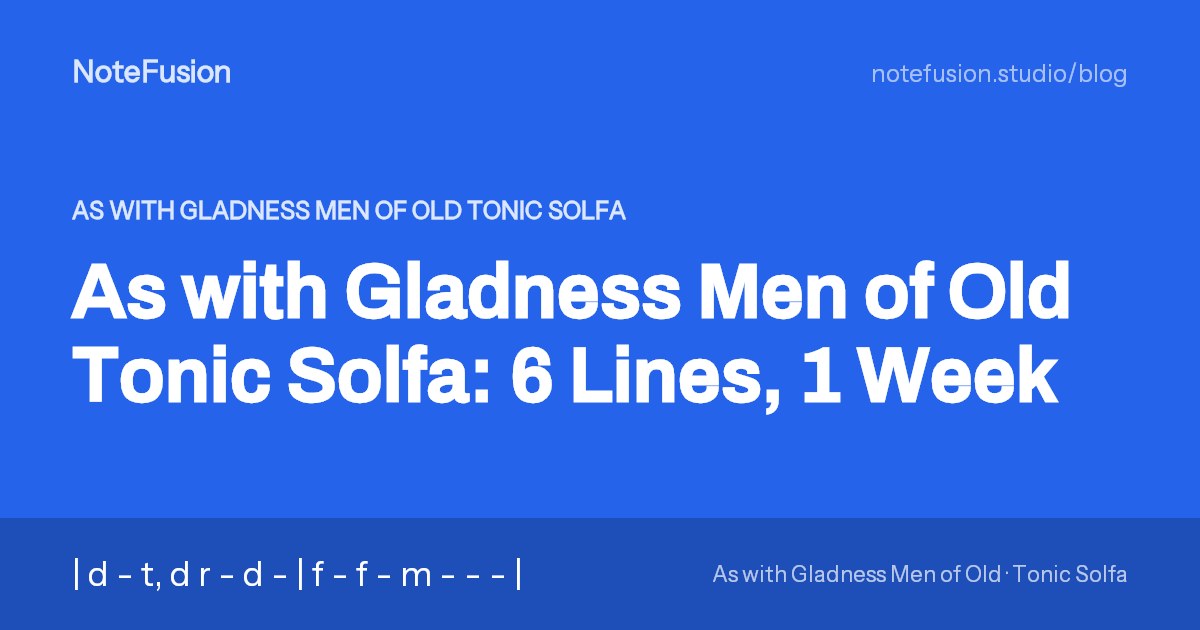
This is the first line, exactly as the page shows it:
| dAs-t,withd_rglad--dness,- | fmen-fof-mold--- |
Read it slowly with your singers. It starts on doh, dips to the t, below it on the second word, comes straight back to doh, steps up to ray and back to doh. Then bar two jumps up to fah, repeats it, and settles on me, which is held for two beats.
Got a recording? Get it in solfa →
Phrase one: the shape that carries the whole hymn
Three small things in these two bars decide whether your choir sounds secure or tentative.
- The little t, d pair. The second word, "with", carries two quick notes on one beat: t, then d. Sopranos often sing it as a single note and the line loses its lilt. Have everyone sing just "d t, d" three times on solfa, then add the words.
- The leap from doh to fah. At the end of bar one the tune is on doh, and "men" jumps up a fourth to fah. Singers who are unsure tend to undershoot. Practise doh to fah as a pair, and if your choir uses hand signs, show the fah sign clearly on the beat. Our guide to Tonic Solfa hand signs has the shapes.
- Fah falling to me. That is a semitone, the smallest step in the scale. Fah needs to stay up until the last moment, then me sits just below it. If the line sags here, it sags all the way through the verse.
The held me at the end of bar two is your breath point. Two beats is plenty of time to finish the word "old" cleanly and breathe before line two.
Why does this tune feel familiar?
Because your choir has almost certainly sung it already. As with Gladness Men of Old and For the Beauty of the Earth are both sung to the tune known as Dix, and our pages show the same G major solfa for both openings. Compare this with the block above:
| dFor-t,thed_rbeau--dty- | fof-fthe-mearth,--- |
Note for note, it is the same line. That is the single most useful fact for a busy director in January. Instead of announcing "a new hymn", say "we are singing For the Beauty of the Earth with Epiphany words". The melody is already in their ears, so rehearsal time goes on the words, the breathing and the blend rather than on learning notes from scratch.
If your choir does not know For the Beauty of the Earth, that is fine too: learn this one now and you will have the harvest and thanksgiving hymn for free later in the year.
How do you teach the six lines quickly?
Teach line one, then let the choir discover that line two is the same tune. Here are the first four bars together, so you can see the repeat on the page:
| dAs-t,withd_rglad--dness,- | fmen-fof-mold--- |
| l,Did-t,the-dguid--l,ing- | s,star-s,be--s,hold--- |
Bars 3 and 4 copy bars 1 and 2. In practice that means a third of the hymn is learned the moment line one is secure. I use this order, which follows the method in how to teach a choir a new song:
- Line one on solfa, then words. Everyone sings the melody together, all parts, until the t, d pair and the fah are clean.
- Ask, do not tell. Play line two and ask the choir what they notice. When they say "it's the same", they own it, and they will remember it.
- Lines three and four as a pair. Open the hymn page and look at bars 5 to 8. Before anyone sings, ask: where is the highest note, and does any bar look like something we have already sung? Spotting shapes on the page is quicker than hearing them cold.
- Lines five and six as the finish. Bars 9 to 12 bring the tune home. Find the final doh in bar 12 first, sing it, then work backwards a bar at a time so the ending is the strongest part.
- Whole verse, then a second verse. The second verse is where words start to trip people up, because the tune is now automatic and attention drifts. Sing verse two straight after verse one so they feel the difference.
Only once the melody is solid should altos, tenors and basses split off to their own lines. With so few rehearsals over Christmas, a confident unison melody with organ is far better than four shaky parts. If you do have time for harmony, a ten-minute sectional rehearsal per part is enough for a hymn this regular.
Is G major the right key for your choir?
G major is a comfortable printed key for many congregations, but your choir is not every congregation. Check two things on the full page: the highest note in lines three to six, and how low the t, below doh sits for your altos. If sopranos are straining or basses vanish, move the doh.
In movable doh nothing changes for the singers when you transpose: the syllables stay exactly the same, only the starting pitch moves. That is the beauty of reading in solfa. Tell the organist the new key, give the choir the new doh, and everyone sings what they already learned. Our guide on how to choose the right key for your choir walks through the checks.
If you would rather see it than calculate it, NoteFusion's "Transpose for my choir" moves the doh and shows whether each part sits comfortably in the new key, which saves an argument with the organist on a cold January evening.
When should you schedule it after the Christmas season?
The Feast of the Epiphany falls on Wednesday 6 January 2027. Many churches keep it on the nearest Sunday, which is 3 January 2027, only nine days after Christmas Day. Rehearsals between Christmas and New Year are often cancelled or thinly attended, so do not leave this hymn until January.
Here is a plan I would use:
| When | What to do | Time needed |
|---|---|---|
| First December rehearsal | Sing line one and line two, point out the For the Beauty of the Earth link | 10 minutes |
| Second December rehearsal | Lines three to six, then verse one complete | 10 minutes |
| Last rehearsal before Christmas | One run-through of two verses, share the sheet for home practice | 5 minutes |
| Christmas week | No rehearsal needed; singers listen and look over the sheet at home | none |
| Rehearsal before Epiphany Sunday | Warm up on line one, then all verses with organ | 10 minutes |
Slotting this into December sounds greedy when you are already drowning in carols, but ten minutes at the end of a carol rehearsal is easy to find, and it means January is a refresher rather than a rescue. If your carol service plan is still taking shape, Christmas carols in tonic solfa has rehearsal orders you can fit this alongside.
Share the hymn page link with the choir before they break for Christmas. A singer who looks at the 12 bars once over the holiday will walk in on 3 January already knowing the shape.
Hymns for Epiphany Sunday to pair with it
As with Gladness Men of Old makes a natural opening or gradual hymn. For the rest of the service, these Epiphany hymns for choir are all on the site:
- Brightest and Best of the Sons of the Morning: the star and the gifts, a good choice before or after the Gospel reading.
- Songs of Thankfulness and Praise: a hymn that looks across the whole Epiphany season, useful on the following Sundays as well.
- Hail to the Lord's Anointed: strong and outward-looking, fine for a recessional.
- Christ, Whose Glory Fills the Skies: light imagery that matches the star theme, in D major on our page.
- The First Noel and Angels from the Realms of Glory: both have verses about the star and the wise men, so your choir can carry a carol they already know into Epiphany. Our Angels from the Realms of Glory refrain drills will help if the held notes wobbled at Christmas.
- When Jesus to the Jordan Came: for the Baptism of Christ, which many churches keep on the Sunday after Epiphany.
Pick two that your choir knows well and one new one at most. With As with Gladness Men of Old already learned from its familiar tune, that new one can be anything from the list. You will find more seasonal choices in the full hymns in Tonic Solfa index.
A quick check before Epiphany Sunday
On the morning itself, run just these three things:
- Sing line one on solfa once, listening for the t, d pair and a high, bright fah.
- Sing the last line on its own and make sure the final doh is in tune and held for its full value.
- Agree where the choir breathes: at the end of each two-bar line, never in the middle of one.
If those three are secure, the rest of the As with Gladness Men of Old tonic solfa takes care of itself, because every verse is the same 12 bars.
If your choir is learning other Epiphany pieces from recordings, you can upload a recording, hum the tune or paste a YouTube, Spotify or Apple Music link into NoteFusion. It writes the melody in movable-doh Tonic Solfa with staff notation, plays it back on a piano slower or looped for home practice, and lets you share the sheet with your choir by link.
Frequently asked questions
What key is As with Gladness Men of Old in tonic solfa?
The NoteFusion hymn page gives it in G major, so doh is G. It is in 4/4 and runs to 12 bars. The tune opens on doh and comes home to doh at the end.
Is As with Gladness Men of Old the same tune as For the Beauty of the Earth?
Yes. Both are usually sung to the tune known as Dix, and the solfa for the opening bars is identical. A choir that already sings For the Beauty of the Earth knows most of this hymn already.
When is Epiphany in 2027?
The Feast of the Epiphany falls on Wednesday 6 January 2027. Churches that keep it on the nearest Sunday will mark it on Sunday 3 January 2027.
How long does it take a choir to learn As with Gladness Men of Old?
Because the first two lines share one melody and every verse uses the same 12 bars, most choirs can learn it in a few short rehearsal slots. Introduce it before Christmas so Epiphany needs only a run-through.
What other hymns suit Epiphany Sunday?
Good choices include Brightest and Best of the Sons of the Morning, Songs of Thankfulness and Praise, Hail to the Lord's Anointed, Christ, Whose Glory Fills the Skies, and the star verses of The First Noel and Angels from the Realms of Glory.