Away in a Manger Tonic Solfa for Children: 5 Easy Steps
Away in a Manger tonic solfa for children's choir: the F major solfa, phrase-by-phrase echo singing with hand signs, and how to pick a better key.
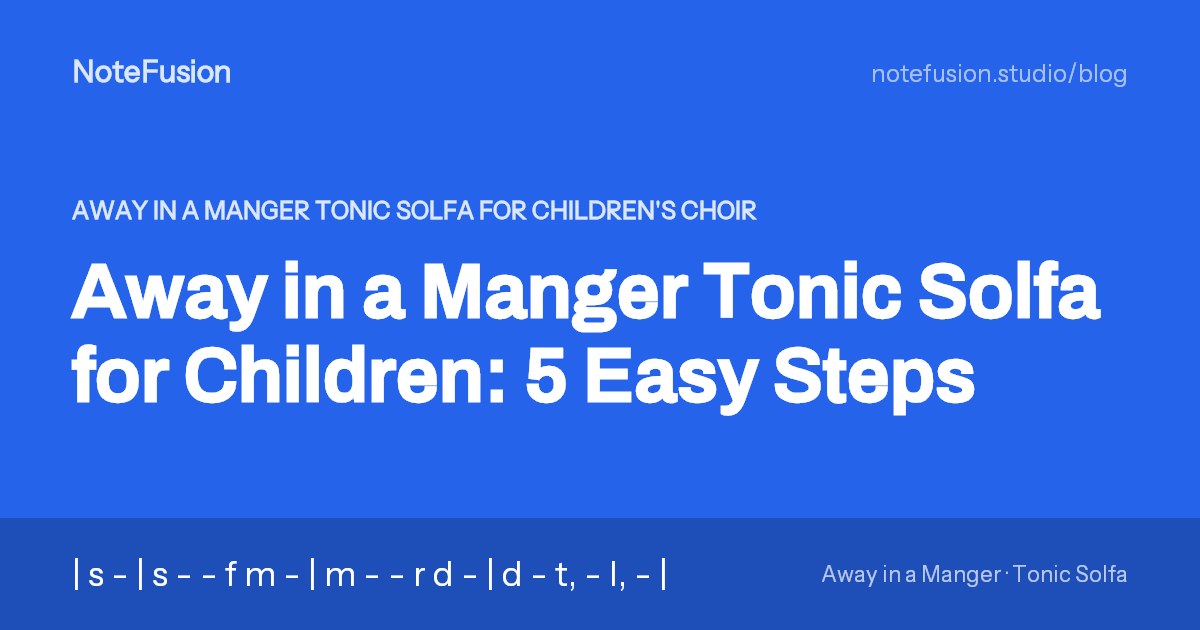
The nativity is three weeks away, the shepherds still have tea towels on their heads, and when you ask the children to sing Away in a Manger, half of them start on one tune and half on another. You have perhaps twenty minutes a week with them, and you need the carol secure before the parents arrive with their phones.
Here is the short answer. Away in a manger tonic solfa for children's choir is simplest in F major: doh is F, the time is 3/4, and the tune begins on soh with a pickup, then walks down the scale one step at a time to low soh, an octave below. Teach it phrase by phrase, echo-singing with hand signs.
In this post I will show you the opening in solfa, a five-step way to teach it to children who may never have seen a solfa sheet, and how to move it into a brighter key if the low notes disappear.
Away in a Manger tonic solfa for children's choir: the first line
This is the opening of the carol as it appears on our Away in a Manger solfa page, in F major with doh on F:
| sA-- | sway--finma- | mman---rger,dno- | dcrib-t,for-l,a- | s,bed,---s,The- |
Three things are worth pointing out before you teach a note of it.
It starts before the first full bar. That short first bar is a pickup: the word "A-" falls on the third beat, and "-way" lands on the strong first beat of the next bar. Children love to come in early here, so count "one, two" aloud and let them sing on "three". If pickups are new to you, the guide to what a pickup note is explains the counting.
It is a staircase. After the two opening sohs, every note is one step lower than the one before, all the way down to the low soh marked with a comma. There are no leaps to find and no awkward intervals. For a child, that is the easiest melody shape there is: you simply walk downstairs.
The dashes are held notes. Each dash keeps the previous syllable going for another beat. Notice how "man-" and "bed" get longer notes at the ends of the phrases. Those are your natural breathing points, and they are where young singers tend to rush. Ask them to hold the note until you lift your hand.
The comma under the final soh is an octave mark: it means the soh below doh, not the one above. If anyone on your team is unsure about these marks, the article on octave marks in tonic solfa covers them in a few minutes.
Got a recording? Get it in solfa →
Which tune do your children already know?
Before you plan anything, sing the first line to the children and watch their faces. The falling tune above is the one most often sung in North America. Many schools and churches in the UK sing a different tune, usually called Cradle Song, to the same words. Other countries and traditions have their own favourites too.
If the children already know Cradle Song from school assemblies, you have two honest options: teach them the tune on this page carefully as a new song, or use the tune they know and transcribe it. What does not work is teaching one tune while the adults in the congregation sing the other. Decide early, tell your pianist, and make sure every printed sheet matches.
How do you teach Away in a Manger to kids phrase by phrase?
You teach it in small chunks by ear first, with hand signs, and bring in the written solfa only once the sound is secure. Here is the order I would use across two or three short sessions.
- Warm up on the scale they are about to sing. Sing up and down the F major scale with hand signs, slowly, and then sing it downwards only, from soh to low soh. That downward run is the whole shape of the first line.
| dF-rG-mA-fB♭- | sC-lD-tE-d'F- |
Sing the first phrase on "loo". Take the pickup and the first two full bars (up to "crib for a bed" in your head, but sing it on "loo"). Sing it to them twice, then ask them to echo it. Words can wait; children concentrate on pitch better when they are not also remembering lyrics.
Echo the same phrase in solfa with hand signs. Now sing it again with the syllables and the signs, and have them copy both. Keep your hand moving lower with each step so the descent is visible.
Add the second phrase the same way. The next two bars carry on down the staircase from doh to low soh. Teach it on "loo", then in solfa, then join it to the first phrase so they hear the whole staircase in one breath.
Put the words on. Once the line is secure in solfa, swap in the words. If a note wobbles, drop back to solfa for just that phrase and then try the words again. Finish each session by singing the whole first line through once, slowly and gently.
Do not try to teach every verse in one go. The later verses use the same tune, so once the melody is learned, verses two and three are just words.
Hand signs for the falling line
The Curwen hand signs turn an invisible tune into something children can see and copy. For this carol you only need the signs from soh down to low soh:
- soh: flat hand, palm facing your body
- fah: fist with the thumb pointing down
- me: flat hand, palm facing the floor
- ray: flat hand slanting upwards
- doh: a closed fist
- te: index finger pointing up
- lah: a relaxed hand drooping from the wrist
- low soh: the soh sign again, held lower, around tummy height
The most useful trick is height. Start the signs at about eye level for the opening soh and bring your hand down a little with every step, so that low soh is clearly below doh. The children will copy your hand position without being told, and you will see straight away who has lost the tune because their hand will be in the wrong place.
Echo singing that actually sticks
Echo singing is simple, but a few habits make the difference between a phrase that sticks and one that is forgotten by the next week.
- Keep the chunks short. One phrase of about two bars is plenty for young children. If they cannot echo it after two goes, the chunk is too long.
- Sing it the way you want it back. Children copy everything: your speed, your volume, your breathing and your sliding between notes. Sing lightly and in tune, and do not sing along when they echo, or you will not hear what they have learned.
- Give the starting note every time. Play or sing the first soh before each echo. In F major that is the C above middle C.
- Let children lead. Once a phrase is secure, ask a confident child to sing it as the leader and the others echo. It keeps attention up and shows you who knows it.
- Repeat at the start of the next session. Begin each week by echoing the phrases you taught last time before adding anything new.
For older children who are ready for reading, hand them the solfa sheet after the echo work and ask them to point to each syllable as they sing. Reading something they can already sing is far less frightening than reading something new.
Is F major too low or too high for children?
For many children's choirs F major is a little low at the bottom. The first line spans exactly an octave, from the opening soh (the C above middle C) down to low soh (middle C itself). Young voices often lose strength and colour down around middle C, so the end of the phrase, on "bed", can turn into a mumble while the beginning sounds lovely.
Listen for these signs at your next rehearsal:
- Too low: the last notes of each phrase go quiet, breathy or growly, or children drop out on them altogether.
- Too high: faces tense, chins lift, and the sound gets shouty on the higher notes later in the verse.
If it is the low end that suffers, which is the common problem with this carol, move doh up. If the higher notes in the later phrases strain, move it down a little. Either way, sing the whole verse in the new key before you decide, not just the first line.
How to transpose Away in a Manger for young voices
The joy of movable doh is that transposing changes nothing for the singers. The syllables stay exactly the same; only the doh moves. Here is the same opening with doh moved up to G:
| sA-- | sway--finma- | mman---rger,dno- | dcrib-t,for-l,a- | s,bed,---s,The- |
Compare it with the F major block above: every syllable, dash and comma is identical. The children sing the same tune with the same hand signs. Only your starting note and the accompaniment change. This table shows where the important notes land in the keys most worth trying:
| Key | Doh | Opening soh | Low soh at the end of the line |
|---|---|---|---|
| Eb major | Eb | Bb | Bb below middle C |
| F major | F | C | Middle C |
| G major | G | D | D above middle C |
| Ab major | Ab | Eb | Eb above middle C |
For most children's groups, my advice is to try G major first. It lifts the low end to D, a comfortable note for most young voices, without pushing the rest of the tune too high. If your children are older and have strong head voices, A flat is worth a try. Eb only makes sense if you are combining the children with adults who find F too high, and it will make the low end harder for the youngest singers.
Remember your accompanist: a pianist reading from a printed F major copy needs a part in the new key, and that needs sorting well before the dress rehearsal. The full method, including how to check ranges and work with instrumentalists, is in how to transpose a song for a choir. If you use NoteFusion, the "Transpose for my choir" option moves the doh for you and shows whether each part sits comfortably, which saves working out the table above by hand.
Fitting it into a nativity or carol service
Away in a Manger is an easy Christmas song for a children's choir because it is gentle, short and familiar, and it suits the quiet moment of a nativity when Mary and the baby appear. A few practical points for the day itself:
- Pick the key and stick to it. Once you have chosen G or A flat, use it in every rehearsal so the children's ears settle.
- Decide on verses early. Two verses sung well beat three verses where the last one falls apart.
- Let the congregation in carefully. If adults join for the last verse, make sure they are singing the same tune and the same key, or the children will be swamped.
- Rehearse the ending. The final low soh should be held and then released together. Practise lifting your hand and stopping on your signal.
If this carol is one item in a bigger service, the guide to Christmas carols in tonic solfa lists other public-domain carols with solfa pages, and the seven-week carol service plan helps you space out rehearsals so nothing is rushed in the final week.
If your children know a different tune, or you want a recording of your version for families to practise with at home, NoteFusion can help. You can hum or sing the tune, upload a recording or paste a song link, and it writes the melody in movable-doh solfa with staff notation, plays it back on piano slower or looped, and lets you share the sheet with a link. You can try it at NoteFusion.
Frequently asked questions
What key is Away in a Manger in for tonic solfa?
The version on our hymn page is in F major, so doh is F and the time signature is 3/4. Because solfa uses movable doh, you can move it to G or A flat for children without changing a single syllable.
What are the first solfa notes of Away in a Manger?
The tune starts on soh as a pickup and then walks down the scale one step at a time until it reaches low soh, an octave below. The solfa block in this article shows the first five bars exactly.
Is Away in a Manger a good song for a children's choir?
Yes. The opening is a stepwise descending line in a gentle 3/4, the phrases are short, and most children have heard it before, which makes it an easy Christmas song for a children's choir to learn in a few short sessions.
How do I teach Away in a Manger to kids who cannot read music?
Use echo singing: you sing one short phrase, they sing it back, and you add Curwen hand signs so they can see the tune going down. Only add the solfa written out once they can sing the phrase confidently by ear.
Why do the children sound quiet on the low notes?
In F major the first line falls to low soh, which is middle C, and many young voices lose strength that low. Moving doh up to G or A flat lifts that note and usually makes the whole carol brighter.
Is there more than one tune for Away in a Manger?
Yes. The tune shown here is the one most often sung in North America, while many UK schools and churches sing a different tune known as Cradle Song. Check which one your children know before you start teaching.