How to Plan a Christmas Carol Service for Choir: 7-Week Plan
How to plan a christmas carol service for choir: a 7-week countdown from November, carols assigned week by week, and solfa sheets for home practice.
The carol service is already in the church diary, the readers have been asked, and you have perhaps seven Thursday rehearsals left. Last year the sopranos were still guessing at the descant on the night, and half the altos learned their part in the car park. This year you want to walk in on the evening knowing every carol is ready.
Here is how to plan a Christmas carol service for choir: fix the order of service first, choose two or three new pieces and keep the rest familiar, then give each week one main carol to learn and one to revise. Send every section its own solfa sheet after each rehearsal, and keep the last two weeks for run-throughs only.
Below is a seven-week countdown that starts in early November, with three carols from our hymn pages placed in specific weeks, and a simple way to get each section practising its part at home between rehearsals.
How to plan a Christmas carol service for choir in five steps
Before any singing, settle these five things in your first planning hour. Everything after this is rehearsal.
- Get the order of service. Ask whoever leads the service for the readings, the congregational carols and any fixed moments (a candle procession, a children's item). You cannot assign choir carols until you know where they fall.
- Choose your choir pieces. Two or three new ones, no more, plus carols the choir already knows. Our list of Christmas carols in Tonic Solfa is a good place to choose from.
- Fix the keys. Check the top and bottom note of every part before week one. Changing the key in week five undoes weeks of muscle memory.
- Write the countdown. One table, one carol per week as the main learning task, pinned where the choir can see it.
- Plan the home practice. Decide now how each section will receive its part, so the sheets go out the same evening as the rehearsal.
Got a recording? Get it in solfa →
When should you start rehearsing Christmas carols?
Start in the first week of November if your service is in mid-December. That gives you six or seven weekly rehearsals, which is enough for a volunteer choir to learn two or three new carols properly and still have two full run-throughs.
If you are only meeting fortnightly, or you are adding harmony parts the choir has never sung, start in the last week of October. Starting earlier rarely helps more than that: carols learned in September tend to go stale, and singers lose interest before Advent arrives.
The question to ask is not "when does Christmas start?" but "how many rehearsals do I need?" Count backwards from the service date, and you will usually find you have fewer than you thought once you remove half-term, a bank holiday and the week the hall is booked for something else.
The 7-week carol service rehearsal schedule
This carol service rehearsal schedule assumes one rehearsal a week of about ninety minutes, with the service in the week after week 7. If your service is earlier, drop week 4 and merge its work into weeks 3 and 5.
| Week | Main learning task | Revision | Home practice sent |
|---|---|---|---|
| 1 (early Nov) | Away in a Manger, verse 1 | None yet | Away in a Manger, all parts |
| 2 | Bethlehem Rejoices | Away in a Manger, verses 2–3 | Bethlehem Rejoices |
| 3 | Angels from the Realms of Glory, verses and refrain | Bethlehem Rejoices | Angels, refrain first |
| 4 | Sectionals on Angels | Away in a Manger | Each section's weakest bars |
| 5 | Congregational carols, descants, endings | Angels, full | Descant for sopranos |
| 6 | Run-through in service order | Everything | Full order with page numbers |
| 7 | Run-through in the building | Everything | Nothing new |
The pattern matters more than the exact carols: easy and familiar first, the hardest piece in the middle when attendance is usually steadiest, and nothing new after week 5. For how to fit warm-ups, new music and polishing into each of those evenings, see these choir rehearsal tips.
Week by week: what each carol needs
Weeks 1–2: Away in a Manger
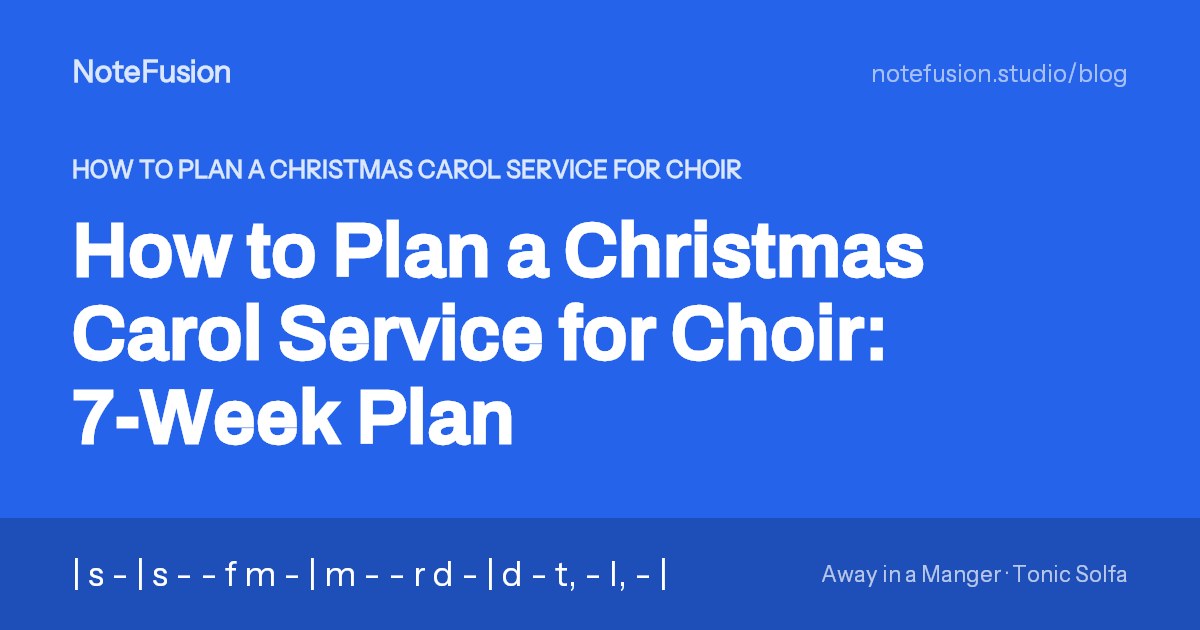
Start with Away in a Manger because almost everyone knows the tune, so the first rehearsal is about sound and parts rather than notes. In F major, in 3/4, it begins on soh and falls step by step to s, by the end of the first line.
| sA-- | sway--finma- | mman---rger,dno- | dcrib-t,for-l,a- | s,bed,---s,The- |
That falling line is the thing to rehearse. Choirs drift flat as the melody descends, and by the time it reaches s, the pitch has sagged. Ask the sopranos to think upward as they sing downward, and check the final s, against the piano. If you have a children's group singing verse one alone, that low s, sits at middle C, which is comfortable for most young voices.
Weeks 2–3: Bethlehem Rejoices
Bethlehem Rejoices is only eight bars long in 4/4, also with doh on F, which makes it ideal for week two: short enough to learn in one evening, new enough to feel like progress.
| mBeth--mle--rhem-rre-- | djoi----t,ces,--- |
Look at the end of bar 2: the tune settles on t, and holds it for two beats. A held leading note wants to rise to doh, and an unsure section will either go flat on it or move early. Have the whole choir sing those two bars on solfa, hold the t, while you count, and only then add the words. Because the piece is short, you can afford to sing it through three or four times in week two and have it secure before Angels arrives.
Weeks 3–5: Angels from the Realms of Glory
Angels from the Realms of Glory is the big one, so it gets three weeks. In C major the melody climbs quickly: it drops from d' to soh and then leaps up a sixth to m', the high E, within the first three bars.
| sAn--mgels- | d'from-sthe-m'realms--r'of | d'glo--sry,-lWing-lyour- |
That leap is where sopranos either shine or scoop. Practise it on solfa from soh to m' slowly, then in tempo. If your sopranos are a small or tired section by the end of a long evening, consider a lower key. Here are the same bars in B flat, where the top note becomes a D:
| sAn--mgels- | d'from-sthe-m'realms--r'of | d'glo--sry,-lWing-lyour- |
The solfa does not change, only the doh. That is why fixing the key before week one matters: if the choir has learned the leap in C and you move it in week five, their ears have to relearn where it sits. Our guide to choosing the right key for your choir shows how to check every part's range before you commit.
Week 4 is for sectionals on this carol. Send the tenors and basses to a separate room with a confident leader for twenty minutes while you work the sopranos and altos through the refrain, then swap. The guide to running sectional rehearsals covers how to split the time and how to bring the parts back together without losing what each group learned.
How do you send each section its solfa sheet?
Send each section only its own part, on the evening of the rehearsal, with one clear task. A singer who opens a message and sees "Altos: Angels, refrain, bars to learn by Thursday" will practise. A singer who receives the whole folder will not know where to start.
A message that works looks like this:
- Who it is for: "Tenors".
- What to learn: one carol, one verse or refrain, and the bar numbers.
- How to practise: "Listen twice, sing it on solfa twice, then add the words."
- The trap to watch: "The held t, at the end of bar 2 goes flat. Hold it and check."
The melody is easy to send, because the hymn pages show it in solfa. Inner parts are harder, since most singers learn them by ear. One way round this: sing or play the alto line on its own into NoteFusion, and it writes that line out in movable-doh solfa with staff notation underneath. Save the sheet and share the link with the altos, who can play it back on a piano, slower or looped, until the bars sit in their ears. Do the same for tenors and basses. More ideas for singers working alone are in our article on learning your choir part at home.
Keep home practice small. Ten minutes on four bars, three times before the next rehearsal, does more than one long session the night before.
Nine Lessons and Carols choir planning
If your service follows the Nine Lessons and Carols pattern, readings alternate with music, so your planning has to follow the story. A little Nine Lessons and Carols choir planning early on saves rearranging the music in week six.
Match each choir carol to the reading before it:
- Readings about the prophets and the promise: a quieter, reflective piece suits here, before the nativity readings begin.
- The shepherds: Away in a Manger fits naturally around the birth readings, especially if children sing a verse.
- The angels' message and the wise men: Angels from the Realms of Glory, whose verses address angels, shepherds and sages in turn, belongs here.
- The final reading: end with a strong congregational carol so the whole church sings, not only the choir.
If your church uses fewer readings, the principle is the same: the choir's hardest piece should not be first (nerves) or last (fatigue). Somewhere in the middle third, after the choir has settled, is where it will sound best.
The last fortnight: run-throughs, not new notes
Weeks 6 and 7 are not for learning. Every new note you introduce now is one the choir will be unsure of on the night. Instead:
- Sing in service order. Stand and sit when you will on the night. Practise the gap between a reading and the first note: who gives the starting note, and how quickly.
- Rehearse the endings. Choirs are often secure in the middle of a carol and shaky on the last chord. Sing just the final line of each piece, twice.
- Rehearse in the building. At least one run-through should happen where the service will be held, so singers hear how the space carries sound and where they stand.
- Mark the music. Every singer should have the order of service with page numbers or sheet names, and any verse the choir sings alone circled.
- Protect voices. In the final week, sing the high moments, like the leap in Angels, once or twice in full voice, then mark them lightly.
If you follow this countdown, the last rehearsal should feel almost boring. That is the goal: a calm final week means a confident service.
When you are ready to send out this week's parts, open NoteFusion, sing or upload a section's line, use "Transpose for my choir" to check it sits comfortably in your chosen key, and share the sheet with that section before they have left the car park.
Frequently asked questions
When should a choir start rehearsing Christmas carols?
Start in the first week of November for a mid-December service. That gives six to seven weekly rehearsals, enough to learn two or three new carols and still have two run-throughs. If the choir is learning a long anthem or new harmony parts, start in late October.
How many carols should a choir learn for a carol service?
Plan a mix: two or three new pieces for the choir alone, and familiar carols sung with the congregation. Volunteer choirs with one rehearsal a week usually manage two or three new pieces well. Five learned badly will not.
How do I get choir members to practise carols at home?
Send each section only its own part, with the bars to learn that week and a recording they can play slowly. A short, specific task such as one carol, one verse and one tricky bar gets done. A whole folder of music usually does not.
What is the order of a Nine Lessons and Carols service?
It alternates nine Bible readings with carols, beginning with readings about the fall and the prophets and ending with the nativity and John's prologue. Many churches adapt the number of readings, so check your own order with whoever leads the service before you assign carols.
What key should Angels from the Realms of Glory be sung in?
In C major the tune climbs to a high E for sopranos within its first three bars, which suits a strong soprano section. If your sopranos are tired by the end of the evening, lowering it to B flat makes that top note a D and is easier on everyone.