Octave Marks in Tonic Solfa Explained in 3 Hymns
Octave marks in tonic solfa explained: what the comma and apostrophe mean, where high and low doh sit, and how basses and sopranos read them.
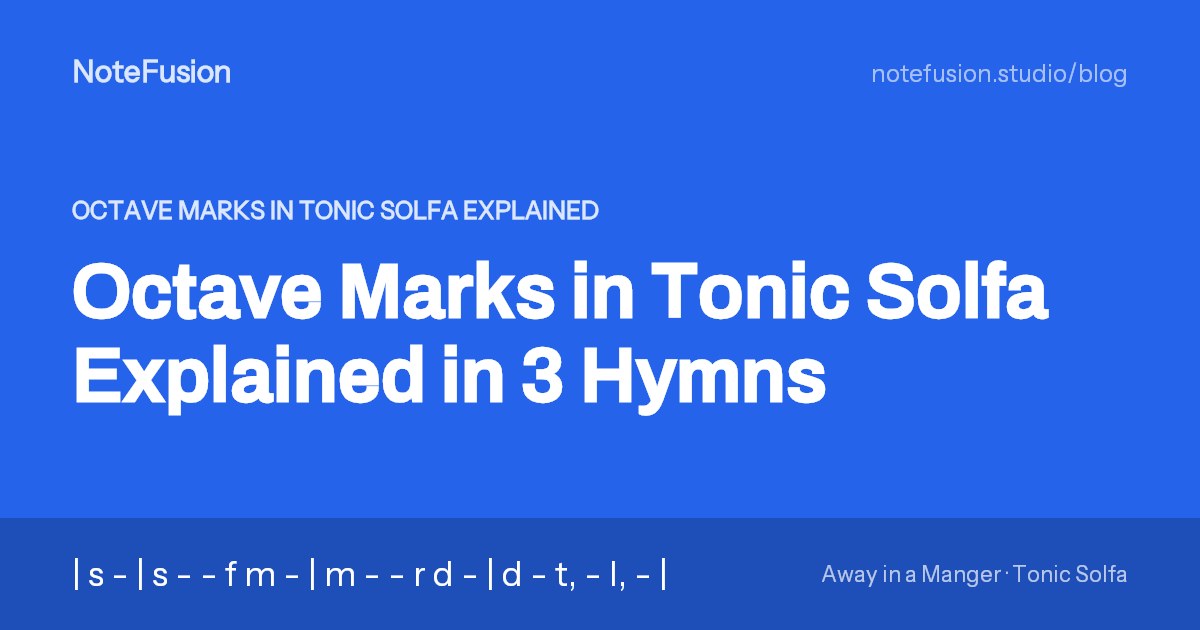
Your altos sang the right letter and still landed an octave away from everyone else. The tenors read soh, found a soh, and it was the wrong one. Nine times out of ten the culprit is a tiny mark next to the letter: a comma or an apostrophe that someone skimmed past.
Octave marks in tonic solfa explained simply: a letter with no mark sits in the middle octave, from doh up to te. An apostrophe (d') lifts the note one octave higher; a comma (s,) drops it one octave lower. The octave always starts on doh, not on the letter C, so the marks move with the key.
In this post I will walk through three real hymn lines that cross doh, one going down, one going up and one dropping all the way to low doh, then show why a bass and a soprano can read identical letters and sing different notes. At the end there is a short drill you can run at your next rehearsal.
Octave marks in tonic solfa explained: the three zones
Think of every hymn as living in three rooms stacked on top of each other. The middle room is the one with no marks. It starts on doh and climbs through ray, me, fah, soh, lah and te. The moment you go past te, you step into the upper room and every letter gets an apostrophe. The moment you go below doh, you step into the lower room and every letter gets a comma.
| Mark | Example | Meaning | Where it sits |
|---|---|---|---|
| None | d r m f s l t | Middle octave | From doh up to te |
| Apostrophe | d' | One octave higher | Above te |
| Comma | s, | One octave lower | Below doh |
| Double mark | d'' or s,, | Two octaves away | Rare, mostly very low bass lines |
On a screen you will usually see the mark typed straight after the letter. In printed books the apostrophe is often a small mark above the letter and the comma a small mark below it. Either way, it means the same thing.
The key fact that trips people up: the boundary is doh, not C. Plain te is unmarked because it is the top of the middle room. Te with a comma is the note just below doh. They share a letter but they are an octave apart.
Got a recording? Get it in solfa →
What does a comma mean in tonic solfa?
A comma means the note is one octave lower than the plain letter, and it always sits below doh. The clearest way to see this is a tune that starts high in the middle octave and walks downhill past doh. The opening of "Away in a Manger" does exactly that:
| sA-- | sway--finma- | mman---rger,dno- | dcrib-t,for-l,a- | s,bed,---s,The- |
"A-way" starts on soh. The line steps down through fah, me and ray to doh on "no crib". Then it keeps going: "for a bed" moves through low te and low lah to low soh. Notice what happens to the marks. As long as the tune is at doh or above, the letters are bare. The instant it passes below doh, the commas appear.
Now compare the first note and the note on "bed". Both are soh. The first is plain s; the second is s,. That is a full octave apart, and the only thing telling you so is the comma. A singer who ignores it will either leap up to the wrong soh or stop the descent halfway, and both mistakes are common in a first read-through.
This is why I tell new choristers to read the comma as the word "low". Low soh, low lah, low te. Say it out loud the first few times and you stop missing it.
What does the apostrophe after doh mean?
The apostrophe after doh means high doh, the doh one octave above the ordinary one. Any letter can carry it: the ray, me and fah above high doh all take an apostrophe too. Here is a hymn line that climbs into that upper room, "A Charge to Keep I Have":
| sA- | mchargeftoskeep-lI- | shave,---d'A- | d'Godttolglo--lri-- | sfy,---sA- |
The opening phrase moves around soh, me, fah and lah in the middle octave. Then, on "A God", it jumps up to d' and holds it for two notes. Listen to how strong that sounds: high doh is the home note, just higher, so it feels settled and bright at the same time.
Now look at the very next note, on "to". It is plain te, with no mark at all. The tune has come down one step from high doh, and te belongs to the middle octave, so the apostrophe disappears. This is the point I most want readers to take away: marks are not about whether the tune is "high" in general, they are about which side of a doh you are on. One step below high doh, you are back in the plain octave.
Other hymns push further. "My Faith Has Found a Resting Place" climbs past high doh as far as high fah in its second phrase, and "Angels from the Realms of Glory" reaches high me in its opening line. When a soprano part shows marks like these, that is a signal to check the key: in a high key, those notes may be uncomfortable, and that is a conversation for your choir director before Sunday.
High doh and low doh in solfa: the octave boundary
High doh is written d' and low doh is written d,. Plain d sits halfway between them. Every melody you sing is measured against these three dohs, so it helps to see a tune that actually reaches low doh. The opening of "We Plough the Fields and Scatter" does:
| s,We- | dplough-dthe-s,fields,-s,and- | mscat----dter-s,The- |
| f,good-m,seed-r,on-d,the- | s,land,-----dBut- |
The line starts on s, and leaps up to doh on "plough". So far so good: s, to d is a rise, because low soh sits below doh. Then on "the good seed on the land" it steps down from low fah through low me and low ray, and arrives on d, for "the". That is low doh, a whole octave below the doh on "plough".
Then comes the note that catches people out. "Land" is on s,, and that is a rise from d,, not a fall. Low doh is the bottom of the lower room; low soh is five steps above it in the same room. If you have been reading the comma as "low", remember it means "in the lower octave", not "lower than the last note". Inside the lower octave the letters keep the same order as the plain scale, each one simply carrying a comma.
If you want to get confident with leaps like s, to d or d, to s,, my article on intervals in Tonic Solfa has drills for exactly these jumps.
Same letters, different voices: bass and soprano
Here is the part that confuses mixed choirs most. A soprano and a bass can both read d and sing different pitches, because men's voices sound roughly an octave below women's. The letter tells you which step of the scale you are on; your voice type tells you which octave it naturally lands in.
What changes between the parts is how often you see each mark:
- Soprano lines spend most of their time in the plain octave and regularly climb to d' at the top of a phrase. Commas are less common, and usually go no lower than s,.
- Alto lines sit lower, often between low soh and plain soh, with plenty of low te and low lah under doh.
- Tenor lines are read by men but are often laid out in the same octave as the women's parts, so a tenor part can look surprisingly "high" on the page with few commas. Many hymn books state at the start how tenor and bass lines should be read; check your book's opening pages.
- Bass lines are full of commas. Low doh and low soh are everyday notes for a bass, because the bass so often sings the root of the chord well below the tune.
So when your basses and sopranos both read plain soh in the same bar, they are reading the same step of the scale but not singing in unison. That is normal and correct. If you are not sure which part fits your voice, SATB parts explained walks through the ranges.
The practical rule for section leaders: when someone is an octave out, do not just play the note again. Point at the mark on the page and ask, "Which doh is this above or below?" Once they can answer that, they stop guessing.
Why the octave resets at doh, not at C
In staff notation, octaves are counted from C. In Tonic Solfa they are counted from doh, wherever doh happens to be. In "Away in a Manger" above, doh is F, so the plain octave runs from F up to E. In a hymn with doh on A, the plain octave runs from A up to G sharp. The marks follow doh, not the piano keyboard.
This has one very useful consequence: transposing a hymn does not change a single mark. If your organist moves "A Charge to Keep I Have" down from C to A flat, the solfa page stays exactly as it is. The d' on "A God" is still d'; it simply sounds lower. That is the whole point of movable doh, and it is why I would rather a choir learned the marks properly than memorised letter names. My beginner's guide on how to read Tonic Solfa covers how doh is chosen for each key.
Minor keys follow the same rule. Because Tonic Solfa reads minor keys la-based, a hymn in A minor has doh on C and lah as its home note. The marks are still measured from that C. So a minor tune that settles on its home note below doh will end on l,, with a comma, even though it sounds like the "bottom" of the key.
A ten-minute octave drill for your next rehearsal
This is the routine I use when a section keeps landing in the wrong octave. It needs no instrument beyond a starting note.
- Find doh together. Give doh and have everyone hum it. Call this "plain doh" out loud.
- Climb to high doh. Sing up the scale, d r m f s l t, and then on to high doh. As you arrive, have everyone raise a hand above their head. That is d'.
- Come back and keep going. Sing back down to plain doh, then continue below it to the soh underneath. Lower hands to waist height on each note below doh. That is the comma zone.
- Call and answer. The director calls a single syllable with its mark, "low lah", "high doh", "te", and the choir sings it from plain doh. Mix up plain te and low te deliberately, since that pair causes the most trouble.
- Apply it to a line. Sing the "Away in a Manger" excerpt above on solfa, saying "low" before each marked note. Then sing it on the words.
- Split the parts. Have basses and sopranos sing the same plain doh together, so everyone hears that the same letter can sit an octave apart in different voices.
Ten minutes of this, repeated for a few weeks, usually does more than any amount of explaining.
Reading octave marks in older hymn books
Older printed solfa can look different from what you see on a screen. Marks may be tiny, set slightly above or below the letter, and easy to lose when the print is faint or a photocopy is several generations old. Some older books use a small figure instead of an apostrophe or comma, placed high for the upper octave and low for the lower one. The meaning does not change.
Three habits help:
- Before you sing, scan the line for marks and circle them in pencil.
- Look at the first note after a key change: doh has moved, so the octave boundary has moved with it.
- Where the print is unclear, check the shape of the line. If the tune has just stepped down from doh, the next note almost certainly carries a comma.
For the colons, dots and other symbols you will meet in printed books, see my guide on how to read solfa in a hymn book.
If you are learning a song from a recording and cannot tell which octave a phrase sits in, NoteFusion can help: hum the line, upload the recording or paste a YouTube, Spotify or Apple Music link, and it writes the melody in Tonic Solfa with every comma and apostrophe in place, alongside staff notation. You can play it back slower or loop the tricky bar to hear exactly where it crosses doh. Try it at NoteFusion.
Frequently asked questions
What does a comma mean in tonic solfa?
A comma after a letter, such as s, (often printed as a small mark below the letter), means the note is one octave lower than the unmarked version. It sits below doh.
What does the apostrophe after doh mean?
An apostrophe, written d', means high doh: the doh one octave above the ordinary doh of the key. Any letter can take an apostrophe, so r' is the ray above high doh.
Is low soh (s,) lower than doh?
Yes. The unmarked octave runs from doh up to te, so s, sits below doh. A tune that moves from s, to d is going up a fourth, not down.
Do octave marks change when a hymn is transposed?
No. The marks are measured from doh, so when doh moves to a new key every letter and mark stays exactly the same. Only the sounding pitch changes.
Why does the bass part have so many commas?
Bass lines spend much of their time below doh, so most of their notes fall in the lower octave and carry a comma. Men's voices also sound about an octave below women's, so the same letter is naturally lower in a bass voice.
What do two commas or two apostrophes mean?
They mean two octaves away from the middle octave, for example d'' or s,,. You will rarely see them in a single voice part, but they can appear in very low bass lines or instrumental parts.