Bless O Lord Each Opening Year Tonic Solfa: 3 Drills
Bless O Lord Each Opening Year tonic solfa in D minor: find lah, mark se and fe, and drill the raised notes before the first service of 2027.
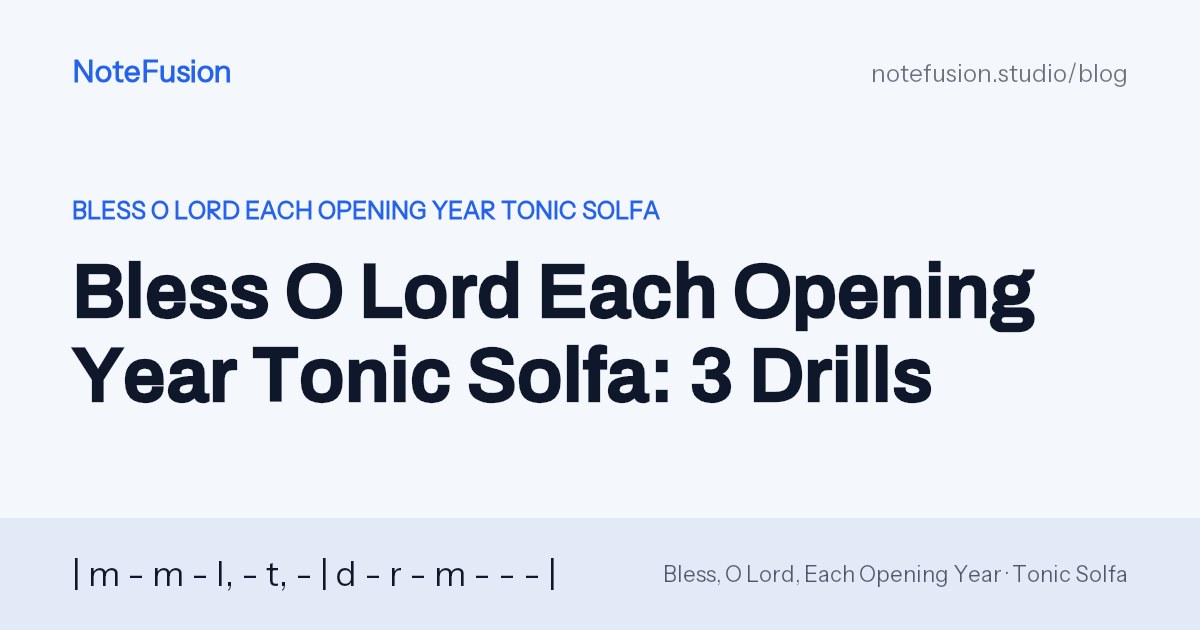
The New Year service is a few weeks away, the hymn on the list is in D minor, and your altos are already asking where doh has gone. This post walks through one hymn, slowly, so the minor key stops being the thing that trips the choir up.
The Bless O Lord Each Opening Year tonic solfa is written la-based: one flat in the key signature puts doh on F, and lah (D) is the home note. The tune opens on me, drops to low lah and climbs back up by step. Any raised notes are read as se (C sharp) or fe (B natural).
Below you will find how to confirm lah for yourself, how to spot and mark the raised notes in your copy, three short drills to fix them in the ear, and a rehearsal plan that gets the hymn ready for Sunday 3 January 2027, the first Sunday of the year.
Where is doh in Bless O Lord Each Opening Year tonic solfa?
Doh is on F, because the hymn is in D minor and D minor shares its key signature (one flat, B flat) with F major. In movable-doh solfa we keep doh where the key signature puts it and let the minor key live on lah. So D is lah, and the opening phrase sits around it.
Here are the first two bars as they appear on the Bless, O Lord, Each Opening Year hymn page:
| mBless,-mO-l,Lord,-t,each- | dopen--ring-myear--- |
Look at the shape. Two repeated notes on me (A), a drop of a fourth to low lah (D, written l, with the comma below), then a steady climb by step through te and doh back up to me. The whole first line stays inside a fifth, from D up to A. That is good news for a volunteer choir: no leaps beyond that first drop, and nothing high for the sopranos in the opening.
The drop from me to l, is the moment that tells your ear the hymn is minor. Sing those two notes to the choir before anything else and ask them which one feels like home. Almost everyone will point to the lower note.
Got a recording? Get it in solfa →
How do you find lah in a minor hymn?
You find lah by checking three things: the key signature, the final note, and the notes the tune leans on. When all three agree, you have it.
- Key signature. One flat means doh is F in a major key. The minor key with the same signature is a third below doh, on D. That D is lah.
- The last note. Minor hymns nearly always end on lah. If the final melody note is D, you are almost certainly in D minor rather than F major.
- The pull of the tune. Sing the opening and stop on the low note. If it sounds settled, that note is lah. In this hymn it arrives in the very first bar.
If you want the full reasoning behind reading minor keys this way, rather than renaming D as doh, our guide to la-based minor in tonic solfa covers it. The short version for your choir: keep the syllables you already know, and learn to hear lah as home.
The D minor scale your choir is reading
Before you touch the raised notes, give the choir the plain minor scale with the letter names underneath. This is the D minor hymn solfa in its simplest form:
| l,D-t,E-dF-rG- | mA-fB♭-sC-lD- |
Read it from lah up to lah. Notice that the scale passes through doh (F) on the way, which is why altos who learned the hymn in a major-key mindset sometimes grab onto F as home. Point it out: F is doh, but it is not where we finish.
A quick check you can do tonight: sing the scale up and down twice, then stop on doh and hold it. Ask the choir whether it feels finished. It should not. Then move down to lah and hold. That contrast is the whole lesson of la-based minor in thirty seconds.
Which raised notes appear in a D minor hymn?
The two raised notes you may meet in a D minor hymn are se and fe. Se is soh raised by a semitone, which in D minor is C sharp. Fe is fah raised by a semitone, which here is B natural instead of B flat.
| Syllable | Normal note in D minor | Raised to | Where it usually appears |
|---|---|---|---|
| soh becomes se | C | C sharp | Just before lah at a cadence |
| fah becomes fe | B flat | B natural | On the way up from me to se |
The raised seventh is the one that matters most. It sits a semitone below lah and pulls up into it, which is what gives a minor cadence its strong sense of arrival. Here is the scale with se in place:
| l,D-t,E-dF-rG- | mA-fB♭-seC♯-lD- |
The opening two bars on our page contain no raised notes, so do not go looking for them there. The place to check is the rest of the hymn, especially the approach to each line ending. Here is how to mark your copy:
- Open the hymn page or your hymn book and look along the melody and each part.
- In staff notation, circle any C with a sharp or any B with a natural sign.
- In solfa, circle every se and every fe.
- Write the letter name above each circle in pencil, so the accompanist and the singers are talking about the same note.
Do this for every part, not just the tune. In a four-part minor hymn, the raised seventh often turns up in an inner part, because the chord before the final lah usually needs it. If you need a refresher on how these altered syllables are named and sung, read fe, se and ta in tonic solfa before you mark up the parts.
Three drills for se and fe
These drills take about ten minutes and work best at the start of rehearsal, after a short warm-up. Use a keyboard or a pitch from your organist to set lah on D.
Drill 1: lah, se, lah
Sing lah, then the semitone below it, then lah again. Keep it slow. The aim is a narrow, bright se, not a sagging soh. If the choir drifts, sing soh first, then se, so they can feel the difference of a semitone. Repeat until the step from se to lah sounds like it is leaning into a door that opens.
Drill 2: the climb from me
Start on me and sing up the harmonic scale to top lah, slowly, one note per beat. The gap between fah and se is wider than any other step in the scale, so singers tend to undershoot se. Stop on fah, hold, then reach up to se and hold. Then try the melodic version, raising fah to fe on the way up so the climb is smooth.
Drill 3: drop and return
This one ties the drills back to the hymn. Sing the hymn's opening drop from me down to low lah, then come back up by step to me as the first two bars do. Once that is secure, add se below lah: sing low lah, the se under it, and back to lah. Basses and altos who will carry the cadence notes should do this one twice.
For each drill, ask one section to sing while the others listen and say whether se was high enough. Choirs tune semitones better when they hear another section get them right.
Part-learning: what each section needs
Volunteer choirs rarely get enough time to learn four parts from scratch, so split the work by what each section finds hardest.
- Sopranos have the tune and, at least in the opening, a comfortable range. Their job is to make the drop to l, clean and not let the repeated me go flat.
- Altos are most likely to confuse doh and lah, because their line may hover around F. Have them sing the D minor scale and stop on lah twice before every run-through.
- Tenors should find their raised notes first. If a tenor line has a se, it is often the note that decides whether the cadence sounds minor or muddy.
- Basses usually land on lah at the end of lines. Have them sing the final two notes of each line on their own until the landing is solid.
A useful habit: when a section misses a raised note, do not run the whole verse again. Isolate the bar, sing it on solfa three times, then on the words once, then put it back in context.
A three-rehearsal plan for the first Sunday of the year
This plan suits a first Sunday of the year hymn choir with one rehearsal a week through December, aiming at Sunday 3 January 2027.
Rehearsal 1: find home. Ten minutes on the D minor scale and Drill 1. Learn the melody on solfa with everyone singing it, then on the words. Mark every se and fe in the parts. Send the hymn page link home with one instruction: listen for the low lah and sing along on solfa.
Rehearsal 2: the parts. Drills 2 and 3. Split into sections for the bars with raised notes, then put the parts together one line at a time. End by singing the whole hymn once, slowly, and stopping only for wrong cadences.
Rehearsal 3: words and shape. A short run of Drill 1, then the hymn at service speed. Work on breathing at the line ends, and on the final lah of each verse being in tune rather than loud.
A practical note: on our hymn pages, this tune shares its key, length and opening two bars with Forty Days and Forty Nights. If your choir sang that in Lent, compare the two pages; you may find much of the work is already done.
If you are building a fuller programme around midnight and the morning after, our New Year watch night hymns in tonic solfa set shows where a new year hymn in minor key sits alongside the brighter major-key choices, so the service has light and shade.
When the hymn needs a different key
If the low notes sit uncomfortably for your altos or basses, move the hymn. The solfa does not change at all: lah is still home, se is still the raised seventh, and every drill above still works. Only the starting pitch you give the choir changes. Raise it a tone and lah moves from D to E; drop it and lah moves to C. Check the lowest bass note and the highest soprano note in the new key before you commit.
If your singers are learning from a recording and the melody could be read in F major or D minor, NoteFusion will ask "Which doh is it?" rather than guessing, write the tune in la-based solfa with staff notation, and play it back on piano slower or looped so a section can drill one bar at home. "Transpose for my choir" moves the doh and shows whether each part sits comfortably, and you can share the sheet with a link before the first rehearsal of the year.
Frequently asked questions
What key is Bless, O Lord, Each Opening Year in?
The version on our hymn page is in D minor with one flat in the key signature. In la-based tonic solfa that puts doh on F and lah on D, the home note.
Why does the solfa start on me if the hymn is in D minor?
In la-based minor, D is lah, so the A above it is me. The tune opens on that me and drops to low lah, which is the minor home note sounding straight away.
What is se in a D minor hymn?
Se is the raised seventh. In D minor it is C sharp, a semitone below lah, and it usually appears just before the tune or a harmony part lands on lah at a cadence.
Is Bless, O Lord, Each Opening Year the same tune as Forty Days and Forty Nights?
On our hymn pages the two share the same key, length and opening two bars. If your choir already knows Forty Days and Forty Nights, compare the full pages, because that head start could save a rehearsal.
Can we sing it in a different key?
Yes. Moving it keeps every solfa syllable the same, so only the pitch you give changes. Pick a key where the lowest notes are comfortable for your altos and basses.