Blest Be the Tie That Binds: Boylston or Dennis? 3 Checks
Blest Be the Tie That Binds, Boylston or Dennis? Compare both tunes in tonic solfa, spot which your hymn book or recording uses, and pick one to teach.
Someone hands you the order of service for a farewell, a wedding or the last Sunday before a pastor moves on, and the hymn is Blest Be the Tie That Binds. You open two hymn books and find two completely different melodies. The organist knows one, half the choir knows the other, and you have one rehearsal.
So, Blest Be the Tie That Binds: Boylston or Dennis? Both tunes carry the same Short Metre words. Boylston climbs from a low soh up to high doh and feels bright and lifting; Dennis starts on me, settles on doh and dips below it, so it feels gentle and low. Teach the one your congregation already sings; if neither is known, Dennis is usually quicker to learn.
In this post I put the two tunes side by side in Tonic Solfa, compare their shape and range for a congregation and for a choir, and show you how to tell in seconds which tune a hymn book or a recording is using.
Why one hymn has two tunes
The words are written in Short Metre, written 6.6.8.6 in the metrical index of most hymn books. Count the syllables of the first verse and you will see it: six in "Blest be the tie that binds", six in "Our hearts in Christian love", eight in "The fellowship of kindred minds", six in "Is like to that above". Any tune with that pattern will fit the words, and editors choose different ones.
That is why the tune name matters more than the title. A hymn book names the melody separately from the words, and the two names you will meet most for this text are BOYLSTON and DENNIS. NoteFusion has a page for each: Blest Be the Tie That Binds (Boylston) and Blest Be the Tie That Binds (Dennis).
Got a recording? Get it in solfa →
Boylston in solfa: a climb to high doh
Here are the first five bars of Boylston, in C major with doh on C, in 3/4.
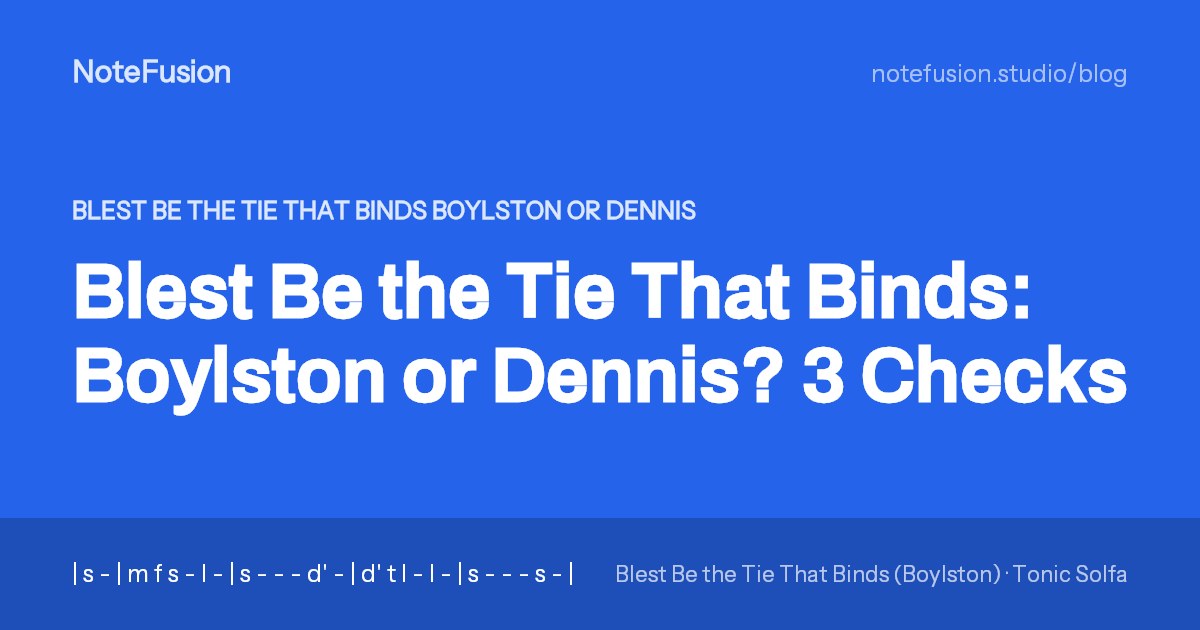
| sBlest- | mbefthestie-lthat- | sbinds---d'Our- | d'heartstinlChrist--lian- | slove;---sThe- |
What to notice:
- It starts on a pickup soh. "Blest" comes before the first full bar, so the choir must breathe and come in on the upbeat, not on beat one.
- The line rises step by step. "Be the tie that" runs m f s l, then "binds" rests on soh.
- "Our hearts" lands on high doh, d'. This is the peak of the opening, and in C major that is the C at the top of the treble stave. It is the note that tells you instantly you are in Boylston.
- It walks back down. "In Christian love" comes down d' t l l to soh.
Every syllable gets one note, which makes Boylston easy to fit to the words. The site's Boylston page is short, nine bars, so it moves along and the verses pass quickly.
Dennis in solfa: circling around doh
Now the first five bars of Dennis, in G major with doh on G, also in 3/4.
| mBlest- | mbe-d_-mthe- | rtie-t,_-rthat- | dbinds---dOur- | dhearts-l,_-din- |
What to notice:
- It starts on me, not soh. The pickup is a single me, and the tune stays close by, moving m d m.
- It goes below doh. In the second full bar the line drops to t, (the comma under the t means the t below doh), and two bars later to l,. Basses and altos will feel at home here; sopranos may find it lower than they are used to.
- It leans on doh. Bar four is a held doh, and bar five turns around doh again. The whole opening hugs the keynote.
- Some syllables carry more than one note. Count the notes against "Blest be the tie that binds Our hearts in" and you will find more notes than syllables, so check the slurs in your book and teach where the words move.
The NoteFusion page for Dennis runs to fourteen bars against Boylston's nine, so it feels more spacious and unhurried. If you want to see how the alto, tenor and bass lines are built under this melody, my post on how to harmonise a hymn in four parts with solfa works through Dennis chord by chord.
How do you tell which tune a hymn book uses?
Look for the tune name printed above or beside the hymn, usually in capitals, often with the metre (SM or 6.6.8.6) next to it. If it says BOYLSTON or DENNIS, you are done.
If the name is missing, or your book prints only solfa, use the first line:
- Find doh. In an older solfa hymn book the key is printed at the top, for example "Key C" or "Doh is G". If you are not sure how to read those marks, see how to read solfa in a hymn book.
- Read the first syllable. A soh pickup points to Boylston; a me pickup points to Dennis.
- Look for the high or low turn. An apostrophe mark (d') within the first two bars after the pickup means you are climbing to high doh: Boylston. Commas under the notes (t, or l,) early on mean the tune is dropping below doh: Dennis.
In staff notation, the same check works by shape: a line that rises to the top of the opening phrase is Boylston; one that wanders around the bottom of its range is Dennis.
How do you tell which tune a recording uses?
Listen to the word "hearts" in the first verse. If it is the highest, brightest note of the opening, you are hearing Boylston. If the singers sit low and the melody seems to circle without climbing, it is Dennis.
A few more clues for when you are learning from a video someone sent you:
- Sing doh with the recording. Once you can hum the home note, ask whether the first syllable sits a fifth above it (soh, Boylston) or a third above it (me, Dennis).
- Watch for slurs. If singers stretch a single word over two notes in the first line, that points to Dennis.
- Check the length. Boylston's verse is noticeably shorter.
Recordings are often in different keys from your book, so do not judge by the starting pitch. Judge by shape.
Blest Be the Tie That Binds, Boylston or Dennis: which should your choir learn?
Here is how I weigh it up for a choir and a congregation.
| Boylston | Dennis | |
|---|---|---|
| Key on NoteFusion | C major, doh is C | G major, doh is G |
| First note | soh (pickup) | me (pickup) |
| Shape of first line | climbs to high doh on "Our hearts" | falls to doh, dips to t, and l, |
| Words to notes | one note per syllable | some syllables slurred over two notes |
| Feel | bright, lifting, moves along | warm, low, unhurried |
| Best for | a confident congregation, a joyful farewell | an older or tentative congregation, a quiet close to a service |
My advice, in order:
- Sing what the congregation knows. A choir can learn either tune in one rehearsal; a congregation cannot. If your people have sung Dennis for years, a surprise Boylston will leave them listening instead of singing.
- Match the book in the pews. If the pew book prints Boylston, teach Boylston, even if your choir folder has Dennis.
- If neither is known, choose by the occasion. Dennis suits a reflective moment, such as the end of a communion service or a farewell where people are emotional. Boylston suits a celebration where you want the sound to lift.
- Never switch tunes between verses. Agree one tune with the organist or keyboard player before rehearsal starts.
Keys for the congregation and the parts
The ranges pull in opposite directions, so the key question is different for each tune. For the full method, read how to choose the right key for your choir; here is how it applies to these two.
Boylston reaches high doh early. In C major that peak is a top C. For a congregation that sings quietly in the morning, try B flat: the pickup soh becomes F and the high doh becomes B flat, which most untrained voices reach without forcing.
Dennis goes down to l, early. In G major, with doh on G above middle C, that low l, is the E just above middle C, which is fine for most people. If your sopranos sound muffled, raise it to A major so the tune brightens and the low l, becomes F sharp. Avoid going lower than G, because the melody starts to sink into the range where untrained trebles lose their tone.
For the parts: in Boylston, watch that the altos are not pushed too high under that high doh, and check that tenors are comfortable at the peak of the phrase. In Dennis, the basses will be singing well below the low l, of the melody, so make sure they are not growling at the bottom of their range in a lowered key.
A 20-minute plan for tonight's rehearsal
- Two minutes: confirm the tune. Play the first line of the tune your pew book prints. Hold up the book and say the name: "This is Dennis."
- Three minutes: sing the scale. Sing d r m f s l t d' and back, then add the low notes t, and l, if you are doing Dennis, or the step from soh to high doh if you are doing Boylston.
- Five minutes: melody on solfa. Everyone sings the first line on syllables, then on words. For Boylston, practise the pickup entry on "Blest" until the whole choir comes in together. For Dennis, mark the slurs and sing them on "lah" first.
- Five minutes: parts. Sopranos and tenors on the melody, altos and basses on their lines, then swap who listens.
- Five minutes: all verses together. Sing straight through at the speed you will use on Sunday, and agree where to breathe: at the end of each six-syllable line, with a shorter catch inside the eight-syllable line if needed.
If someone has sent you a recording and you cannot tell which tune it is, or it is in a key that suits nobody, NoteFusion can help. Paste the YouTube, Spotify or Apple Music link, or hum the first line, and it writes the melody in movable-doh Tonic Solfa with staff notation, plays it back slower or looped, and "Transpose for my choir" shows whether each part sits comfortably in a new key. Try it at /app.
Frequently asked questions
What is the difference between Boylston and Dennis?
They are two different melodies for the same Short Metre words. Boylston opens on a low soh and climbs to high doh in its first line. Dennis opens on me, falls to doh and dips below it to t, and l,, so it sits lower and closer around home.
Which tune for Blest Be the Tie That Binds is easier for a congregation?
Dennis usually feels easier because it moves mostly by step close to doh. Boylston is just as singable but asks for a confident climb to high doh in the first line. The easiest tune, though, is the one your congregation already knows.
How do I know which tune my hymn book uses?
Look for the tune name printed above or beside the hymn, often in capitals: BOYLSTON or DENNIS. If no name is printed, check the first notes: a rise from soh up to high doh is Boylston, while a start on me that drops to doh is Dennis.
Can I sing Blest Be the Tie That Binds to another tune?
Yes. The words are in Short Metre (6.6.8.6), so any Short Metre tune your congregation knows will fit. Tell the organist and the choir well in advance so nobody starts the wrong melody.
What key should my choir sing Boylston and Dennis in?
The NoteFusion pages give Boylston in C major and Dennis in G major. If Boylston's high doh strains your congregation, try B flat; if Dennis feels low and murky, try A major.