Choir Diction Tips for Clear Words: 3 Drills on One Hymn
Choir diction tips for clear words: three short drills on the opening of Amazing Grace for final consonants, matched vowels and clean breaths.
Your choir has learnt the notes, the parts are secure and the sound is warm, yet after the service someone says kindly, "That was lovely. What were the words?" The tune reached the back of the church. The text did not.
Choir diction tips for clear words come down to three habits: put every final consonant in the same place at the same time, shape each vowel the same way across each section, and plan breaths so they fall after a word ends, never inside it. Drill all three on one familiar opening line and the whole repertoire improves.
In this post I take the opening of Amazing Grace and turn it into three short drills you can run at your next rehearsal: final consonants together, matched vowels, and breath placement that does not chop words in half. Then I show how to carry the same habits into a second hymn so they stick.
Why can't the congregation understand my choir?
Usually it is because twenty people are saying the same word at twenty slightly different moments. One soprano puts the "t" of "sweet" early, a tenor puts it late, the altos leave it off altogether, and what reaches the congregation is a blur of vowel with a scatter of hiss and tap around it.
There are three usual culprits:
- Ragged final consonants. The ends of words carry much of their meaning. "Grace", "great" and "grade" share a vowel; only the last sound tells them apart.
- Mismatched vowels. If half the altos sing a bright "ay" and half a dark "eh", the vowel loses its shape and the word stops sounding like a word.
- Breaths in the wrong place. A singer who runs short of air snatches a breath mid-phrase, often inside a word or between an article and its noun, and the sentence falls apart.
None of this needs more volume. A choir singing softly with tidy consonants is easier to follow than a loud one without them.
Got a recording? Get it in solfa →
Choir diction tips for clear words: the three habits on one line
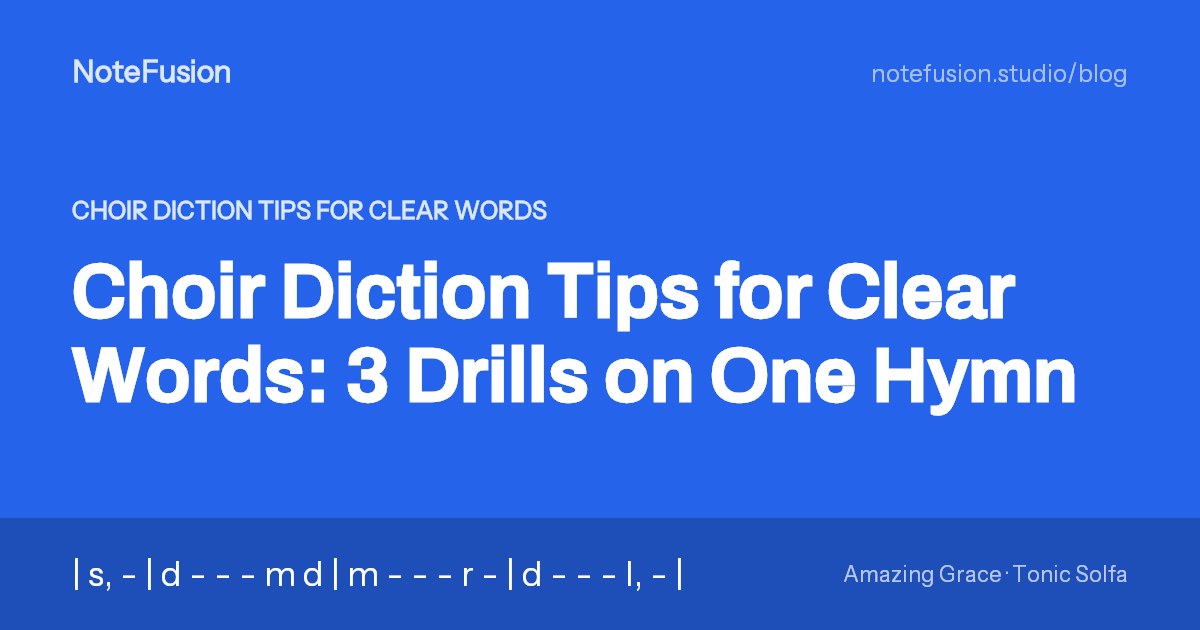
Here is the opening of Amazing Grace in G major, where doh is G. You can find the full hymn on our Amazing Grace in Tonic Solfa page.
| s,A-- | dmaz----mingd_ | mgrace!---rhow- | dsweet---l,the- | s,sound,---s,That- |
This short stretch is ideal for diction work. Everyone knows it, so nobody is busy reading notes. It contains a word ending in a hissed consonant ("grace"), one ending in a sharp stop ("sweet"), one ending in a voiced cluster ("sound"), two vowels that slide (the "ay" of "grace" and the "ow" of "sound"), and a pickup word, "That", which forces you to decide where the breath goes. Every word that matters also falls on a held note, so the faults are easy to hear.
Notice the shape in the solfa: "sweet" settles on doh and "sound" drops to low soh, s,. Low notes swallow words easily, which is exactly why this line repays the work.
Drill 1: Final consonants in choir singing, all together
Consonants in choir singing work best when the director decides exactly where each one lands, and the whole choir agrees.
- Speak the line in rhythm. No pitch. Have the choir speak "Amazing grace, how sweet the sound" in the time of the hymn while you tap the beat. Listen only to the ends of "grace", "sweet" and "sound".
- Fix the moment. For each held word, the final consonant goes on the beat that follows the held note: the "s" of "grace" lands as "how" begins, the "t" of "sweet" lands as "the" begins. Tell the choir, "the consonant belongs to the next beat". This stops early closing, which shortens the vowel and muddies the pitch.
- Whisper it. Whisper the line with exaggerated consonants. Whispering removes the comfort of tone, so every late or missing "t" is obvious. Pick out one section at a time if you need to.
- Sing it on one note. Have everyone sing the line on doh, keeping the consonants exactly where you placed them in step 2. Pitch does not change, so attention stays on the words.
- Sing it as written. Now sing the five bars from the solfa. Stop the moment a consonant scatters and repeat just that word.
Two details make a big difference. First, "s" travels a long way, so keep it short; one tidy hiss is plenty. Second, the "t" of "sweet" is followed by the "th" of "the". Singers often merge them into a mumble. Ask for a clear, light "t", a tiny separation, then the "th". Practise "sweet / the" slowly three or four times until it sounds like two words.
Drill 2: Matched vowels on "grace", "sweet" and "sound"
This is where diction meets blend, and the work overlaps with how to blend voices in a choir. A matched vowel is clearer because the word arrives as one shape rather than several.
The vowel that slides: "grace"
The vowel in "grace" is a diphthong: it starts open, close to "eh", and closes towards "ee". If singers move to the "ee" early, the held note turns thin and pinched, and each singer slides at a different time.
- Sing "grace" on a single held note, staying on the open "eh" part for almost the full length.
- Add the "ee" only in the last instant, immediately before the "s".
- Conduct the change: a small closing gesture with your left hand shows everyone when to move.
The vowel that drops: "sound"
"Sound" also slides, from "ah" towards "oo". On low soh this matters even more, because a closed "oo" sung low loses its carrying power. Hold the "ah", close to "oo" at the very end, then place the "nd" together. The "n" is voiced, so it can be sung on pitch for a moment; the "d" is a light tap on the next beat.
The vowel that stays: "sweet"
"Sweet" has a long "ee" that tends to spread and become shrill on doh. Ask singers to keep a little space inside the mouth, as if starting to say "ih", while still thinking "ee". The word stays clear but loses its edge.
A quick test: let each section sing "grace" in turn while the others listen. Then sing it together. If one section sounds different, it is almost always the timing of the slide, not the vowel itself.
Where should a choir breathe so words are not cut?
In the opening of Amazing Grace, the breath goes at the end of the held note on "sound", not before "That" in a gap of its own and certainly not between "That" and "saved". The time for the breath is taken out of "sound", so the pickup "That" still comes in on time.
This is the general rule for breath placement:
- Breathe at punctuation, after the final consonant. Finish the word fully, including its "nd" or "s", then breathe.
- Take the time from the long note before the breath, not from the pickup after it. If "sound" is two beats long, sing it for slightly less and breathe in the space left.
- Never breathe between a pickup and the word it leads to. "That" belongs with "saved". "The" belongs with "sound". Joining them keeps the sense of the sentence.
- Mark breaths in the copy. Ask everyone to pencil a tick after "sound". Shared marks mean shared breaths, and shared breaths mean nobody cuts a word on their own.
There is no need to breathe after "grace" in this line; the exclamation mark is a shape in the voice, not a gap. If some singers genuinely cannot reach "sound" on one breath, let them stagger: drop out briefly on "how" and rejoin on "sweet", while their neighbours carry on. The words stay unbroken because the choir as a whole never stops.
Carrying the habits into a second hymn
Once the opening of Amazing Grace is tidy, test the same three habits on a different line so they become reflexes rather than a one-hymn trick. The opening of O God, Our Help in Ages Past is a good partner, in C major with doh on C.
| sO- | mGod,-lour-shelp-d'in- | d'a--tges-d'past,-sOur- |
Run the same checklist:
- Final consonants: "God" ends in a voiced "d", "help" in an "lp" cluster, "past" in "st". Place each one on the next beat, together. "Help in" is a trap: singers tend to slur it into "hel-pin". Ask for a small lift between the words.
- Vowels: "O" is the first sound of the hymn. Agree a pure, open "oh" and start it together, with no scooped entry. The "a" of "ages" is the same sliding vowel as "grace", so the work you did there applies directly.
- Breaths: the comma after "past" is the breath point, with time taken from that held note so the pickup "Our" joins straight on to the next line.
If the choir manages the second hymn without reminders, the habit has taken hold.
Choir pronunciation exercises for a ten-minute rehearsal slot
You do not need a separate diction session. Fold ten minutes into the structure you already use; my choir rehearsal tips post shows where a short focused slot fits in a full evening.
- Two minutes: consonant warm-ups. Fast, light patterns on "t", "d", "k" and "s" wake the tongue and lips. You can add these to your usual vocal warm-ups for choirs.
- Two minutes: speak the Amazing Grace opening in rhythm, then whisper it.
- Three minutes: sing it on one note, then as written, section by section for the vowels on "grace" and "sound".
- Two minutes: mark the breath after "sound" and sing the full first verse with it.
- One minute: apply the same three checks to one line of whatever hymn you are preparing for Sunday.
That last step is the one that matters. These are general choir diction tips for clear words, but they only reach the congregation when they are applied to the hymn on the service sheet.
A final point for directors: listen from the back of the room at least once during the slot, or ask a friend to stand there. Words that sound crisp from the conductor's stand can still blur at the back, and only that distance tells you whether the consonants are truly together.
Practising diction at home between rehearsals
Singers who practise alone can check their own diction by listening closely to the line at a slower speed. NoteFusion plays any melody back on a piano, slower or looped, so a chorister can loop the five bars of Amazing Grace and practise placing "grace", "sweet" and "sound" against a steady pulse until the consonants land exactly on the beat.
If you are learning a new song from a recording and want the melody written out in Tonic Solfa with staff notation, so you can mark breaths and consonant placements on the sheet before rehearsal, you can hum it, upload it or paste a link in NoteFusion and share the result with your choir.
Frequently asked questions
How do you make choir words clear to the congregation?
Place final consonants together on an agreed beat, sing the same pure vowel across each section, and plan breaths so they fall after a word has finished. Rehearse these on one short phrase until they become habit.
Should a choir sing final consonants louder?
Crisper rather than louder. A short, light consonant placed at exactly the same moment by everyone carries further than a heavy one that each singer places at a slightly different time.
How do choirs sing diphthongs like the vowel in 'grace'?
Hold the first, open part of the vowel for almost the whole note and add the closing sound only at the very end, just before the consonant. Everyone should move to that closing sound together.
Where should a choir breathe in Amazing Grace?
In the opening line, take the breath from the end of the held note on 'sound', so that 'That' comes in on time and joins straight on to 'saved'. Never breathe between 'That' and 'saved'.
What are good choir pronunciation exercises for a short rehearsal?
Speak the text in rhythm, whisper it with exaggerated consonants, sing the opening phrase on one note with the words, then sing it as written. Five to ten minutes on one familiar hymn is enough to hear a difference.
Why do the words get lost when my choir sings softly?
Quiet singing often softens the consonants along with the tone. Keep the consonants just as precise at a soft dynamic, and let the vowels carry the reduced volume.