What to Do When Your Choir Has No Tenors: 3 Fixes
What to do when your choir has no tenors: compare low altos, high baritones and an SAB rewrite on one hymn, and see which tenor notes to swap.
The tenor row is empty again, the Sunday hymn is printed in four parts, and your two men wince at anything above middle C. So, what to do when your choir has no tenors? Give the tenor line to your lowest altos, give it to your highest baritones, or rewrite the hymn in three parts (SAB). Keep the written tenor notes where you can, and change only the few that fall outside the new singers' range.
Leaving the tenor line out makes the harmony sound thin and hollow. Asking a bass to sing it as written makes him strain. Neither is a real answer.
This article tests all three fixes on one hymn, O God, Our Help in Ages Past in C major. You will see where each fix works, which tenor notes to swap when the line goes too low for altos or too high for baritones, and a short rehearsal plan you can use this week.
What to do when your choir has no tenors: pick the right fix
No single fix suits every choir with no tenors. The deciding question is who you actually have:
| Your singers | Best fix | What you will need to change |
|---|---|---|
| Several altos with solid low notes | Low altos on the tenor line | The lowest tenor notes |
| Two or more men who are not deep basses | Baritones on the tenor line | The highest tenor notes |
| Very few men, or a thin alto section | SAB rewrite | Which part covers the essential chord notes |
If you are not sure which voices you have, SATB parts explained sets out the usual ranges for each part. In short, a tenor line often sits roughly between the G below middle C and the F or G above it. A comfortable low alto starts around that same G, and a baritone usually tops out around E or F above middle C. So altos lose the bottom of a tenor line and baritones lose the top. The rest of this article is about handling those two edges.
Got a recording? Get it in solfa →
The test hymn: O God, Our Help in Ages Past in C major
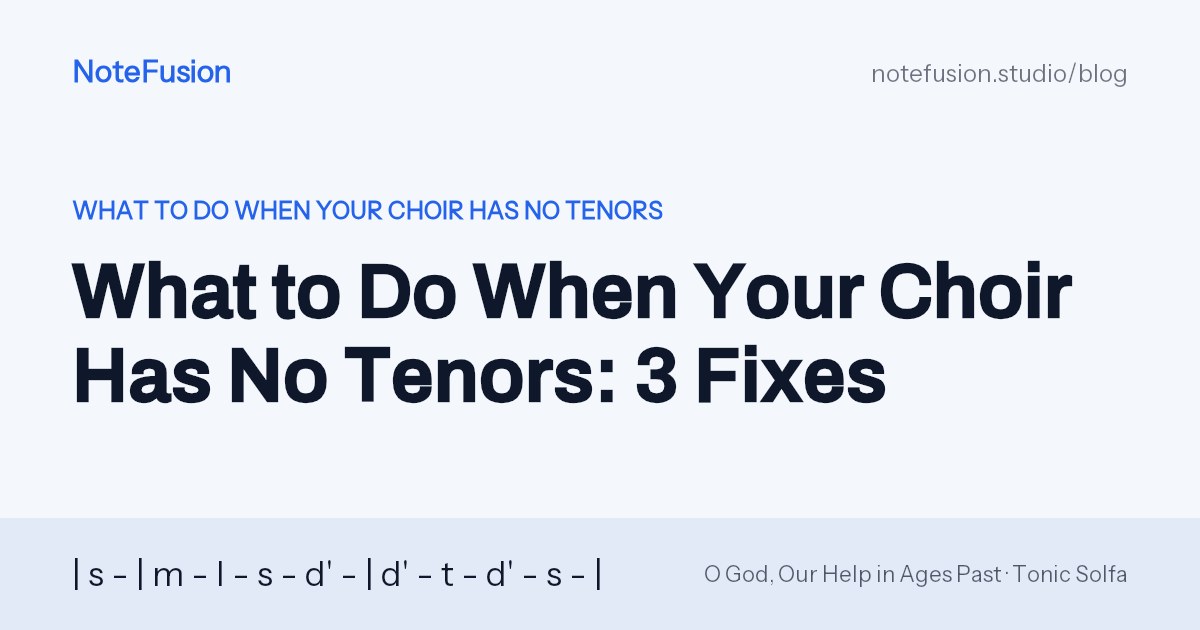
I have chosen O God, Our Help in Ages Past because nearly every congregation knows it and its harmony is plain. C major also makes the arithmetic easy, because doh is C. Here is the opening of the melody:
| sO- | mGod,-lour-shelp-d'in- | d'a--tges-d'past,-sOur- |
The soprano climbs to high doh on "past". Under a tune like this, a tenor line generally moves around middle doh, dipping towards soh below and rising towards me or fah above. To judge a tenor note quickly, you need to know which letter name each syllable is:
| dC-rD-mE-fF- | sG-lA-tB-d'C- |
In this key, middle doh is middle C. So for the tenor line in C major:
- s, and below (G and lower, under middle C) is the danger zone for altos.
- m and f above middle doh (E and F) are a stretch for most baritones, and s (G) above middle doh is usually too high.
- Everything between is shared ground that both groups can sing.
Go through the tenor line with a pencil before rehearsal. Circle any note at s, or lower, and box any note at m or higher above middle doh. Those marks are your whole list of problems. In most hymns it is only a handful of notes.
Can altos sing the tenor part?
Yes, for most of the line. Altos singing the tenor part works best when you have at least two or three altos with a firm bottom to their voices. That way your remaining altos can still cover their own part. Sing the tenor notes at written pitch, not an octave up, so the chord keeps its shape.
The drawback is tone. Much of a tenor line lies in the lowest part of an alto voice, where the sound gets breathy and quiet. Seat the altos singing tenor close to the piano or organ, and ask them for a bright "ah" vowel rather than a dark, swallowed one so the line carries.
Which notes to swap when the line goes too low
For each circled note (s, or lower), try these in order:
- Move it up an octave. A low s, becomes the s above middle doh. The chord keeps exactly the same notes, so the harmony survives. Check the jump into and out of it. If it creates a leap of more than a sixth, try option 2.
- Move it to another note of the same chord. If the chord is the doh chord (doh, me and soh) and the tenor has a low soh, take me or doh above it instead. Doubling doh or soh is safe. Doubling me sounds slightly thicker but works.
- Never double te. If the chord is the soh chord at a cadence and another voice already has te, do not give te to the altos singing tenor as well. Two voices on te pull the harmony out of balance. Choose soh or ray instead.
The most common trouble spot is the final cadence, where tenor lines often sink to a low note. One octave lift there often solves the whole hymn.
Can baritones sing the tenor line?
Often, and it sounds more like a real four-part choir than altos do. Baritones singing tenor give the line a male colour, and that matters most in the middle of the chord. The catch is that most tenor lines contain a few notes above a baritone's easy top. Those notes come out strained, sharp or shouted.
This fix needs at least two men: one on bass, one or more on tenor. If you only have one man, he belongs on the bass line. Without a bass, the harmony loses its foundation.
Which notes to swap when it goes too high
For each boxed note (m or above, above middle doh):
- Move it down an octave, but first check the bass note sounding at the same moment. If your new tenor note lands on or below the bass, you have turned the chord upside down. Basses carry the root, and the chord must keep it at the bottom.
- If the octave clashes with the bass, take a lower chord note. A high soh in the doh chord can become me or doh just below. A high fah in the soh-seven chord can become ray or te, as long as te is not already sounding in another part.
- Keep held notes and repeated notes together. If the tenor holds a note across a tie or repeats it, move the whole group, not just the first note. Otherwise the line jumps about for no reason.
- Sing it through slowly with the bass. Two lines moving close together can drift into parallel octaves when you lower notes. If the baritones and basses suddenly sound like one line, change one of the notes to a different chord member.
The principle behind all of this is the same one you would use when writing parts from scratch. If you want to understand which chord notes can be doubled and which cannot, how to harmonise a hymn in four parts with solfa walks through it with three chords.
Fix 3: rewrite the hymn as SAB
When you have very few men, stop trying to cover four lines. SAB means soprano, alto and baritone. The men sing one line, built mostly from the bass part. Three well-sung parts sound fuller than four parts with one barely there.
Here is how to build the baritone line and decide what happens to the tenor's notes:
- Start from the bass line. Copy it out. Where it dips lower than your men can sing, move the note up an octave. Use the same rule as before: lift whole phrases rather than single notes where you can.
- Check each chord for its third. A chord needs its root and its third to sound complete. The fifth can go missing without anyone noticing. In the doh chord, doh is the root and me is the third. In the soh chord, soh is the root and te is the third.
- If the tenor was the only voice with the third, give that note to the altos. Usually the soprano or alto already has it, and the tenor note can simply disappear.
- Keep any chromatic note. If the tenor has a fe or a ta, it is there for a reason, often a passing key change. Give it to whichever of the alto or baritone can reach it.
- Protect te at cadences. Before a final doh chord, te should be heard in some part. If only the tenor had it, move it to the alto.
SAB takes the longest to prepare, perhaps a single evening with the score. But your men only have one line to learn, and they will sing it with confidence.
Does changing the key help a choir with no tenors?
Sometimes. Lowering the key helps baritones on the tenor line because every high note comes down. But it hurts altos singing the tenor part, and it pushes your basses lower too. Here is the same opening a whole tone down in B flat:
| sO- | mGod,-lour-shelp-d'in- | d'a--tges-d'past,-sOur- |
The solfa does not change, and that is the advantage of movable doh. Only the letter names move. In B flat, a tenor fah becomes E flat instead of F, which is easier for a baritone. But the bass's low notes drop by the same amount. Before you settle on a key, check every part, not just the one causing trouble. How to choose the right key for your choir shows how to weigh the top and bottom of each section. How to transpose a song covers telling your organist or pianist the new key.
My advice is to combine the fixes. Lower the key a tone so the baritones can manage the tenor line, then swap only the one or two notes that are still out of reach. Lowering the key alone rarely solves everything.
A plan for your next rehearsal
You do not need a full evening. Twenty minutes inside a normal rehearsal will do:
- Before rehearsal (at home): mark the tenor line with your circles and boxes. Decide which fix fits the singers you actually have. Pencil the swapped notes into one master copy.
- Minutes 1 to 5: sing the melody together on solfa so everyone hears where doh sits.
- Minutes 5 to 10: teach only the new tenor line, whoever is singing it, on solfa and slowly. Spend most of the time on the swapped notes, because those are the ones the singers will instinctively get wrong.
- Minutes 10 to 15: put the new tenor line with the bass. This is where clashes show up. Fix any note that crosses below the bass.
- Minutes 15 to 20: sing all parts on words, one verse only. Listen for whether the middle of the chord is now filled.
Write the swapped notes clearly on the copies you hand out. A singer reading the original printed part will go back to the old note under pressure. Once one hymn works, you will know what to do when your choir has no tenors on every hymn that follows: mark the edges, choose the fix, swap the few notes.
If you are working from a recording rather than a printed hymn, NoteFusion will write the melody in Tonic Solfa with staff notation. Its "Transpose for my choir" option moves doh and shows whether each part sits comfortably, so you can see at a glance whether a lower key frees up your baritones before you start swapping notes.
Frequently asked questions
What can a choir do if it has no tenors?
Give the tenor line to low altos, give it to baritones, or rewrite the hymn as SAB. Whichever you choose, change only the few notes that fall outside the new singers' range.
Can altos sing the tenor part?
Yes, for most hymns. Lower altos can sing the tenor line at written pitch where it sits around middle doh. Where it drops much below that, move those notes up an octave or onto another note of the same chord.
Can baritones sing the tenor line?
Often, yes. Baritones manage the lower half of most tenor lines comfortably. The high notes need moving down an octave or onto another chord note. Check that the new note does not land on or below the bass.
What is SAB arrangement?
SAB means soprano, alto and baritone: three parts instead of four. The men sing a single line built mainly from the bass part. Any tenor note the harmony cannot do without moves to the altos.
Does lowering the key help a choir with no tenors?
It helps baritones on the tenor line, because the high notes come down. It makes things harder for altos singing the tenor part and for basses on their lowest notes, so check every part before you change the key.