Christmas Carol Rehearsal Plan for Choir: 4-Week Guide
A comprehensive 4-week Christmas carol rehearsal plan for church choirs. Choose carols, learn solfa parts, and get every section ready for Sunday.
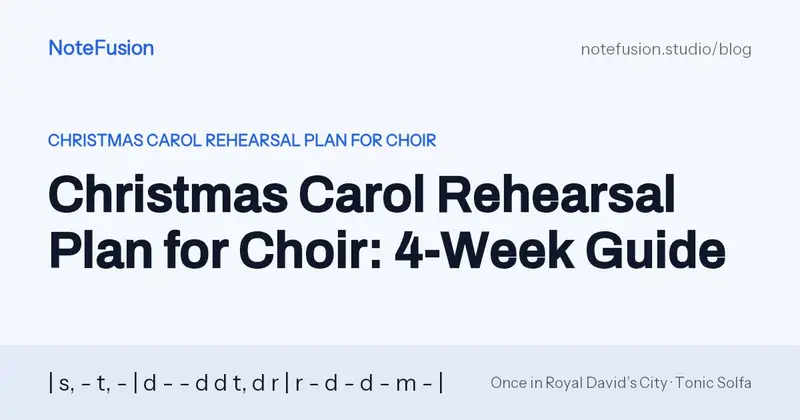
When you have about four weeks before the carol service and your choir is facing a stack of unfamiliar music, a solid Christmas carol rehearsal plan for choir is the only thing standing between a peaceful evening and Sunday panic. As a church musician who works with volunteer singers every single week, I know how quickly December fills up. You need a practical, week-by-week roadmap that gets every voice part ready without burning people out or causing unnecessary frustration during precious rehearsal hours.
Over the next four weeks, we will move from picking the right arrangements to learning tunes in solfa, drilling the inner parts, and putting everything together for a polished service. If you are looking for specific repertoire to fill your programme, take a look at our collection of Christmas carols in Tonic Solfa to find public-domain favourites that your choir will love.
Week 1: Choosing Your Carols and Setting the Keys
How do you choose carols that stretch your choir just enough without breaking them? Start by looking at your singers, not the page. Assess your balance: do you have a booming soprano section but only one nervous tenor? Pick carols with sensible ranges, and do not hesitate to transpose music down if the melody sits too high for an ordinary Sunday voice. During your first rehearsal, hand out the sheet music and establish your foundational pieces. For instance, when you introduce a steady traditional setting, getting the opening intervals right from the very first beat sets the tone for the entire month.
| s,Once-t,in- | droy---daldDa-t,_dvid’sr_ | rcit--dy-dStood-ma- |
Spend forty minutes of this first session reading through your core selections in movable-doh Tonic Solfa. When singers see the syllables instead of drowning in ledger lines on a staff, they grasp the shape of the tune immediately. Point out where the phrases breathe and where the high notes sit so there are no nasty surprises later. Encourage everyone to mark their breath points with a soft pencil so they maintain a consistent line throughout every verse.
Got a recording? Get it in solfa →
Week 2: Mastering the Tunes and Conquering Pickups
Why do choirs rush their entries on complex carol syncopations? Usually because the pickup notes are muddy. In your second week, focus entirely on the rhythm and the anacrusis of each piece. Whether you are tackling a gentle lullaby or a rousing hymn, every section needs to know precisely which beat they launch on. Take a familiar verse and clap the rhythm together before you sing a single note, ensuring that colons and half-beat dots are crisp and uniform across all four voice parts.
| sAn--mgels- | d'from-sthe-m'realms--r'of | d'glo--sry,-lWing-lyour- |
Encourage your choristers to use home practice resources between rehearsals. When singers can listen to slow playback and follow their specific line at home, rehearsal time is spent polishing ensemble blend rather than teaching basic notes from scratch. If a melody line twists through accidental sharps or unexpected leaps, isolate those exact bars and drill them slowly until the pitch memory is rock solid.
Week 3: Sectional Rehearsals for Inner Parts
How do you fix a wandering alto line or a tenor section that keeps slipping back into the melody? Split your forces into sectional groups for twenty minutes during your third rehearsal. Put the altos in one corner with a confident leader, and gather the tenors and basses in another. This is the moment to sort out tricky harmonies, especially in pieces like Silent Night, where inner voices must hold still while the melody floats above them.
| sSi---llentsnight,- | m_----- | sho---llysnight,- | m_----- |
Work through the harmony bar by bar. Have the altos sing their exact solfa syllables against a quiet piano drone or a sustained soprano note. Once each section can hold its own line without leaning on the rest of the room, bring everyone back together for a full- choir run-through. Pay special attention to the transition points where parts divide or rejoin, as these are the exact spots where singers tend to lose confidence.
Week 4: Putting It All Together and Polishing Dynamics
By the fourth week, the notes should be firmly in everyone's heads, which means you can finally focus on musicality. Too many carol services suffer from shouting because choirs treat every verse as fortissimo. Spend this rehearsal mapping out your dynamics. Decide where the sound drops to a whisper on a quiet verse and where it opens up for a triumphant refrain. Practice smooth breath control so phrases do not get chopped up in the middle of a word.
Run through the entire order of service from start to finish without stopping for minor errors, building the endurance your choir will need on the big night. Remind them to watch your beat patterns, especially on fermatas and sudden tempo changes. If you need a simple way to generate clean rehearsal sheets and practice tracks for your volunteers before this final week, you can always transcribe a song or paste a link into NoteFusion to get instant Tonic Solfa and staff notation for your exact choir voicing.
Frequently asked questions
How many weeks before the carol service should we start rehearsals?
Four weeks is the ideal window for a church choir. It gives you enough time to introduce new music, drill individual parts, and polish the performance without exhausting your singers.
What is the best way to handle weak tenor sections during Christmas carols?
If your tenors are few or stretched by high ranges, you can reinforce them with alto notes or use simplified SATB arrangements. Sharing clear solfa sheets and dedicated part tracks ahead of rehearsal also helps tenors practise with confidence at home.
How should I structure a 90-minute carol rehearsal?
Spend the first ten minutes on vocal warm-ups using solfa scales. Dedicate the next forty minutes to learning new repertoire phrase by phrase, spend thirty minutes running through familiar carols, and use the final ten minutes for polishing dynamics and endings.
How do I help volunteers who cannot read staff notation?
Use movable-doh Tonic Solfa alongside staff notation. Syllables like doh, ray, and me make intervals instantly clear, allowing volunteers to learn tunes quickly from recordings or simple handouts.