Descant for Christmas Carols: A Soprano's 3-Step Guide
Learn how to add a descant for christmas carols at your carol service. Find doh, master the high harmony, and lead the congregation.
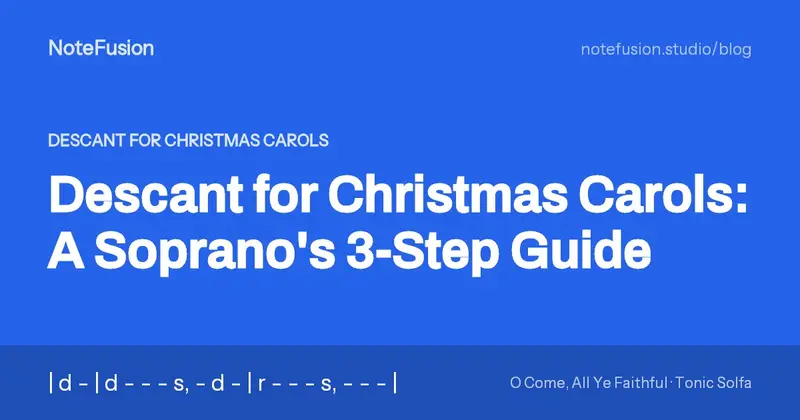
The carol service is on Sunday, the nave is packed, and the director turns to the sopranos with a smile and hands out a sparkling descant for the final verse. Panic sets in because the high notes look dizzying and rehearsal time has vanished. Adding a descant for christmas carols is one of the most thrilling parts of a church choir's December, provided your sopranos know how to climb the Tonic Solfa scale without losing their footing.
Whether you are preparing for a candlelit service or planning your seasonal music using our carol service songs list, mastering a soaring descant relies on a practical routine. Let us break down what a descant is, which carols take one best, and how your choir can nail the high harmony before Sunday.
What is a descant and which carols take one?
A descant is an independent high melody sung by the sopranos above the main hymn tune during the final verse. Traditionally, choirmasters reserve this treat for the grand finale of a carol, allowing the congregation to belt out the familiar melody while the upper voices weave a shining counter-melody.
The two carols that take a descant most naturally are O Come, All Ye Faithful and Hark! The Herald Angels Sing. Both have sturdy, block-chord structures in their middle verses that make an aerial soprano line sound magnificent.
| dO- | dcome,---s,all-dye- | rfaith----s,ful,--- |
| s,Hark!-dthe-dher---t,ald | dan--mgels-msing-r_- |
For more seasonal inspiration, browse our full collection of Christmas carols in Tonic Solfa to see how different arrangements sit on the page.
Got a recording? Get it in solfa →
How do you find doh before learning the descant?
Before any soprano attempts a high note, you must anchor your ears by finding doh. If your carol is set in G major, doh is G. If it is in F major, doh is F. Never jump straight into the top octave without establishing the home note first.
Have your sopranos hum the tonic triad—doh, me, soh, doh—to settle their pitch. When reading from Tonic Solfa, high notes above the upper octave will feature an apostrophe mark, such as d' or m', telling you exactly how far up the staircase you are stepping.
Step 1: Sing the main tune first
My golden rule for choir directors is simple: never teach a descant until the choir can sing the main hymn tune from memory. If your sopranos do not have the primary melody in their ears, the high harmony will pull them off pitch.
Spend ten minutes drilling the standard melody using simple solfa syllables. For instance, when working on familiar seasonal settings, make sure every section is secure before anyone looks at the upper harmony line. If you need to check ranges or transpose a piece into a more comfortable key for your volunteers, you can paste your sheet music or audio link into NoteFusion to generate clean Tonic Solfa instantly.
Step 2: Map the high intervals in Solfa
Once the main tune is secure, isolate the descant line and speak the solfa rhythm out loud before singing a single note. Descants often feature wider leaps than the standard melody, moving from soh up to high doh' or leaping down to minor notes.
Clap the beat while reading through the high phrases slowly. If a particular bar feels slippery, isolate those three notes and loop them until the muscle memory locks in. Slow practice prevents the dreaded sharp pitch drift that happens when sopranos strain to reach high notes.
Step 3: Layer the descant against the melody
Now comes the real test: putting the parts together. Split your sopranos. Ask half the section to hold the main melody firmly while the other half sings the descant against them.
This exercise builds inner ear independence. If the descant singers drift toward the tune, stop, reset your starting doh, and try again. Once both halves are confident, have the altos, tenors, and basses join in on the main hymn while your sopranos lift the descant above the entire room.
Step 4: Keep the tone light so the congregation leads
The biggest mistake a soprano section can make on a descant is forcing the tone. When singers shout high notes, the choir overwhelms the congregation, turning a congregational carol into a performance.
Remind your sopranos to keep their vowels round, their breath support steady, and their volume floating. Think of the descant as light falling through stained glass—it should shimmer above the congregation, letting every man, woman, and child in the pews lead the main song with confidence.
To turn your seasonal preparation into a smooth weekly routine, take a look at our Christmas carol rehearsal plan for choir and get every section ready.
If you have a recording of a gorgeous descant arrangement on YouTube or Spotify that your choir loves, but you only have it in staff notation or audio, you don't have to transcribe it by hand. Head over to NoteFusion to turn any tune into clear Tonic Solfa and staff notation in seconds.
Frequently asked questions
Which Christmas carols traditionally take a descant on the last verse?
O Come, All Ye Faithful and Hark! The Herald Angels Sing are the two most traditional carols for a soprano descant on the final verse during a carol service.
How do I find doh for a Christmas carol in Tonic Solfa?
Look at the key signature or check the opening note. In F major, doh is F. In G major, doh is G. Every movable-doh note builds outward from that home pitch.
Should the sopranos sing the melody or the descant first?
Always learn and sing the main tune first. Once the choir knows the melody inside out, the sopranos can layer the descant on top without losing their tuning.
How do we keep a descant from drowning out the congregation?
Keep the tone light, bright, and floating rather than heavy or pushed. A descant should soar above the congregation like silver bells, not shout over them.
Where can I find Tonic Solfa sheets for Christmas carols?
You can explore traditional carols on our hymns page or turn any recording into solfa instantly using NoteFusion at /app.