How to Read a Hymn in D Flat Major Solfa: Doh Is Db
How to read a hymn in D flat major solfa: find doh on Db from the five flats, read it like any key, and know when to transpose Beneath the Cross of Jesus.
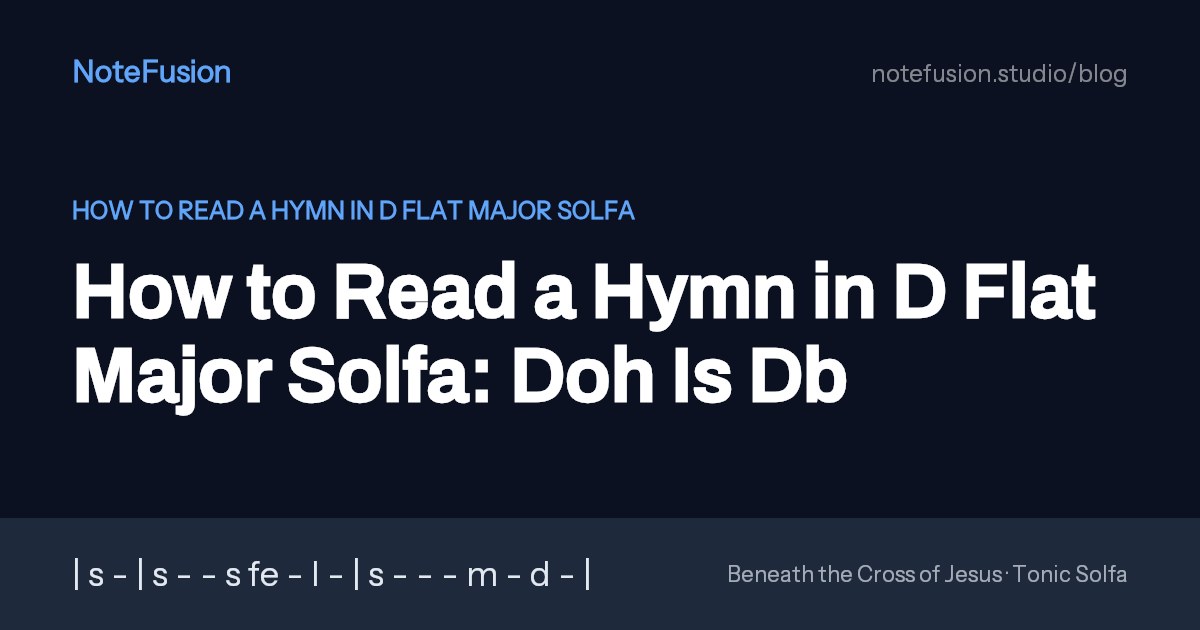
A hymn lands on the music stand with five flats crowding the start of the staff, and half the altos quietly decide it is going to be hard. If that is you this week, here is the good news before anything else.
How to read a hymn in D flat major solfa: doh is on D flat, and that is the only thing the five flats change. Once you know doh is Db, you read every syllable exactly as you would in C or G major. Soh is still five notes above doh, me is still a major third up, and the tune shapes are identical in any key.
In this post I will show you how to find doh from the five flats, walk through the opening of Beneath the Cross of Jesus, which our hymn page gives in Db major, explain the one chromatic note in its first line, and help you decide when a director should simply move the hymn to a friendlier key.
Where is doh in D flat major?
Doh is on D flat, the black key just above C on a piano. You can work it out from the key signature in a few seconds.
The five flats always appear in the same order: Bb, Eb, Ab, Db, Gb. There are two quick rules for flat keys, and both point to the same note:
- The last flat is fah. The last flat here is Gb. Fah is the fourth note of the scale, so count down four notes from Gb (Gb, F, Eb, Db) and you reach doh on Db.
- The second-to-last flat is doh. Read the flats left to right and stop one before the end: Db. That is your doh.
If you want the full picture of how sharps and flats point to doh in every key, my guide to key signatures explained for singers has the tables. For now, this is what the D flat major scale looks like with letter names under the syllables:
| dD♭-rE♭-mF-fG♭- | sA♭-lB♭-tC-d'D♭- |
Look at the syllables, not the letters. The letters are full of flats, but the solfa line is the plain scale d r m f s l t you already know. That is the point of movable doh: the flats do their work on the staff and on the piano, so the singer does not have to carry them.
Got a recording? Get it in solfa →
How to read a hymn in D flat major solfa, step by step
Here is the routine I use with any hymn in an unfamiliar key, and D flat is no different.
- Check the key line. A solfa sheet will say "Doh is Db" or "Key Db" at the top. If you only have staff notation, use the last-flat rule above.
- Get doh in your ear. Have the pianist play Db, or use a pitch pipe or an app. Sing it on "doh" and hold it.
- Sing up to soh and back. Most hymns open on doh, me or soh, so sing doh, me, soh, me, doh until it feels settled. You are tuning your ear to the key, not to the letter names.
- Find your starting syllable. Look at the first note of your part and pitch it from doh. Do not try to pitch "A flat" in your head; pitch soh.
- Read the shapes. From here you read steps, leaps and repeated notes exactly as in any key. A leap from soh down to doh is the same distance in Db as in C.
- Watch for chromatic syllables. Notes like fe or ta show up as accidentals on the staff. In solfa they have their own names, so you just sing the name.
That is genuinely the whole method. The only part that is specific to D flat is step one.
Beneath the Cross of Jesus solfa: the first line worked through
Here are the opening bars as they appear on our Beneath the Cross of Jesus page, in Db major:
| sBe-- | sneath--sthefecross-lof- | sJe----msus-dI- |
Walk through it with your section:
- The pickup. The hymn starts on soh before the first full bar, on the word "Beneath". Pitch it from doh: sing doh, me, soh, then stay on soh.
- Three repeated sohs. "Beneath the cross" sits on soh. Keep it steady; repeated notes are where choirs tend to sag in pitch.
- The dip to fe. On "of" the tune drops a semitone to fe. More on this below.
- Up to lah and back to soh. "Jesus" climbs to lah, then settles back on soh, held for a long note.
- Down through me to doh. "I" falls to me and then to doh, landing on the home note.
Notice what you did not need to think about: Ab, G natural, Bb, F, Db. Those are the letter names for that line, and a singer reading solfa never has to say them. A soprano who has sung soh a thousand times in other hymns already knows how this line sits.
If you want to practise the Db feel with other hymns, our catalogue has It Is Well with My Soul and Sweet Hour of Prayer in the same key. Reading two or three hymns in Db in one sitting quickly takes the fear out of five flats.
The one note that looks harder than it is: fe
The note on "of" is fe, a raised fah. It sits one semitone below soh. In D flat major, fah is Gb, so fe is G natural, and on the staff you will see a natural sign in front of it.
This is where staff readers sometimes stumble: a natural sign in a five-flat key looks like an extra puzzle. In solfa it is just a syllable with a clear sound. Fe leans upwards towards soh, almost like a tug back to the note you came from.
Try this drill with your choir:
- Sing soh and hold it.
- Slide down as little as you can to fe, then straight back up to soh.
- Repeat slowly until the step feels tiny and close.
- Now sing fe and go up a tone to lah.
The common mistake is singing fah instead of fe, which drops too far and makes the line sound flat and heavy. If the whole section keeps fe high and close to soh, the phrase stays bright. My article on chromatic notes in tonic solfa goes into fe, se and ta in more detail.
Does a five flats key change anything for singers?
For the reading, no. For the sound and the practical set-up, a little. Here is how I would split it:
| What changes in Db | What stays the same |
|---|---|
| The pitch you start from | Every syllable and interval |
| The accompanist's fingering | The shape of each part |
| Where the top and bottom notes fall in your voice | How you count the rhythm |
| How chromatic notes are written on the staff | How chromatic notes are named in solfa |
The honest answer about a five flats key for singers is that the difficulty belongs to the instrumentalist, not the choir. Pianists often find Db comfortable because the black keys sit nicely under the hand, but a volunteer who mostly plays in C, G and F may need extra practice. Guitarists usually reach for a capo rather than play Db shapes directly. Brass and saxophone players read in their own transposed keys anyway.
The other real change is range. A hymn in Db sits one semitone higher than the same hymn in C. That small shift can be the difference between a soprano's top note ringing and a soprano's top note pinching.
When should a director transpose it instead?
Keep a hymn in D flat if your singers are comfortable and your accompanist can play it confidently. Move it when one of these is true:
- Your sopranos strain on the highest notes. Dropping to C lowers everything a semitone, which is often enough.
- Your basses vanish on the lowest notes. Raising to D lifts the bass line a semitone and helps it carry.
- Your accompanist is uneasy with five flats. C major has no flats at all, which can make a nervous Sunday much calmer.
- The congregation sings along and is struggling. A key that suits trained voices may not suit everyone in the pews.
The lovely thing about solfa is that transposing costs the choir nothing. Here are the same opening bars of Beneath the Cross of Jesus solfa moved down to C major:
| sBe-- | sneath--sthefecross-lof- | sJe----msus-dI- |
The syllables are identical. Only the key line and the pitch of doh have changed. Your choir does not relearn a single note; the director simply gives a new doh. The pianist, though, now reads a different set of notes on the staff, so tell them well before the service.
For the full process, including how to check each part's range before choosing, see how to transpose a song. If you are torn between two keys, how to choose the right key for your choir gives you a quick test.
A ten-minute plan for your next rehearsal
If Beneath the Cross of Jesus is on your list this week, here is how I would spend ten minutes on it:
- Two minutes: set the key. Play Db. Sing the D flat major scale up and down on solfa from the block above, then doh, me, soh, me, doh.
- Two minutes: the fe drill. Soh, fe, soh, slowly, until every section keeps fe close and high.
- Three minutes: the first line. Sing bars 1 to 3 on solfa, then on the words. Listen for the repeated sohs holding pitch.
- Two minutes: test the range. Sing through to the highest phrase. Watch your sopranos' faces and listen to your basses. If either is struggling, note it.
- One minute: decide the key. Stay in Db, or agree to move it down to C, and tell the accompanist tonight, not on Sunday morning.
If you need to give the starting note without a piano on the day, how to give a choir the starting note covers that.
If you are learning a hymn like this from a recording rather than a printed copy, NoteFusion can help: upload the recording or paste a YouTube link, and it writes the melody in movable-doh solfa with staff notation, tells you where doh is, and lets you use "Transpose for my choir" to see whether each part sits comfortably in Db or a lower key. You can play it back slowly on piano and share the sheet with your section by link. Try it in the app.
Frequently asked questions
Where is doh in D flat major?
Doh is on D flat. The key signature has five flats (Bb, Eb, Ab, Db, Gb). The last flat, Gb, is fah, so count down four notes and you land on Db.
Is D flat major harder to sing than C major in solfa?
No. In movable-doh solfa the syllables and the distances between them are the same in every major key. The five flats only tell you where doh sits. They do not change the tune you sing.
What does fe mean in Beneath the Cross of Jesus?
Fe is a raised fah, one semitone above fah and one below soh. In D flat major, fah is Gb, so fe is G natural. On the staff it shows as a natural sign. In solfa you just sing fe.
Should my choir sing Beneath the Cross of Jesus in D flat or transpose it?
Keep D flat if your sopranos and basses are comfortable and your accompanist can play it. Move it to C or D if the top notes strain your sopranos, the basses disappear, or your pianist or guitarist struggles with five flats. The solfa stays the same either way.
Why is a hymn written in D flat instead of C sharp?
D flat major and C sharp major sound the same, but D flat needs five flats and C sharp needs seven sharps. Publishers almost always choose the key signature with fewer marks.