How to Sing Harmony by Ear in a Choir: 4 Solfa Steps
How to sing harmony by ear in a choir: hold a drone, find the third below or above the tune in solfa, and test your line against a slowed recording.
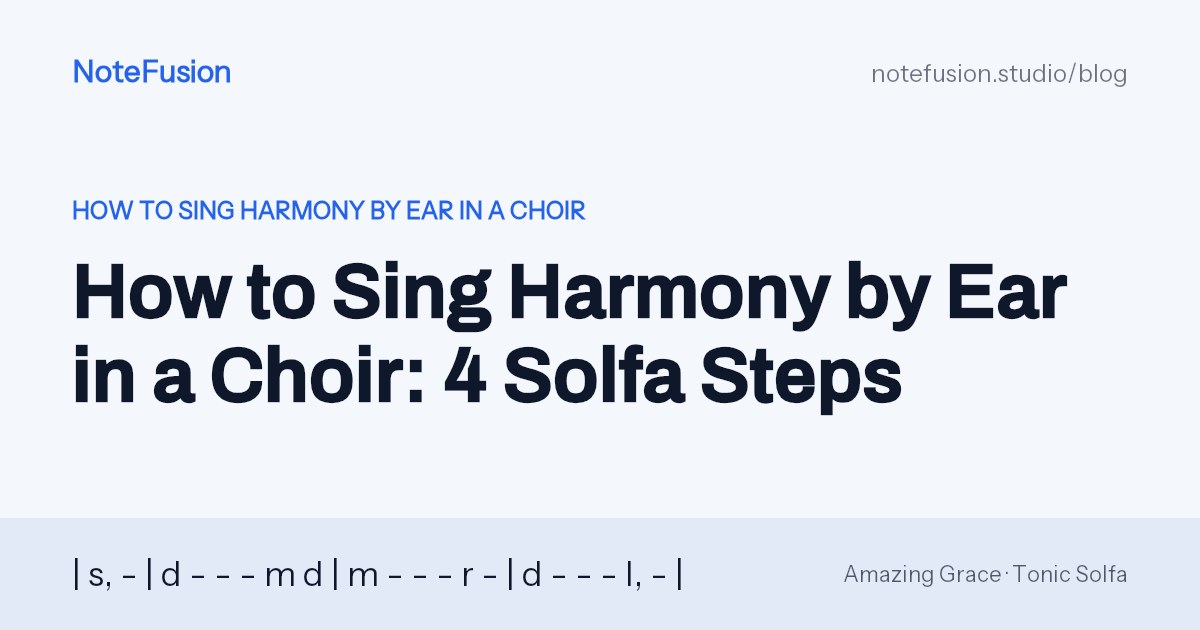
The choir has a new song for Sunday, there is no printed alto or tenor part, and the only thing anyone has is a recording of the tune. Every time you try to sing something different, you slide straight back onto the melody, or you land on a note that rubs against everyone else.
Here is how to sing harmony by ear in a choir: hold a drone on doh or soh until you can keep a note against moving music, then sing a line a third below the tune (me under soh, doh under me), or a third above it, and test that line against a recording of the melody played slowly. Solfa makes each step concrete.
In this post I will walk you through those four steps with real hymns, show you which syllables to reach for, and give you a short practice routine you can try before your next rehearsal. You do not need sheet music, only a tune you know and the syllables d r m f s l t.
How to sing harmony by ear in a choir: the short version
If you only remember one thing, remember this: harmony by ear is mostly about knowing where you are in the key, not about having a special gift. When you know the tune is on soh, you know a comfortable harmony note is me or doh. When the tune moves to me, you move to doh. Solfa turns guesswork into a handful of rules.
The routine I recommend is:
- Drone first. Hold doh, then soh, while the tune plays over you.
- Third below. Shadow the tune two steps of the scale lower.
- Third above. Shadow it two steps higher, or an octave down for tenors and basses.
- Test against playback. Sing your line while the melody plays slowly, and fix the places that rub.
Each step takes ten minutes. Do one a day for a week and you will hear the difference.
Got a recording? Get it in solfa →
Why solfa makes harmony easier to hear
Solfa names the job a note does in the key, not just its pitch. Doh feels like home, soh feels strong and open, me feels warm, and te leans hard towards doh. Those feelings are the same in every key, which is why movable doh is such a good tool for harmony: once you learn that me sounds sweet against doh, it sounds sweet in G major, Eb major or D major alike.
A "third" in solfa is simply a skip of one syllable: doh to me, me to soh, ray to fah. If you are unsure of the sound of each skip, spend a few minutes with intervals in Tonic Solfa first; thirds are the interval harmony singers use most. Here is the G major scale with letter names, so you can see which syllables sit two steps apart:
| dG-rA-mB-fC- | sD-lE-tF♯-d'G- |
Count along it: from doh, skip ray, land on me. From me, skip fah, land on soh. That skipping pattern is the whole basis of the next three steps.
Step 1: Hold a drone on doh or soh
The first skill is not finding a harmony note; it is keeping your note while someone else moves. Most singers lose harmony because their ear gets pulled onto the louder, more familiar melody. A drone trains you out of that.
Take "Amazing Grace" in G major. Ask a friend, or a keyboard, to play or sing the opening tune while you hold doh (G) on a steady "ah":
| s,A-- | dmaz----mingd_ | mgrace!---rhow- | dsweet---l,the- | s,sound,---s,That- |
Listen to what happens as the tune moves over your doh. When it lands on doh or me, the sound settles. When it touches ray or the low lah, you will feel a gentle rub that wants to move on. That rub is not a mistake; it is the music pulling forward. Your job is to stay put and not follow it.
Then repeat with soh as your drone. Soh is the drone basses and tenors often find most natural, because so many hymn tunes lean on it. You will notice different notes rub this time, which is useful: you are learning which melody notes sit happily against which harmony notes.
Two tips for the drone:
- Breathe in shifts. If you are practising with others, stagger your breaths so the drone never stops.
- Keep the vowel the same. A wobbling vowel makes your pitch wobble too. If tuning is a struggle generally, the drills in how to sing in tune in a choir pair well with this step.
How do you find the third below the tune?
You find the third below by singing two scale steps under whatever the melody sings: doh under me, me under soh, ray under fah, te (low, t,) under ray. This is the harmony most altos reach for first, because it follows the tune's shape and sits just under the sopranos.
Start with a tune that barely moves. "Now the Day Is Over" in A major opens on soh and stays there:
| sNow-sthe-sday-sis- | so----sver,--- |
While the tune sings soh, you sing me, a third below. Hold it for the whole two bars. Because the melody does not move, you can concentrate entirely on whether your me is clean and steady. If it sounds sweet and full, you have it. If it sounds sour, you have probably drifted up towards fah; sing your me alone, then add the tune again.
Once that feels secure, move to a tune that steps. In "Holy, Holy, Holy" the tune climbs from doh to me to soh. Shadowing it a third below gives you low lah under doh, doh under me and me under soh. Try it, and you will notice that low lah under the opening doh sounds a little dark. That is a real lesson: a strict third below does not always sound best on doh. Many alto lines simply stay on doh, or drop to low soh, where the tune sits on doh. Use the third as your starting point and let your ear overrule it when it sounds wrong.
How to find the alto part by ear
A written alto part is rarely a perfect third below all the way through. Altos often hold one note while the tune moves, or step gently where the tune leaps. So:
- Sing a third below the tune for the whole verse.
- Listen to a recording with the alto audible and mark the places where the real line holds still instead of following.
- Learn those places as separate small pieces, then join them back in.
That way the third below gives you most of the line for free, and you only have to learn the exceptions.
How do you find a harmony above the melody?
You find it by singing two scale steps above the tune: me over doh, soh over me, fah over ray. Higher sopranos use this for a descant-like line, but the more common use in a choir is for tenors, who sing the same syllables an octave lower.
This is worth understanding. If the tune is on doh and a tenor sings me an octave down, the tenor is now below the sopranos, but the two notes still blend like a third because they are the same syllables. That is why "third above, an octave down" is one of the most useful ideas if you want to learn tenor harmony without sheet music. Your line sits in your range, follows the tune's shape, and fills the gap between the sopranos and the basses.
Try it on "Lord, Thy Word Abideth" in F major:
| dLord,-dThy-mWord-fa-- | sbid----seth,--- |
The tune moves doh, doh, me, fah, then rests on soh. Over doh you sing me; over me you sing soh; over fah you reach for lah; and over the long soh you can hold te, though most ears prefer to settle on soh or me there. Tenors, sing all of that in your comfortable octave. Notice that where the tune holds still on soh, you can also hold still. Harmony lines that rest when the tune rests are easier to keep.
If you are not yet sure whether you are a tenor, baritone or alto, read SATB parts explained before you decide which octave to practise in. Singing harmony in the wrong range makes every note feel harder than it is.
Practise against a recording that plays the melody back
This is the step most people skip, and it is the one that makes everything stick. You cannot check a harmony line on its own; you have to hear it against the tune. A recording of the melody gives you that, as long as you can slow it down and repeat one phrase.
Here is the routine I use with singers:
- Play the tune once and just listen. Sing it quietly in solfa so you know where doh is.
- Slow it down. At a slower speed you have time to find your third and hear whether it fits.
- Loop one phrase. Sing your harmony against the same two bars until it feels boring. Boring means secure.
- Turn the melody down. Once you can hold your line, make the tune quieter so your ear stops leaning on it.
- Record yourself with the tune. Play it back. Rubs you did not notice while singing will be obvious when listening.
This is where NoteFusion can help. You can hum the tune, upload a recording or paste a YouTube, Spotify or Apple Music link, and it writes the melody out in Tonic Solfa with staff notation, then plays it back on a piano, slower or looped. Having the tune's syllables in front of you means you can work out your third note by note instead of guessing, and the slowed piano playback gives you a clean melody to sing against. For a fuller home-practice plan, see how to learn your choir part at home.
Common problems and quick fixes
| Problem | What is happening | Fix to try tonight |
|---|---|---|
| You keep sliding onto the melody | Your ear is following the louder, familiar line | Cover one ear, or stand beside someone on your part |
| Your harmony note sounds sour | You have drifted half a step, often from me towards fah | Sing your note alone, then add the tune back slowly |
| A strict third sounds wrong on doh | Low lah under doh can sound dark | Hold doh, or drop to low soh, where the tune rests on doh |
| You lose your line on long notes | Breath or focus fades on the held note | Practise with a drone, breathing early before held notes |
| The harmony is too high or low | You are in the wrong octave for your voice | Sing the same syllables an octave lower or higher |
Two final points. First, harmony is easier in a comfortable key; if your line keeps cracking at the top, the song may simply be pitched too high for your section. NoteFusion's "Transpose for my choir" moves the doh and shows whether each part sits comfortably, which is a quick way to check. Second, do not aim for perfection on the first try. Get the drone, then the third below, then the third above, and let each one settle before you add the next.
If you want the tune of your next song in solfa so you can start working out your harmony tonight, open NoteFusion, hum or paste the song, and practise your line against the slowed playback.
Frequently asked questions
Can anyone learn to sing harmony by ear?
Most people who can sing a tune in tune can learn it. The hard part is not hearing the harmony but holding your own note while someone else sings a different one. Drones and short daily practice build that skill quickly.
What is the easiest harmony to sing under a melody?
A line a third below the tune. In solfa, wherever the melody sings me you sing doh, and wherever it sings soh you sing me. It follows the tune's shape, so your ear has something familiar to lean on.
How do I find the alto part by ear?
Start with a third below the soprano tune, then listen to a recording for the places where the real alto line holds a note still instead of moving. Altos often repeat or step while the tune leaps, so mark those spots and learn them separately.
How can a tenor learn harmony without sheet music?
Sing a third above the melody, but an octave lower, so it lands in the tenor range. Hold doh or soh as a drone first, then practise your line against a slowed, looped recording of the tune until it feels steady.
Why do I keep drifting onto the melody when I sing harmony?
The melody is louder and more familiar, so your ear follows it. Cover one ear, stand next to a singer on your own part, and practise against the tune played quietly so you learn to hear both lines without copying one.