Bethlehem Rejoices Tonic Solfa: Learn It in 3 Rehearsals
Bethlehem Rejoices tonic solfa in F major: pitch the first me, tune the low te, learn the carol in three rehearsals and place it in your carol service.
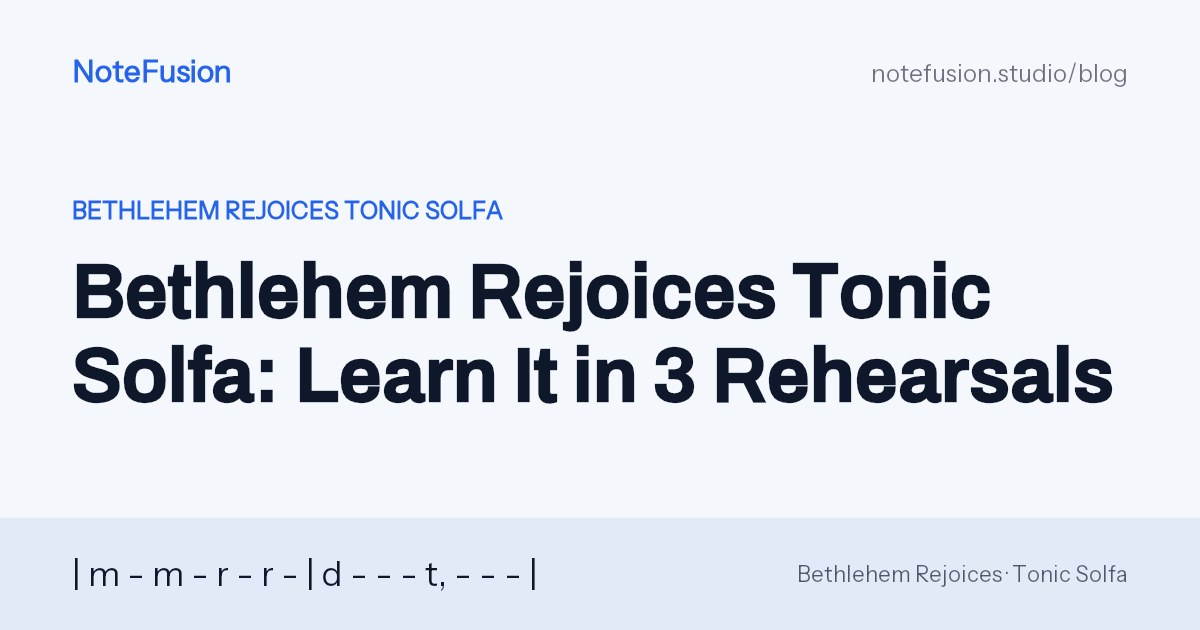
The carol service list has gone round, and somewhere between the big congregational carols sits a short one your choir has never sung: Bethlehem Rejoices. You have perhaps three rehearsals before the service, half the altos missed last week, and you need the notes in front of everyone now.
Here is the short answer. Bethlehem Rejoices tonic solfa is written in F major, so doh is F. The melody opens on me (the note A), steps down through ray to doh, then drops to te below it, all in 4/4. The whole carol is only eight bars long, which means a choir can learn it in one session and polish it over two more.
Below you will find the opening bars as they appear on the solfa page, how to pitch that first me, a three-rehearsal plan, and where this short carol earns its place in a December service order.
Bethlehem Rejoices tonic solfa: the opening bars
The full melody is on the Bethlehem Rejoices page. These are the first two bars, which carry the title words:
| mBeth--mle--rhem-rre-- | djoi----t,ces,--- |
Read it slowly before you sing it. The first bar has four notes, one to each beat: the line starts on me, repeats it, steps down to ray and repeats that. That covers "Beth-le-hem re-". The second bar has only two notes, each held for two beats: "-joi-" lands on doh, and "-ces" falls to the low te (written t, with the comma below because it sits under doh).
Two things in these bars decide whether the carol sounds settled or shaky:
- The repeated notes. Singing the same pitch twice in a row is where choirs quietly sag. The second me must be exactly the same as the first, and so must the second ray.
- The held notes. After four even beats, the choir has to hold doh for two full beats and te for two full beats. The usual mistake is clipping both and arriving early at the next phrase.
Notice too that the phrase ends on te, not doh. Te leans upwards towards doh, so the phrase sounds open, as if it is waiting for the next line. Let it hang rather than letting it die away.
Got a recording? Get it in solfa →
What key is Bethlehem Rejoices in?
Bethlehem Rejoices is in F major, with one flat (B flat) in the key signature, and doh is F. If your choir is used to finding doh from the key signature, the rule for flat keys works here: the last flat is fah, so with B flat as fah, count down four notes to F for doh. My guide on how to find the doh of a song walks through this for every key.
Here is the F major scale with the letter names under the syllables, so your keyboard player and your solfa readers are talking about the same notes:
| dF-rG-mA-fB♭- | sC-lD-tE-d'F- |
So for this carol: me is A, ray is G, doh is F, and the low te is E. The opening phrase sits in a comfortable middle range for most voices, which is one reason it works for a choir with mixed experience.
How do you pitch the first note of Bethlehem Rejoices?
You pitch it by giving doh first and letting the choir climb to me, because the carol does not start on doh. Starting a choir cold on me is how you get three different starting notes.
Try this at your next rehearsal:
- Play or sing F and call it doh. Everyone hums it.
- Sing up the scale from doh to me, slowly, on solfa: doh, ray, me. Hold the me.
- Without a break, give a count of four in the tempo you want and bring them in on "Beth-".
If you have no instrument, my article on giving a choir the starting note covers pitching from memory or a tuning app. The habit of "doh, then climb" is worth more than any one carol, because the same routine works for every carol on the list.
A three-rehearsal plan for this short Christmas carol for church choir
Because the carol is so short, the danger is spending too little time on it. Eight bars sung carelessly stand out more in a quiet church than forty bars sung carelessly in a loud one. Here is how I would spread it across three sessions.
Rehearsal 1: notes on solfa (15 minutes)
- Pitch doh and sing the F major scale up and down once, slowly.
- Sing the first two bars on solfa syllables, not words. Director sings, choir echoes.
- Stop on the low te at the end of bar 2. Ask everyone to hold it and listen: is it close to doh, or has it sunk? Te should feel high, pulled up towards doh.
- Work through the rest of the eight bars from the hymn page two bars at a time, the same way: echo, then together.
- Sing the whole carol on solfa twice. Then stop. Do not add words yet.
Rehearsal 2: words and held notes (10 minutes)
- Start straight on solfa from memory, then repeat with words.
- Count the held notes aloud: on "-joi-" everyone says "one, two" silently in their head before moving. Do the same on "-ces".
- Agree breathing places and mark them on everyone's copy. A short phrase like this needs no snatched breaths in the middle of a word.
- If you sing in parts from your own copy, add one part at a time under the melody once the tune is secure.
Rehearsal 3: in the service order (5 to 10 minutes)
- Sing it in the position it will take in the service, after whatever comes before it, so the choir practises the change of pitch.
- Sing it once unaccompanied to check the repeated notes and the low te hold their pitch.
- Decide the ending: how long the final note lasts and how the director signals the cut-off.
If you are building the whole programme around a calendar, my seven-week plan for a Christmas carol service shows where a short carol like this slots in, usually in the last fortnight when the longer carols already have their notes.
Bethlehem Rejoices in F major or another key?
For most choirs, F major is a sensible key. The opening phrase moves between A and the E below doh, which sits well for altos, tenors and basses singing the tune, and is comfortable for sopranos too. If your sopranos find it dull or your choir sounds murky that low, move doh up a tone to G.
The beauty of movable doh is that nothing on the solfa changes. Here are the same two bars with doh on G:
| mBeth--mle--rhem-rre-- | djoi----t,ces,--- |
The syllables are identical; only the letter names move. Your singers read exactly what they learned in rehearsal one, and only the person giving the note needs to know the new doh. Before you move it, check the rest of the carol on the hymn page so you know the highest note your sopranos will meet.
Where does Bethlehem Rejoices fit in a carol service?
It fits best where you need something short and focused: a sung response, a link, or an opening. A full carol with four or five verses can feel heavy between two readings; eight bars can say "Bethlehem" and move the service on.
There is also a practical advantage in its key. Several familiar carols in the NoteFusion collection have doh on F as well: Once in Royal David's City, While Shepherds Watched Their Flocks, Away in a Manger and Hark! The Herald Angels Sing. Placing Bethlehem Rejoices next to one of them means the choir keeps the same doh and only has to find a new starting syllable.
Here is one way to place it in a simple lessons-and-carols order:
| Point in the service | What happens | Why Bethlehem Rejoices works here |
|---|---|---|
| Opening | Choir sings it as an introit before the first congregational carol | Short, sets the scene, needs no announcing |
| After a reading about Bethlehem or the shepherds | Choir sings it as a response | The words answer the reading directly |
| Between two long congregational carols | Choir alone, unaccompanied | Gives the congregation a moment to listen |
| Before the final carol | Sung once more, quietly | Brings back a familiar sound to close |
Pick one or two of these, not all four. My advice is to use it as a response after a Bethlehem reading, then sing a congregational carol in F straight after so the organist does not need to change key.
For more carols to build around it, my list of Christmas carols in tonic solfa groups the usual favourites with their keys and rehearsal tips.
Common problems and quick fixes
- The choir comes in on different notes. You started them on me without giving doh. Go back to "doh, climb to me, count in".
- The repeated notes go flat. Sing bar 1 on a single vowel ("noo") and ask singers to think the second note slightly higher. It usually lands exactly in tune.
- The low te sinks. Hold it, then move to doh above it and back again. Once singers hear how close te is to doh, they stop letting it drop.
- The held notes are clipped. Have the choir tap the beats quietly on their thigh during bar 2 so they feel two full beats on each note.
- Entries after the introduction are ragged. The carol starts on beat one with no pickup, so a clear upbeat from the director is all it needs. If your accompanist plays an introduction, agree the last bar of it so everyone knows when to breathe.
If your choir struggles to start any carol together, my post on carol openings in solfa groups six carols by their first syllable, which pairs well with this one in a warm-up.
Home practice between rehearsals
Volunteers who practise at home learn short carols fastest, but only if they practise the right notes. Send the hymn page link to your choir group, and ask everyone to do three things before the next rehearsal: sing the F major scale once, sing the first two bars on solfa, and hold the low te for a slow count of two.
If a singer learns better by ear, NoteFusion can play the melody back on a piano, slower or looped, so they can repeat one phrase until it sits. And if you decide to move doh to G, "Transpose for my choir" shows whether each part sits comfortably before you commit. You can save the sheet and share it with a link, which saves photocopies in December.
To work from your own recording or a hummed tune, or to try a different key, open NoteFusion in your browser and have your carol in solfa and staff notation before your next rehearsal.
Frequently asked questions
What key is Bethlehem Rejoices in?
The NoteFusion page has Bethlehem Rejoices in F major, so doh is F. It is in 4/4 and runs to eight bars.
What is the first note of Bethlehem Rejoices in tonic solfa?
The melody starts on me, which is A when doh is F. Give the choir doh, have them sing up the scale to me, then count them in.
Is Bethlehem Rejoices a good short Christmas carol for a church choir?
Yes. At eight bars it can be learned in one focused session and polished over two more, which makes it a good choice when a choir has little rehearsal time before a carol service.
Can I sing Bethlehem Rejoices in a different key?
Yes. Because tonic solfa uses movable doh, the syllables stay the same in any key and only the letter names change. Move doh up a tone to G if the opening feels too low for your sopranos.
Where does Bethlehem Rejoices fit in a carol service?
Its length suits a sung response after a reading about Bethlehem, an introit before the opening carol, or a short link between two longer carols. Several familiar carols in the same service also have doh on F, so it can sit next to them without a new starting pitch.