To God Be the Glory Hymn Story: History and Solfa
Discover the true history of To God Be the Glory, written by Fanny Crosby and set to music by William Howard Doane, plus how to sing it.
If you are preparing a programme note, a talk, or simply want to know the history of a favourite congregational song for Sunday, understanding the background of To God Be the Glory brings fresh meaning to every verse. When a choir stands ready to sing this magnificent hymn, knowing its origins helps singers connect the words of Fanny Crosby with the sweeping melody composed by William Howard Doane. In many churches, music committees look for reliable historical details to share with their congregations, turning ordinary services into educational and deeply worshipful experiences.
The to god be the glory hymn story is a remarkable account of two prolific Victorian writers whose collaboration produced one of the most triumphant expressions of praise in Christian worship. Published originally in 1875, the song remained relatively quiet in America until British revival meetings brought it to the forefront of congregational singing across the UK and the wider world. Today, it remains a beloved favourite that unites different generations of believers through its soaring melodies and enduring theological themes.
The Partnership of Fanny Crosby and William Howard Doane
Fanny Crosby penned thousands of gospel hymns during her lifetime, often producing verses at remarkable speed after hearing a tune played or receiving a thematic prompt. William Howard Doane, a successful businessman and enthusiastic amateur musician, provided the rousing musical setting that matched Crosby's celebratory text. Their creative partnership yielded numerous standard hymns, but To God Be the Glory stands out for its majestic scope and congregational warmth. Their collaborative method involved Doane sending musical drafts to Crosby, who would then match her remarkable poetic memory to the rhythmic flow of the notes.
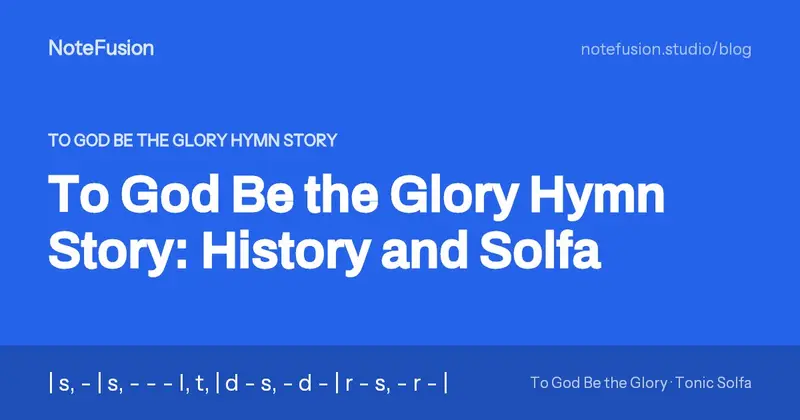
To understand how the melody moves, we can look at the opening bars as they appear in Tonic Solfa, where the home note doh anchors the soaring lines of praise:
| s,To- | s,God---l,bet,the | dglor--s,y,-dgreat- | rthings-s,He-rhath- | mdone!---mSo- |
Notice how the melody opens with a confident leap from soh, to the upper reaches, establishing the celebratory tone before the congregation even reaches the familiar refrain. This upward movement requires singers to engage their breath support early, avoiding any tendency to slide into the notes from underneath.
Got a recording? Get it in solfa →
From Obscurity to Global Revival
Despite its eventual fame, the hymn experienced a quiet beginning. After its appearance in the 1875 collection Brightest and Best, it was printed in various hymnals but did not immediately capture the public imagination in the United States. Its fortunes changed dramatically in the mid-twentieth century when British choir leaders and international evangelistic campaigns adopted it widely. The soaring refrains made it a staple for anniversary services, festive gatherings, and large-scale choir festivals across multiple continents.
When teaching the refrain to a church choir that relies on movable-doh notation, it helps to isolate the rhythmic patterns and ensure the inner parts maintain their tuning against the melody. You can test your choir's starting pitch using NoteFusion to generate clear practice audio before your next rehearsal. Having a dependable rehearsal track allows volunteers to practice at home during the week, ensuring that sectional blends are solid long before Sunday morning arrives.
How to Rehearse To God Be the Glory with Your Choir
Getting your sopranos, altos, tenors, and basses to sing this hymn with clean intonation requires a methodical approach during sectional rehearsals. Because the melody ranges across an octave with frequent leaps from doh to soh, singers can occasionally drift flat if they push their chest voice too high on the repeated high notes. Working through the parts slowly, measure by measure, builds the necessary vocal stamina without causing fatigue.
Here is a simple three-step rehearsal plan for your next choir practice:
- Establish Doh: Play the home chord on the keyboard or pitch pipe, and have the choir hum the scale from doh up to top doh and back down to ground the pitch in their ears.
- Isolate the Refrain: Drill the chorus separately from the verses, ensuring the tenors and altos hear their inner harmony notes clearly without leaning entirely on the sopranos.
- Check the Breath: Remind singers to take deep breaths at the bar lines rather than mid-phrase, keeping the movement smooth and connected across every musical line.
For more ideas on selecting complementary congregational items, browse our collection of Hymns in Tonic Solfa. If you want to explore the specific musical structure of this piece further, you can examine the full arrangement at /hymns/to-god-be-the-glory.
Understanding the Musical Structure and Refrain
The structure of To God Be the Glory relies heavily on a call-and-response dynamic between the verses and the chorus. While the verses tell the narrative of redemption and divine grace, the refrain bursts forth with a jubilant affirmation that anchors the entire composition. For singers learning from Tonic Solfa, paying close attention to the beat divisions and quarter notes prevents rushing through the syncopated moments.
Directors often find that sectional rehearsals work best when the men are grouped together to master the leaping bass and tenor lines. When the lower voices gain confidence in their foundational harmonies, the upper voices can soar with greater freedom and accuracy. This balance is especially crucial in smaller church choirs where every voice part carries significant weight.
Bringing the Hymn Together for Sunday
When Sunday morning arrives, the success of the hymn depends on a confident start from the organist or worship leader. Give the choir a clear, audible doh, set a steady 3/4 tempo that avoids dragging, and let the congregation fill the worship space with the timeless words penned by Crosby over a century ago. Whether you use staff notation or read directly from Tonic Solfa sheets, keeping the phrasing buoyant and the vowels pure will ensure the message rings out clearly to every listener in the sanctuary.
To turn your own choir recordings or melody ideas into clean Tonic Solfa sheets instantly, try NoteFusion right in your browser.
Frequently asked questions
Who wrote To God Be the Glory?
The words were written by the blind American gospel hymn writer Fanny Crosby, and the tune was composed by William Howard Doane.
When was To God Be the Glory published?
It was published in 1875 in a collection named Brightest and Best, though it gained worldwide popularity later when Billy Graham used it in his crusades.
What key and doh are used for To God Be the Glory?
In standard hymnals, it is typically set in A flat major where doh is Ab, moving in a steady 3/4 time signature.
How can my choir learn this hymn quickly?
Start by finding doh on your starting note, drill the opening intervals in Tonic Solfa, and practise the lively refrain separately before combining verse and chorus.