Tis So Sweet to Trust in Jesus Tonic Solfa: 3 Rehearsals
Tis So Sweet to Trust in Jesus tonic solfa in Ab major: find doh in four flats, learn verse and refrain apart, and steady the dotted rhythm.
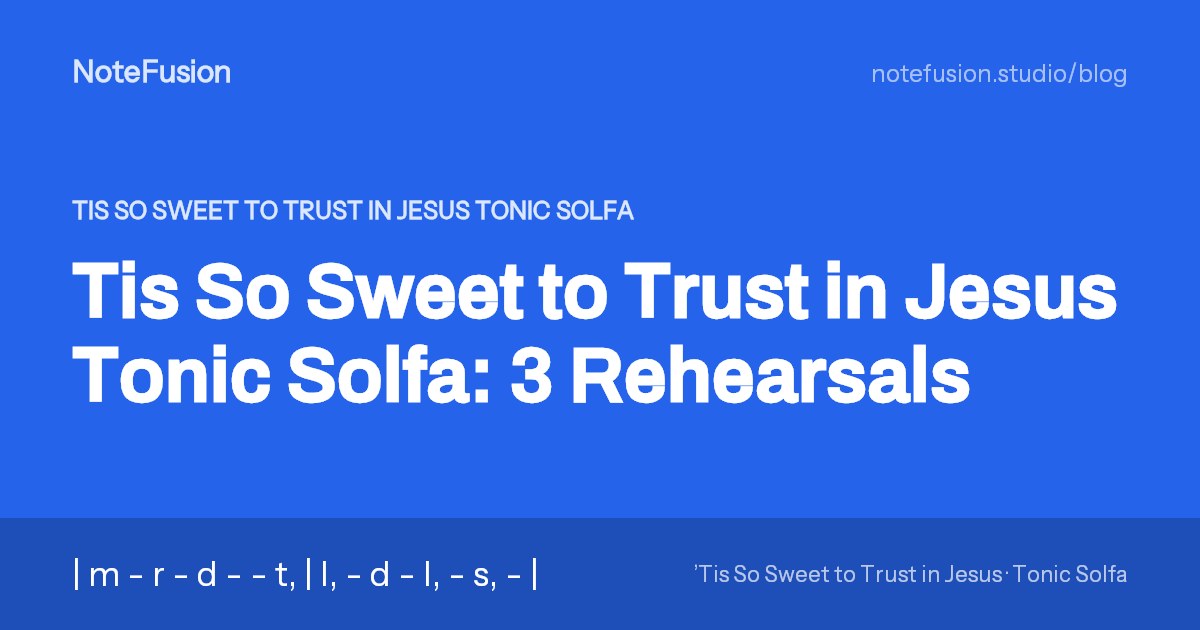
Your choir has sung this hymn for years, yet the moment the page goes up in four flats the altos hesitate, the tenors guess, and the refrain comes out rushed and lumpy.
Tis So Sweet to Trust in Jesus tonic solfa is written in Ab major, so doh is Ab. The tune is in 4/4 and starts on me, steps down to doh, then dips below it to low lah and low soh. Teach the verse (bars 1 to 8) and the refrain (bars 9 to 16) as two separate jobs, and drill the dotted long-short figures slowly before adding words.
The tune feels familiar, so nobody expects it to trip them up, but it usually does in two places: finding doh, and the long-short rhythm. Below I'll show you exactly where doh sits in four flats, how to read the first line, how I teach the verse and refrain apart, and a three-rehearsal plan you can start tonight.
Where is doh in 'Tis So Sweet to Trust in Jesus?
Doh is Ab, because the hymn is in Ab major with four flats. The flats always appear in the same order: Bb, Eb, Ab, Db. For any flat key, the second-to-last flat is doh. With four flats, the second-to-last is Ab. If the key signature rules feel shaky, key signatures explained for singers walks through every key with a table.
Here is what that means for your singers in practice:
- Doh is Ab. Play it, sing it, and let the whole choir hum it before anything else.
- Me, the first note of the melody, is C, a third above doh.
- Low soh (written s, with the comma below) is the Eb below doh. The tune reaches it at the end of the first line.
- Low lah (l,) is the F just above that Eb.
The last flat, Db, is fah. That is worth saying out loud to any keyboard player who reads from staff: every D on the page is played as Db, and in solfa it is simply fah. Singers never need to think about the flat; they only need to know where doh is.
One tip for pitching: if you have no instrument, give the choir doh first, then let them sing down from me to doh so they hear the opening shape before you start. The first sound they make should be a confident me, not a hopeful one.
Got a recording? Get it in solfa →
Tis So Sweet to Trust in Jesus tonic solfa, bar by bar
This is the opening line as it appears on the ’Tis So Sweet to Trust in Jesus hymn page:
| m’Tis-rso-dsweet--t,to | l,trust-din-l,Je--s,sus,- |
Read it slowly with your choir. Each bar holds eight marks, and in 4/4 that means each mark is half a beat. A syllable followed by dashes is held through those dashes.
- "'Tis" is on me, held for one beat (two marks).
- "so" is on ray, also one beat.
- "sweet" is on doh, and here is the first long-short pattern: doh is held for a beat and a half (three marks), then "to" on low te gets only half a beat.
- Bar 2 drops to low lah and low soh, with doh in the middle, on "trust in Jesus".
That held doh followed by a quick low te is the dotted rhythm in its simplest form: a long note that takes most of the time, and a short note that pushes you into the next beat. If your choir can feel it here, in bar 1, they are halfway to singing the refrain well. For a fuller explanation of dashes, half beats and held notes, see how to read rhythm in tonic solfa.
Notice also how low the first line goes. Ending on low soh means the melody sits under doh at the very moment people are settling into the hymn. Sopranos sometimes go breathy there; ask them to keep the same tone they used on me at the start.
Teach the verse first: bars 1 to 8
The verse is four lines of two bars each. I teach it before the refrain for one reason: the verse is where the choir learns the home notes, doh and the low notes below it, so the refrain has something solid to lean on.
Here is the order I use:
- Sing doh, then the scale down to low soh. Just the notes from doh down. This is the territory the first line lives in, and it warms the ear to the low end of the key.
- Speak the words in rhythm. No pitch. Let the choir feel the held "sweet" and the quick "to" before they have to think about notes.
- Sing line 1 on solfa. Use the syllables, not the words. Hand signs help here, especially for the drop below doh.
- Add the words to line 1. Then move to line 2 and repeat steps 2 to 4.
- Join lines in pairs. Lines 1 and 2 together, then 3 and 4, then the whole verse.
Two lines at a time is the right size for a volunteer choir. Whole verses at once usually produce a confident first line and a mumble afterwards. The general approach is set out in how to teach a choir a new song, which also covers layering parts and home practice.
Watch for this in the verse: because the long-short pattern repeats, singers start to shorten the long notes to keep up. Each long note must be held for its full length. If a line ends early, people breathe early, and the next line comes in ragged.
How do you sing the dotted rhythm in the refrain?
You sing it by holding the long note fully and making the short note a quick lead-in to the next beat, and you learn it by clapping and chanting before you add any pitch. The refrain starts at bar 9. Here are its first two lines:
| mJe--ssus,-sJe--msus,- | rhow-dI-mtrust-rHim!- |
| mHow-sI’ve-sproved--mHim | ro’er-dand-ro’er;--- |
The refrain is where choirs get excited, and excitement is the enemy of a long-short rhythm. The long notes get clipped, the short notes get stretched, and the whole thing turns into even notes at a faster speed. Wherever you see a syllable held over two dashes and then a single short note before the next beat, that is the same shape you met on "sweet to" in bar 1. Treat every one of them the same way.
The drill I use, in this order:
- Find the long-short pairs on the page. Ask the choir to point to each place in bars 9 to 16 where a held note is followed by a single quick one. Reading it before singing it changes how they sing it.
- Clap the rhythm at half speed. One clap per syllable, with hands staying together through the long note. Counting "one, two, three-and" helps the short note land on the "and".
- Chant the words in rhythm, no pitch. The short syllable should sound almost like a pick-up into the next beat, not a separate event.
- Sing the refrain on solfa at half speed. Then on the words at half speed.
- Raise the tempo in two steps. Never jump straight to full speed. Rushing usually starts when the tempo goes up too quickly.
If one line keeps collapsing, loop just that line. Two bars sung correctly five times will do more than the whole refrain sung loosely once.
'Tis so sweet refrain parts: adding alto, tenor and bass
Once the melody of the refrain is steady, bring in the other voices one at a time. For the refrain parts I add altos first, then basses, then tenors. Altos often move in rhythm with the sopranos, so they reinforce the long-short feel; basses anchor the harmony; tenors sit in the middle and are easiest to place once the outer voices are secure.
A few points that save time:
- Give each part its own doh check. Before altos sing their line, have them sing doh with the sopranos. Before basses come in, have them sing doh an octave lower. Every part is in the same key, so every part shares the same doh.
- Keep the rhythm drill for every part. If the parts move with the melody, they need the same clap-and-chant work. Do not assume altos will pick it up by standing next to sopranos.
- Pair parts before combining all four. Soprano and bass together first, then add alto, then tenor. Hearing the outer voices fit makes it easier for the inner voices to find their notes.
- End on a held chord. At the last bar of the refrain, have everyone hold the final note and listen. It is a quick way to check tuning before you sing the next verse.
If you have section leaders, send them away for ten minutes with the refrain only. Bars 9 to 16 are short enough to learn in a sectional and come back with.
Is Ab major too high or too low for my choir?
Ab major suits many choirs, but if your sopranos strain on the higher notes, moving the hymn down a semitone to G major is a sensible choice. Because solfa uses movable doh, nothing about the syllables changes; only the pitch you give for doh moves. Here is the same opening line in G:
| m’Tis-rso-dsweet--t,to | l,trust-din-l,Je--s,sus,- |
The singers read exactly the same marks, and the opening me is now B rather than C. Your accompanist needs to know about the change, but the choir only needs a new doh.
Going lower has a cost: the first line already dips to low soh, and in G that low note sits a semitone deeper still, which can make the opening line murky for sopranos and leave basses growling. Try both keys in rehearsal and listen to the first line and the top of the refrain. Pick the key where both sound full. NoteFusion's "Transpose for my choir" moves doh and shows whether each part sits comfortably, which saves guessing.
A three-rehearsal plan you can start tonight
Here is how I would fit this hymn into three ordinary rehearsals, using about fifteen minutes of each.
Rehearsal 1: doh and the verse.
- Sing doh (Ab) and the scale down to low soh.
- Clap and chant the rhythm of bar 1, focusing on the held "sweet".
- Teach the verse two lines at a time on solfa, then on words.
- Send everyone home with the sheet and one job: sing line 1 on solfa every day.
Rehearsal 2: the refrain rhythm.
- Sing through the verse once as a warm-up.
- Find every long-short pair in bars 9 to 16 on the page.
- Clap, chant, then sing the refrain melody at half speed.
- Raise the tempo in two steps; stop and loop any line that rushes.
Rehearsal 3: parts and the full hymn.
- Refrain melody once, then add altos, basses and tenors in turn.
- Hold the final chord and check tuning.
- Sing verse and refrain together, then a second verse to make sure the words, not the notes, are now the only new thing.
If your choir only meets once a week, this is three weeks, which fits comfortably before the Sunday you have planned it for. If you meet twice, you can have it ready in a fortnight.
Getting the sheet into your choir's hands
The full melody is on the ’Tis So Sweet to Trust in Jesus hymn page, with both Tonic Solfa and staff notation. For home practice, the most useful thing is hearing the refrain slowly and on repeat, so the long-short rhythm settles in the ear before rehearsal.
If you are working from a recording of the version your church sings, or want to hum the tune and see it written out, NoteFusion turns it into movable-doh Tonic Solfa with staff notation, plays it back on a piano slower or looped, and lets you share the sheet with your choir by link.
Frequently asked questions
What key is 'Tis So Sweet to Trust in Jesus in?
The version on our hymn page is in Ab major, with four flats in the key signature. That makes doh Ab, and the tune is in 4/4 over 16 bars.
What is the first note of 'Tis So Sweet to Trust in Jesus in solfa?
The melody starts on me, which is C in Ab major. From there it steps down to doh and then dips below doh to low lah and low soh by the end of the first line.
How do I find doh in a key with four flats?
Look at the flats in order (Bb, Eb, Ab, Db) and take the second-to-last one. With four flats that is Ab, so Ab is doh.
How should a choir sing the dotted rhythm in the refrain?
Hold the long note for its full length and make the short note a quick lead-in to the next beat. Clap and chant the rhythm slowly before adding pitch, then add the words last.
Can I sing 'Tis So Sweet to Trust in Jesus in a lower key?
Yes. Because solfa is movable doh, the syllables stay the same in any key; only the starting pitch changes. G major, a semitone lower, suits choirs who find Ab a little high.