Why Is It Te Not Ti in Tonic Solfa? Te vs Ta Explained
Why is it te not ti in tonic solfa? Curwen's spelling gives every note its own initial letter. Here is how to tell te from ta in a hymn.
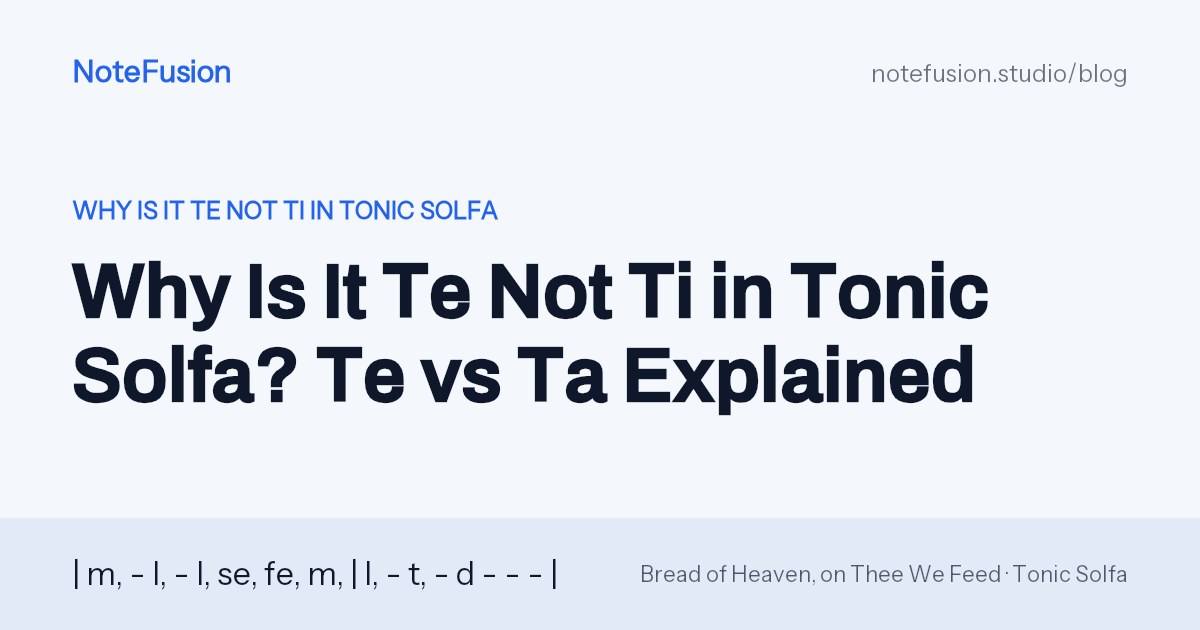
You have printed a new hymn for Sunday, and halfway down the page an alto points at a note and asks why it says te when her school taught her ti. Then someone else spots ta in another hymn and wonders whether it is a misprint. Five minutes of rehearsal gone on spelling.
So, why is it te not ti in tonic solfa? Both name the same note, the seventh of the major scale, a semitone below doh. John Curwen's Tonic Solfa writes every note as one letter, so the seventh needed a name starting with a letter no other note used. His books spell it te; many American books spell it ti.
In this post I will explain where the spelling comes from, why it matters for the letters on your sheet, and, more usefully for your next rehearsal, how to hear and sing the difference between te and ta so nobody in your choir confuses the two.
Why is it te not ti in tonic solfa?
The short answer is that the seventh needed its own initial letter, and Curwen chose te as the spelling for it.
The older singing syllables that came into English use ended the scale with si. That works in fixed-do countries where the syllables are spoken in full, but Tonic Solfa does something different: it writes each note as its first letter. Look at the bare scale as it appears on any Curwen sheet:
d r m f s l t
Seven notes, seven different letters. If the seventh were still si, it would be written s, and you could not tell it apart from soh. A sheet full of s marks where half mean soh and half mean the seventh would be impossible to read at sight. Giving the seventh a name that begins with t solved the problem at once.
The spelling te (rather than ti) fits the way Curwen spelled all the syllables for English readers: doh, ray, me, fah, soh, lah, te. They are written so that an English speaker says them correctly without being taught Italian vowels. Te is pronounced like the drink, tea. If you want the fuller story of how Sarah Glover and John Curwen shaped the system, read the history of Tonic Solfa.
Here is the scale in G major, with the letter names under the solfa, so you can see te sitting on F sharp, one step below the top doh:
| dG-rA-mB-fC- | sD-lE-tF♯-d'G- |
Got a recording? Get it in solfa →
Ti or te solfa: does the spelling change the note?
No. Whether your book says ti or te, the pitch is identical. Both are the leading note, the one that pulls upwards into doh. Both use the same hand sign, the index finger pointing up and slightly forward, which suits a note that wants to rise.
The difference is purely a matter of tradition:
| Spelling | Where you will usually meet it | Written as |
|---|---|---|
| te | Curwen Tonic Solfa sheets, hymn books printed in solfa, many church choirs | t |
| ti | Many American classrooms and songbooks using movable do | t (or ti in full) |
| si | Fixed-do traditions, where it names the note B | not used in Tonic Solfa |
The last row matters. In fixed-do countries, si is always B, whatever key you are in. In movable doh, te moves with the key: in G major it is F sharp, in Ab major it is G. If a singer in your choir grew up with fixed do, that is a bigger adjustment than the spelling, and our guide to movable doh explains it well.
My advice for a choir is simple: pick one spelling and use it everywhere, on the sheet, on the whiteboard and in what you say aloud. If your sheets are Curwen-style, that means te. Mixing spellings is where the real confusion begins, because of the next note on our list.
Tonic solfa spelling of the seventh note, and the vowel rule behind it
The reason te matters more than it seems is that Tonic Solfa uses vowels to signal chromatic notes.
When a note is raised by a semitone, its vowel changes to an e sound. Fah raised becomes fe; soh raised becomes se. When a note is lowered, its vowel changes to an a or aw sound. Te lowered becomes ta.
That gives you a neat pattern:
- te: the ordinary seventh of the major scale
- ta: te lowered by a semitone
- se: soh raised by a semitone, common in minor keys
- fe: fah raised by a semitone
Once you know the pattern, the spelling te makes sense as part of a system rather than an odd choice. It is also why a choir that casually writes ti on one sheet and te on another can trip itself up: singers who have learned that a final a means lowered start reading vowels closely, and inconsistent spellings undermine that habit.
You can see the raised notes at work in this minor hymn. Bread of Heaven is in G minor, so it is read la-based, with doh on Bb and lah (G) as home:
| m,Bread-l,of-l,heav’nse,_fe,onm,_ | l,Thee-t,we-dfeed,--- |
In the first bar the melody drops from lah through se and fe, both raised notes with that e vowel, to low me. In the second bar it climbs back through low te to doh. In a minor key, te is the second note above lah, and it behaves just as it does in major, leaning into doh. For a full walk-through of fe, se and ta, see chromatic notes in Tonic Solfa.
How do you tell te from ta in a hymn?
On paper, look at the vowel: te is the normal seventh, ta is the lowered one. By ear, te sits a semitone below doh and pulls up into it, while ta sits a whole tone below doh and usually falls away downwards.
In practice, here is what that means in a few keys your choir sings in:
| Key | Doh | te | ta |
|---|---|---|---|
| G major | G | F sharp | F natural |
| F major | F | E | E flat |
| Ab major | Ab | G | G flat |
| D major | D | C sharp | C natural |
The most common place you meet ta in hymns is when a phrase borrows a note from the key a fourth higher, or when the tune passes briefly through a minor colour. Because ta is lower than te, it tends to move down to lah rather than up to doh. That direction is your best clue when a singer is unsure.
Te, by contrast, almost always resolves upwards. Here is a familiar example from 'Tis So Sweet to Trust in Jesus in Ab major, where doh is Ab:
| m’Tis-rso-dsweet--t,to | l,trust-din-l,Je--s,sus,- |
The opening walks down from me through ray and doh, and the fourth note is t, with the comma below it: low te, the G just under doh. Notice what happens: the line keeps falling to low lah, then rises to doh, then lah, then low soh. Low te here is a passing step on a downward scale, and singers handle it easily because it is a plain diatonic note. If that note were ta, the sheet would show it with the a vowel, and it would sound a semitone lower, a G flat. You can see the whole hymn on the ’Tis So Sweet to Trust in Jesus page.
Why singers confuse them
Three things cause most of the te and ta mix-ups I see in choirs:
- The letters look alike. Te and ta differ by one letter, and in a cramped hymn book line it is easy to miss.
- Sloppy vowels. If singers say both as a vague "tuh", the syllable stops telling them anything.
- Habit from recordings. Volunteers who learn tunes by ear often sing the te they expect, even where the composer wrote ta.
A five-minute te and ta drill for your next rehearsal
This is the drill I would run at the start of a rehearsal before any hymn with ta in it. It needs no instrument beyond a starting note.
- Set doh. Give the choir doh in the key of the hymn and have everyone hum it.
- Find te. Ask them to sing doh, step down to te, and return to doh, using the hand sign. Say te clearly as "tee". Repeat until the semitone is tight.
- Find lah. From doh, step down through te to lah and back up. Now they have the frame: lah, te, doh.
- Introduce ta. From doh, sing down to ta, deliberately lower than te, then on down to lah. Say ta as "taw" with an open mouth. Point out that it lands closer to lah than to doh.
- Alternate. Point to te or ta on the whiteboard at random. The choir sings doh, then the note you point at, then where it naturally goes: up to doh after te, down to lah after ta.
What you are building is a reflex: the e vowel means bright and leaning up, the a vowel means darker and leaning down. Once singers have that, ta in a hymn stops being a surprise.
If your altos or tenors are learning a part with ta in it at home, playback helps more than anything. In NoteFusion you can play the tune slower or loop the bar with the chromatic note, so they hear the semitone dozens of times before Sunday.
When ta turns up and how to mark it
You will not meet ta in most simple hymns; plenty of the old favourites use only the seven ordinary notes. When it does appear, it is worth marking before rehearsal rather than discovering it in front of the choir.
My routine when preparing a sheet:
- Scan for vowels. Run your eye along each part looking for fe, se and ta. Circle them.
- Check the direction. For each ta, note where it goes next. If it falls to lah, it is behaving normally. If it goes somewhere unexpected, play it through first.
- Check for a key change. Sometimes a long run of ta notes means the music has actually moved to a new key and the next section is better read with a new doh. Our guide to how to read Tonic Solfa covers how key changes are shown on a sheet.
- Warn the section. Tell the part that has the ta which bar it is in, and run the drill above in that key.
If you are writing your own sheets, spell it te for the ordinary seventh every time, even if your singers learned ti. Consistency is what lets the vowel system do its job.
The bottom line for your choir
Ti and te are the same note. Tonic Solfa spells it te because the seventh needed a letter that soh had not already taken, and because Curwen's spellings are built for English speakers. The spelling earns its keep when chromatic notes appear: te, said "tee", sits a semitone under doh and rises; ta, said "taw", sits a whole tone under doh and falls. Teach your choir to read the vowel, and the question in the alto row answers itself.
If you want to check a hymn or a song from a recording before you hand it out, NoteFusion will write the melody in movable-doh Tonic Solfa with staff notation underneath, and play it back slowly so you can hear exactly where te and ta fall.
Frequently asked questions
Is it ti or te in tonic solfa?
Both names refer to the same note, the seventh degree of the major scale. Curwen's Tonic Solfa spells it te, and many American songbooks and classrooms spell it ti. If your choir reads Curwen-style sheets, write and say te.
Why did Curwen change si to te?
In the older syllables the seventh was si, which starts with s, the same letter as soh. Tonic Solfa writes each note as its initial letter, so two notes cannot share one. Changing the seventh to a t-word gave every note its own letter.
What is the difference between te and ta?
Te is the seventh note of the major scale, a semitone below doh. Ta is te lowered by a semitone, a whole tone below doh. In G major, te is F sharp and ta is F natural.
How do you pronounce te and ta in solfa?
Te is said like tea. Ta is usually said taw, with an open vowel, so the ear and the mouth both mark the difference from te.
Does the spelling change if I use ti instead of te?
No. The pitch is identical. The only real risk is mixing spellings on one sheet, where a singer might misread a letter, so pick one spelling for your choir and keep it.