A Child of the King Tonic Solfa: Sing in Eb Major
Master A Child of the King tonic solfa in Eb major. Read the opening bars, drill SATB choir parts for the refrain, and transpose the hymn for Sunday.
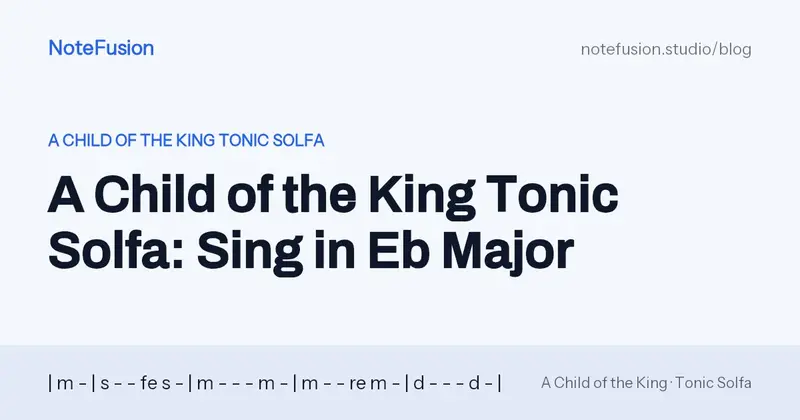
Your soloist has just handed you Harriet Buell and John Sumner's beloved hymn for Sunday morning, but rehearsal starts in twenty minutes and half your choir reads only solfa notation. A gospel tune with an accidental in the very first line can stop singers in their tracks if they try to guess the intervals by ear.
To sing a child of the king tonic solfa, set doh on E flat (Eb) in 3/4 time. The melody enters on beat three with the syllable me, leaps up to soh, touches the sharpened note fe on the word 'houses', and returns cleanly to doh on 'lands'.
Learning A Child of the King from a solfa sheet makes the chromatic steps easy to pitch and helps your singers master four-part harmony without getting lost in ledger lines.
| mMy- | sFath---feersis- | mrich---min- | mhous---reesmand- | dlands,---dHe- |
What is the tonic solfa for A Child of the King?
The tune begins with an upbeat on me before moving to a sustained soh decorated by fe, followed by a parallel descent to doh. Here is how the musical phrase works bar by bar for the soprano line:
- Bar 1 (Pickup): The single syllable me on beat three acts as a gentle springboard into the melody.
- Bar 2: The voice lands on soh, dips down to fe (the sharpened fourth scale degree), and steps straight back up to soh.
- Bar 3: The melody settles on a sustained me, holding across three beats.
- Bar 4: A parallel figure repeats the pattern lower down: me steps down to re (the sharpened second scale degree) and resolves back up to me.
- Bar 5: The opening line concludes by dropping to doh, establishing the tonal centre of the hymn.
When singers ask for the my father is rich in houses and lands solfa, this five-bar opening contains the entire musical vocabulary of the verse. Once your sopranos and soloists feel the tension and resolution between fe and soh, and between re and me, the rest of the stanza falls into place.
Got a recording? Get it in solfa →
How do you find doh in this gospel hymn in E flat solfa?
To find doh in this gospel hymn in e flat solfa, inspect the three flats at the start of the staff score: B flat, E flat, and A flat. In movable-doh solfa, the penultimate flat in any flat key signature marks the position of doh, which makes E flat your home pitch.
If you want to understand how any key signature points you directly to doh, take a look at our guide to key signatures explained for singers. For an unaccompanied choir, you can sound an Eb on a pitch pipe or keyboard and have every section sing the tonic chord:
- Basses sing low doh.
- Tenors sing soh.
- Altos sing me.
- Sopranos match the altos on me, since that is the pickup pitch.
Because the tune opens on me rather than doh, choristers who expect to start on the key note can easily pitch the opening an interval of a third too low. Remind the choir to hear doh silently in their minds, then lift their opening pitch to the major third (me) before the director gives the preparatory beat.
Tuning the chromatic notes: fe and re
Many church choirs stumble over the accidental notes in the opening phrase. In nineteenth-century gospel songs, these passing semitones add warmth and expressive colour, but if a choir scoops into them or sings them flat, the harmony sounds muddy.
Singing fe cleanly
In bar 2, the melody moves from soh down to fe and back up to soh. Because fe sits just a semitone below soh, it acts as a temporary leading note. Have your singers practise this three-note pattern in isolation:
- Sing: soh – fe – soh.
- Think of fe as leaning forward toward soh rather than falling down toward fah.
- Keep the vowel bright and open so the pitch does not sag.
Singing re with confidence
In bar 4, the melody uses re, which sits a semitone below me. Just like fe resolves upward to soh, re resolves upward to me:
- Sing: me – re – me.
- Ensure the choir does not confuse re with the ordinary second degree (ray).
- Keep the throat relaxed so the half-step interval remains tight and precise.
When your choir sings these two small turns accurately, the verse sounds elegant and assured.
How do you drill the refrain for choir and congregation?
The refrain of A Child of the King is what the entire congregation will sing with your choir, so it must sound bold, secure, and rhythmically crisp. In 3/4 time, choirs have a natural tendency to drag the second and third beats of each bar, making the chorus feel heavy rather than triumphant.
To build momentum in the chorus, drill these three rehearsal steps:
- Isolate the rhythm first: Have the choir speak the words in rhythm on beats 1, 2, and 3 without pitch. Clap the downbeats to keep the tempo moving steadily.
- Sing the refrain in unison: Put all four voice sections on the melody line. This ensures every singer internalises the shape of the tune before splitting into harmony.
- Add the inner harmonies: Bring in the altos and tenors while the basses provide the foundation. The refrain relies heavily on the primary chords—doh, fah, and soh—giving the harmony a ringing, resonant structure that encourages the congregation to join in.
Because the chorus begins with a strong statement of the title text, remind your choir to articulate the initial consonants cleanly. Crisp diction on 'I'm a child of the King' sets the standard for the entire room.
Rehearsing A Child of the King choir parts in SATB
When working on a child of the king choir parts, each section has a specific role to play in supporting the melody.
Soprano line
The soprano part carries the tune and spends most of its time between middle doh and top soh. Because the highest note rarely exceeds soh, sopranos can focus on pure tone and expressive phrasing without vocal fatigue. Encourage them to lead the congregation with clarity rather than overpowering volume.
Alto line
The alto part provides harmonic richness, frequently moving in thirds and sixths below the soprano. While the sopranos execute the chromatic turn from soh to fe to soh, the altos often hold a stable harmonic pedal or move by step between doh and te,. Keeping the alto part firm prevents the sopranos from pulling the tuning off centre.
Tenor line
Tenors often enjoy gospel hymns because the tenor part sits right in the warm middle of the male voice. In this hymn, tenors bridge the gap between the alto line and the bass foundation. Watch out for the tendency of untrained tenors to sing the soprano melody an octave lower; ensure they read their own solfa syllables rather than shadowing the tune.
Bass line
The bass line anchors the hymn with classic root movements: doh to fah to soh. In 3/4 gospel time, the bass section must drop cleanly on beat one of every measure. If the bass entries lag, the entire choir will rush beat two to compensate.
Here is a simple overview of how the parts interact across the opening phrase:
| Part | Starting Pitch | Typical Role | Watch Out For |
|---|---|---|---|
| Soprano | me (pickup) | Carries the melody | Scooping into fe and re |
| Alto | doh or s, | Harmonises below melody | Drifting to the soprano line |
| Tenor | m or d | Sustains harmonic core | Singing melody an octave down |
| Bass | d, (low doh) | Supplies the harmonic root | Dragging on beat one |
When and how should you transpose A Child of the King?
While E flat major is the traditional key found in most standard hymnals, it may not always suit your specific ensemble. If your sopranos sound strained on upper notes, or conversely, if your basses cannot produce enough tone on the lowest notes, changing the pitch can transform the performance.
Before deciding on a key change, consult our guide on how to choose the right key for your choir to check the vocal ranges of your singers. To learn how to move songs across keys smoothly, read our tutorial on how to transpose a song.
Here is how transposing affects A Child of the King:
- Singing in D Major: Lowering the key by a semitone (doh is D) takes pressure off high voices. If your service takes place early in the morning when voices are not fully warmed up, D major feels much more accessible.
- Singing in F Major: Raising the key up one tone (doh is F) adds brilliance and ring to a large, confident choir. However, make sure your sopranos can comfortably handle the higher notes in the refrain without shouting.
Because you are reading movable doh, the solfa syllables never change when you transpose. Bar 1 remains me, bar 2 remains soh – fe – soh, and bar 5 remains doh. You simply sound a different starting pitch on your instrument and let the solfa guide the voices.
Here is what the opening looks like when transposed to D major:
| mMy- | sFath---feersis- | mrich---min- | mhous---reesmand- | dlands,---dHe- |
Notice that the syllables, rhythms, and relationships remain identical. Only the absolute pitch has shifted.
A practical 15-minute rehearsal plan
If you have limited rehearsal time before Sunday service, use this structured four-step routine to get your choir performance-ready:
- Minutes 1–3 (Tonal Centring): Sound doh on E flat. Have all singers hum doh, then me, then soh. Sing the scale upwards from doh to soh and back down.
- Minutes 4–7 (Tackle the Chromatics): Drill the fe and re intervals using call-and-response. Sing
s - fe - sand have the choir repeat it. Then singm - re - muntil every section matches pitch cleanly. - Minutes 8–11 (The Refrain): Practise the refrain in four parts. Focus on clean entries on beat one and ensure the tenors and altos hold their inner harmony steady.
- Minutes 12–15 (Run-through with Verses): Put verse one and the refrain together. If you have a soloist singing the stanzas, have the choir listen quietly through the verse and enter with full, vibrant sound on the chorus.
If you want to prepare clean, readable solfa scores for your choir or hear parts played back at slower tempos for home practice, NoteFusion makes it straightforward. You can paste a recording link or upload an audio file at notefusion.studio/app, generate the movable-doh solfa sheet alongside staff notation, check vocal ranges with "Transpose for my choir", and share the sheets directly with your singers before your next rehearsal.
Frequently asked questions
What key is A Child of the King usually sung in?
The hymn is traditionally set in E flat major (Eb), which places doh on Eb with three flats in the key signature.
What is the starting note of A Child of the King in tonic solfa?
The melody begins on me on beat three as a pickup note, stepping straight up to soh on the downbeat of the first full bar.
How do you sing the accidental note in the first line?
The first line includes fe, which is a sharpened fah that resolves upward to soh on the word 'houses'.
Can our choir sing A Child of the King in D major instead of E flat?
Yes. If your choir finds the top notes in E flat tight or your accompanist prefers fewer flats, transposing down one semitone to D major keeps the solfa syllables identical while lowering the pitch comfortably.