A Mighty Fortress Is Our God Tonic Solfa: 6-Step Plan
A Mighty Fortress Is Our God tonic solfa in D major, bar by bar: the high-doh opening, the pickup, where to breathe, and a rehearsal order for parts.
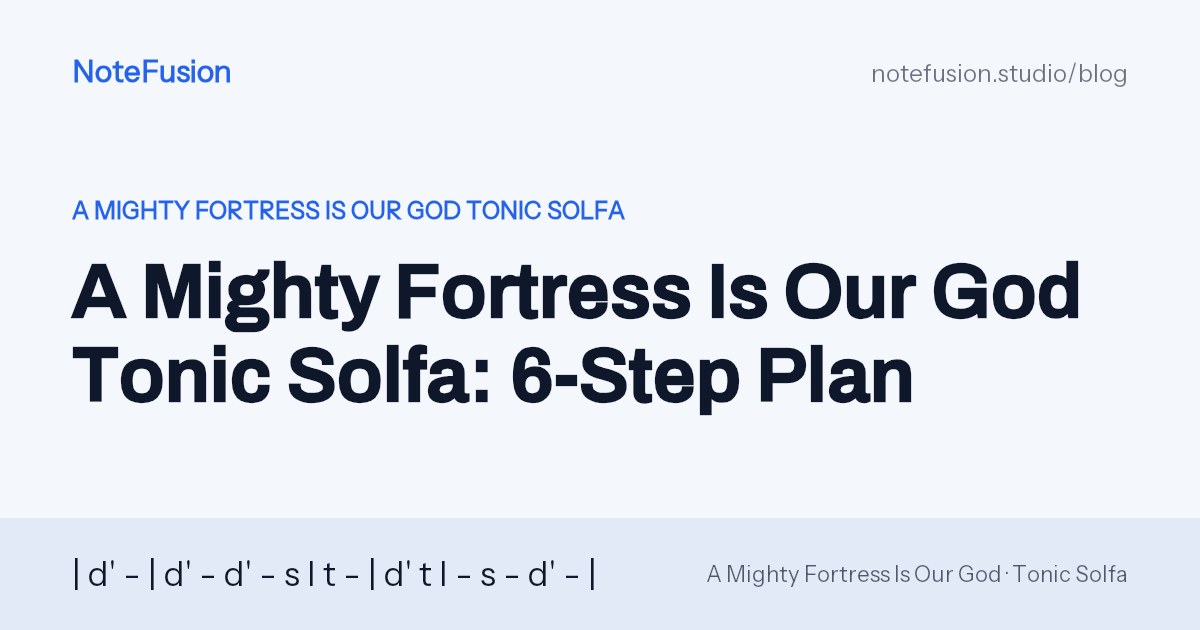
The hymn is on the list for Sunday, the organist will play it in D, and half your choir has only ever sung it from the back of a congregation. They know the sound of it, but put the music in front of them and the first line comes out ragged: the opening "A" is late, the run down from the top note smudges, and somebody breathes in the middle of "fortress".
A Mighty Fortress Is Our God tonic solfa, in D major with doh on D, begins on high doh (d') as a pickup, repeats it, drops to soh, climbs s l t back to d', then runs d' t l s and leaps up to d' for the next line. Learn that opening shape first and the rest of the hymn sits on familiar ground.
In this post I'll walk through those opening bars, show where the breaths go, and give you a rehearsal order that gets the melody secure in every section before anyone touches the alto, tenor or bass line.
A Mighty Fortress Is Our God tonic solfa: the opening bars
Here are the first three bars from the A Mighty Fortress Is Our God hymn page, in D major as printed there:
| d'A- | d'might--d'y-sfor-l_ttress- | d'ist_lour-sGod,-d'A- |
Read it slowly and you will see the whole character of the tune in eleven notes:
- The pickup. The very first d' stands alone before the first bar line. That is the word "A", and it comes on the last beat of an imaginary bar.
- Repeated high doh. Two more d' notes start the first full bar. Three of the same note in a row sounds easy, but it is where choirs drift flat, because nobody is listening for the pitch once they have "found" it.
- The drop and the climb. From d' the tune falls to s, then walks back up s l t. Those three notes in the first bar are paired, so each takes half a beat, and t pulls hard towards the d' that follows.
- The run down. Bar two goes d' t l s, again with the first two notes paired. This is the falling scale that people recognise as the sound of the hymn.
- The leap back up. After landing on s, the last note of the excerpt jumps up to d'. That d' is the pickup "A" for the next line, so the shape starts again.
The apostrophe on d' simply means the doh above the ordinary one. If any of your singers stumble on that mark, the article on octave marks in tonic solfa explains it in a few minutes.
Got a recording? Get it in solfa →
What does the key of D major mean for each voice?
It means doh is D, so the opening d' is the D near the top of the treble stave, a comfortable starting note for sopranos and a reachable one for most altos singing the tune in unison. Here is the D major scale with letter names, so your keyboard player and your singers are using the same map:
| dD-rE-mF♯-fG- | sA-lB-tC♯-d'D- |
The practical point is that this tune starts at the top and works downwards, which is the opposite of most hymns. Your singers need to arrive on that first d' with the voice already placed and supported, not creep up to it. If your choir is tired, young, or mostly lower voices, the same syllables work in a lower key, and nothing about the solfa changes except where doh sits:
| d'A- | d'might--d'y-sfor-l_ttress- | d'ist_lour-sGod,-d'A- |
Same d', same s l t, same run down, just a tone lower with doh on C. My advice: agree the key with your organist before the first rehearsal, not on Sunday morning, because a hymn that opens on its top note is unforgiving if the key is wrong. The guide on choosing the right key for your choir covers how to decide. In NoteFusion, "Transpose for my choir" moves the doh and shows whether each part sits comfortably, which saves a lot of guesswork.
How do you sing Ein feste Burg with the pickup in time?
You sing Ein feste Burg in time by breathing on the beat before the "A" and placing that first d' as the last beat of a bar, not the first. The commonest fault with this hymn is that the choir waits for a downbeat that never comes and the first word lands late.
Try this at your next rehearsal:
- Count "1, 2, 3" aloud at the speed you want.
- Everyone breathes on "3".
- Everyone sings d' on "4", and the next d' lands on the new "1".
Do it four or five times on the first two notes only, until the entry is clean. If the idea of an upbeat is new to some of your singers, send them this explanation of the pickup note before rehearsal.
The same thing happens at the end of the excerpt. The words read "is our God, A", and the final d' belongs to the next line. That means the breath after "God" has to come out of the s that ends the phrase. Sing s for nearly its full length, then breathe quickly and leap up to d'. Choirs that hold s too long come in late on the second line; choirs that cut it short sound breathless and hurried. Practise the join on its own: s, breath, d'.
Reading the rhythm: paired notes and held notes
In the even-note version on our hymn page, most notes take one beat and a few are paired into half beats: s l in the first full bar and d' t in the second. Those pairs are where words and notes stop lining up one-to-one, so singers need to know which syllable carries across two notes. Mark the slurs in pencil on everyone's copy before you sing a word.
Phrase endings are the other thing to watch. In this hymn each line closes on a note that should be given its full value before the breath, and many hymnals add a pause sign at those points. Check the book your congregation uses, because some editions print an older, more rhythmic version of Ein feste Burg with syncopations and longer notes in different places. Choose one version and make sure the choir, the organist and the congregation's books agree.
If the dashes and half-beat pairs in a solfa line are still a puzzle for your singers, how to read rhythm in tonic solfa goes through beats, dashes and rests with examples.
Two habits keep the long lines of this hymn steady:
- Keep the vowel going through the paired notes. Don't re-start the sound on the second note of a pair; let it flow from the first.
- Breathe only at the commas. The lines are long enough that singers are tempted to snatch air mid-phrase. Agree the breath points as a choir and mark them with a tick.
A rehearsal order for the melody before the parts
This is the order I would use for a Reformation Sunday hymn that needs to be ready in two or three rehearsals. It follows the same thinking as teaching a choir a new song: everyone learns the tune first, then the parts layer on top.
- Sing the run on solfa. Everyone, every voice, sings d' t l s slowly on the syllables, then fast. Then s l t d' going up. Five minutes, no words.
- Add the opening. Pickup d', repeated d', drop to s, climb to d', run down, leap up. Still on solfa, still everyone together, men singing an octave lower.
- Put the words on the first section. Once the solfa is clean, swap in the words of the first two lines. Watch the slurred syllables.
- Use the repeat. Ein feste Burg is built so that its opening section comes round again with new words. Tell the choir this before you start; when they realise that learning the first lines gives them the next lines free, confidence goes up quickly.
- Learn the second half by phrases. Take the remaining lines one at a time on solfa, then words, joining each new phrase to the one before.
- Sing the whole melody twice in unison. Only move on when the tune survives without the keyboard doubling it.
If you have a recording of the hymn sung the way your church does it, NoteFusion can turn it into solfa and play the melody back slower or looped, so singers can drill one phrase at home between rehearsals.
Adding the choir parts to A Mighty Fortress
With a choir that knows the melody, A Mighty Fortress choir parts go on quickly. My order is bass first, then alto and tenor together, because the bass line gives everyone the harmony underneath and makes the inner parts easier to hear.
- Basses: Sing your line on solfa against the sopranos holding the tune. Listen for where you land on doh at the ends of phrases; those notes anchor the whole choir.
- Altos: Your part will often move in thirds or sixths with the melody. Sing it slowly against the sopranos so you hear the interval rather than drifting onto the tune.
- Tenors: Hold your line steady against the basses first, then add the upper parts. Tenors who know the melody well have to resist sliding back onto it.
- Sopranos: You already have it. Your job now is to keep that opening d' bright and in tune while three other lines move underneath you.
One combined run-through at the end of rehearsal, at Sunday speed, tells you which phrases still need a section on their own next time.
Reformation Sunday hymn solfa: a final check before the service
Before you sing this as your Reformation Sunday hymn, run through this short list:
- The organist and choir agree on the key, and everyone knows where doh is.
- The pickup "A" comes in together on the first verse and every verse after.
- Breath points are marked, and nobody breathes inside "fortress" or across a slur.
- Phrase endings get their full value before the breath, especially the s before each leap up to d'.
- The version in the choir's copies matches the congregation's books.
The opening shape, high doh falling to soh and climbing back, carries the whole hymn. Get that clean and in time, and the rest follows.
If you want to practise with the melody playing, open the A Mighty Fortress Is Our God solfa page or bring your own recording to NoteFusion, where you can hear the tune slowly on piano, transpose it for your choir and share the sheet with a link.
Frequently asked questions
What key is A Mighty Fortress Is Our God in for tonic solfa?
The NoteFusion page gives it in D major, so doh is D. The tune opens on high doh, written d', which is the D in the middle of most sopranos' range.
What is the first note of A Mighty Fortress Is Our God in solfa?
It starts on high doh, d', sung as a pickup before the first full bar on the word "A". The next two notes are also d' before the melody drops to soh.
Is A Mighty Fortress the same tune as Ein feste Burg?
Yes. Ein feste Burg is the German name of the hymn and its tune, and the English words are sung to it. Some books print the older rhythmic version and others an even-note version, so check which one your choir is reading before rehearsal.
How do I teach A Mighty Fortress to a choir quickly?
Teach the melody to everyone first, starting with the downward run from high doh to soh, then the pickup entry. Because the opening section repeats with new words, learning it once covers two lines. Add bass, then alto and tenor, only when the tune is secure.
Why does my choir come in late on A Mighty Fortress?
The opening word is a pickup on the beat before the bar line, so singers who wait for beat one arrive late. Count the bar in aloud and have everyone breathe on the beat before the "A".