How to Write a Rest in Tonic Solfa: Blank Beat vs Dash
How to write a rest in tonic solfa: leave the beat blank, never a dash. See rests and held notes side by side, plus a clap drill for tonight.
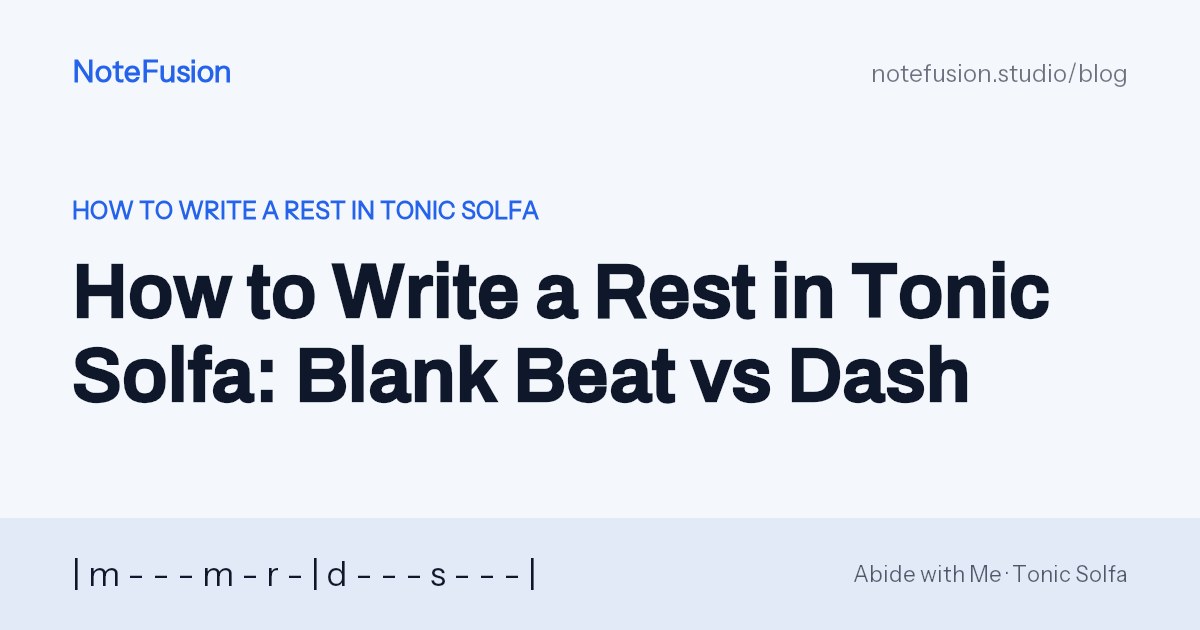
Your altos sing straight through a gap the composer meant as silence, while your tenors cut a long note short because they read the dash as a pause. Same page, two opposite ideas, and the phrase falls apart before the words even start.
Here is how to write a rest in Tonic Solfa: leave the beat empty. Keep the bar line and the beat marks in place, but write nothing in the space for that beat. A dash means the opposite: the note before it keeps sounding through the beat. An empty beat is silence; a dash is a held note.
That one distinction clears up most rhythm arguments in a rehearsal. Below I set the two side by side, show you how to write rests shorter than a beat, explain where to breathe when no rest is printed, and give you a clapping drill you can run at your next practice before anyone sings a note.
How to write a rest in tonic solfa
The rule fits on one line, but writing it cleanly takes a little care, especially if you are copying out a part by hand or for a new choir. My method:
- Count the beats in the bar first. In 4/4 you need four beat spaces; in 3/4, three. Mark them out before you write any syllables.
- Write the syllables that sound in their beats.
- For a beat that is held, put a dash in it. The dash belongs to the note on its left.
- For a beat that is silent, leave the space blank but keep the beat marks either side of it. Never delete the space itself, or the bar will be a beat short.
- Read the bar back aloud using time names or simply counting, saying the syllable on sounding beats, "hold" on dashes and nothing on blank beats.
Step 4 is where most mistakes happen. If you squeeze the gap out, the rest disappears and the next note arrives early. The empty space is not a missing note; it is a written instruction to be silent for exactly that long.
If beats, colons and dots are still new to you, read how to read rhythm in Tonic Solfa first, then come back here.
Got a recording? Get it in solfa →
What does an empty beat mean in solfa?
An empty beat means silence that still takes up time. The pulse carries on; you just do not sing in it.
This is why singers new to solfa find rests harder to see than in staff notation. On the stave, a rest is a symbol you can point at. In Tonic Solfa, a rest is the absence of a symbol. The eye slides over it, and the voice follows the eye. In older hymn books, where beats are separated by colons, a rest shows up as two beat marks with nothing between them, or as a bar that begins with a mark and a gap before the first syllable.
So teach your singers to look for gaps, not just syllables. A useful habit: whenever two beat marks sit close with white space between them, the section leader taps the page and the whole section says "rest" together. After a few weeks people start noticing empty beats on their own.
Rest vs held note in tonic solfa: side by side
The dash is the symbol singers see most often after the syllables themselves, so let us look at it properly. Here are the opening bars of Abide with Me, which is full of held notes:
| mA----mbide-rwith- | dme;---sfast--- |
The blocks on this blog lay each bar out as a row of time slots rather than using the colons you see in a printed hymn book, but the dash means the same in both. Every dash after a syllable keeps that syllable sounding. On "me" the d carries on through its dashes, and the s that follows on "fast" does the same. There is no silence anywhere in these two bars, even though the page looks spacious.
Now picture the same bars with one of those dashes rubbed out and the slot left blank. The note would stop at that point, the choir would hold its breath through the empty slot, and the next syllable would come in on time. The length of the bar would not change at all. Only the sound would.
| What you see | What it means | What the choir does |
|---|---|---|
| A syllable (d, m, s,) | A new note starts | Sing it, with a fresh consonant if the words have one |
| A dash after a syllable | The same note continues | Keep the sound going, same vowel, no new attack |
| An empty beat or slot | A rest | Stop the sound, keep counting, often breathe |
The practical difference shows up in the words. Through a dash, you sustain the vowel and save the final consonant for the end. Before a rest, you place the final consonant at the start of the empty beat so the silence is clean. Choirs that confuse the two either chop held notes into pieces or smear sound across a gap the composer wanted silent.
How do you write a rest shorter than a beat?
You divide the beat the same way you would for short notes, then leave one part of it empty.
- Half-beat rest: a beat split into two halves is shown with a dot in the middle. Write the syllable on one side of the dot and leave the other side blank. A blank before the dot means you are silent for the first half and sing on the second, which is common at the start of a phrase. A blank after the dot means you sing on the first half and stop for the second.
- Quarter-beat rest: quarter beats use a comma inside the half beat. The same idea applies: the empty quarter is the silence. For more on the comma's two jobs, see what a comma means in Tonic Solfa.
- A whole bar of rest: leave every beat in the bar blank but keep all the beat marks. Section parts in anthems often do this while another voice sings alone. Count the bar out loud in rehearsal until it is automatic.
The principle never changes: the dividing marks stay, the syllable goes. If the dot or comma vanishes along with the syllable, nobody can tell whether the silence is half a beat or a whole one.
Where do choirs breathe when no rest is written?
Mostly at the end of a held note, by shortening it slightly. Many hymn tunes have no printed rests at all, because the long note at the end of a line does the job. Look at the opening of Amazing Grace:
| s,A-- | dmaz----mingd_ | mgrace!---rhow- | dsweet---l,the- | s,sound,---s,That- |
In the last bar shown, s, on "sound" is held with dashes, and then a second s, arrives as the pickup for "That". There is no blank beat between them. If your choir sings exactly what is written, nobody has time to breathe before the next line.
So you, as director, turn part of that held note into a rest. My advice is to decide it once and mark it on everyone's copy: "cut off after two beats" or "breathe on the last dash". Then rehearse the cut-off as a rest, not as a fade. The note stops together, everyone breathes in the stolen time, and the pickup lands on the beat. If you want a held note to stretch longer instead, that is a pause sign, which works differently; I cover it in the pause sign in Tonic Solfa hymns.
The reason this matters for reading: a singer who knows the difference between a written rest and a breath taken from a dash will not argue with your markings. They will see that you have converted part of a held note into silence on purpose.
The clap-the-rests drill: try it tonight
This takes about five minutes and works with any hymn in the folder. I like doing it on a line the choir already half knows, because they stop worrying about pitch and start seeing the rhythm.
- Pick one line and put it in front of everyone. Amazing Grace above works well if you add your own breath mark at the end of bar 5.
- Set a slow, steady pulse. Tap it on the music stand or have one person click their fingers.
- Clap on every syllable. One clap per new note, no matter how long it lasts.
- Press your palms together on every dash. Keep them joined for the length of the held note. Everyone should see a row of joined hands.
- Open your hands wide on every empty beat or breath mark, palms facing out, and stay silent. This is the important part: the silence gets its own gesture so nobody can skip it.
- Run the line twice, then speak it. Say the solfa syllables in rhythm, sustaining them through dashes and dropping out on the open-hands beats.
- Only now sing it. Keep the hand gestures for the first sing-through if the choir is willing.
Watch the open hands in step 5. If a section opens late, they are sliding through rests; if they open early, they are cutting held notes short. You will see the problem before you hear it, and you can fix it in seconds rather than after three wrong runs.
For a harder version, give the sections different lines with rests in different places and run them together. Altos clapping while sopranos have open hands is very good training for independent entries.
Writing rests in your own sheets
When you copy out parts or write down a new song, rests are the first thing to go missing, especially on a computer. Word processors love to collapse extra spaces, and a blank beat can quietly vanish when you change font or paste the line into a message. Two habits help:
- Keep every beat mark visible and line them up in a fixed-width font so blank beats stay the same width as full ones. The guide to typing Tonic Solfa on a computer shows how to set this up.
- After typing, count the beats in each bar. If a bar with a rest comes up short, the gap has collapsed.
If you composed the tune yourself, sing it into your phone first and listen for where you actually stop the sound. Those are your rests; where you keep singing the same vowel, those are your dashes. The full process is in how to write down a song you composed in solfa.
One last check before you hand the sheet out: read it once making sound only where the page tells you to. If you find yourself humming through a blank beat, either the rest is wrong or you have been singing the song wrongly for years. Both are worth knowing before Sunday.
If you are learning a song from a recording and cannot tell whether a gap is a rest or just a singer's breath, NoteFusion can help: hum the line or paste a link, and it writes out the melody in Tonic Solfa with staff notation, then plays it back on a piano, slower or looped, so you can hear exactly where the sound stops. You can try it in your browser at NoteFusion.
Frequently asked questions
How do you show a rest in tonic solfa?
You leave the beat empty. The bar lines and beat marks stay in place, but nothing is written in the space for that beat, so the singer stays silent until the next syllable.
What does a dash mean in tonic solfa?
A dash means the note before it carries on sounding through that beat. It is a held note, not a silence.
What does an empty beat mean in solfa?
An empty beat is a rest. The beat still passes in time, so you keep counting, but you make no sound.
How do you write a half-beat rest in tonic solfa?
Split the beat with a dot as you would for two half-beat notes, then leave one side of the dot empty. The empty half is the rest.
Where should a choir breathe if there is no rest written?
Usually at the end of a long held note before a new phrase. The director decides how much of the held note to shorten, and everyone cuts off together.