All Things Bright and Beautiful Solfa for Kids: 5 Steps
All Things Bright and Beautiful tonic solfa for children in C major: teach the refrain with hand signs first, then add one verse each session.
Your Sunday school class has a few weeks to learn a song for the harvest service. Half of them cannot read the hymn book yet, the printed version has more verses than their attention span, and the key it sits in makes some of them shout and others growl. All Things Bright and Beautiful is the right song for them. The secret is the order you teach it in.
All things bright and beautiful tonic solfa for children works best in C major, where doh is C and the refrain stays within a single octave. Teach the refrain first, by echo and Curwen hand signs, until the children can sing it from your signs alone. Then add one verse per session, singing the refrain between each.
That is the whole method. Below you will find the refrain in solfa, the hand signs it needs, a session-by-session plan for the verses, harvest service ideas, and the snags I would watch for at your next practice.
Why teach All Things Bright and Beautiful in C?
Because doh is C, and C is the easiest note in the room to find. On a piano it is the white key just to the left of any pair of black keys. If your classroom has chime bars or a glockenspiel, C is clearly marked. Whoever is leading, even a volunteer who does not play, can find the starting note without fuss.
There are three more reasons I like All Things Bright and Beautiful in C for young singers:
- A clean key signature. No sharps or flats, so the staff notation printed alongside the solfa is uncluttered for any child who is starting to read notes.
- A comfortable middle range. Children's voices are light. In C the refrain sits where they can sing gently, without straining upwards or dropping into a mumble.
- Easy accompaniment. A pianist, a guitarist or a ukulele player can all manage C without much practice.
The full tune in C, with solfa and staff notation together, is on the All Things Bright and Beautiful solfa page. Print it for your helpers; the children will learn by ear and by hand sign.
Got a recording? Get it in solfa →
The refrain in solfa: what the children will sing
Here are the first four bars, the opening of the refrain that frames every verse:
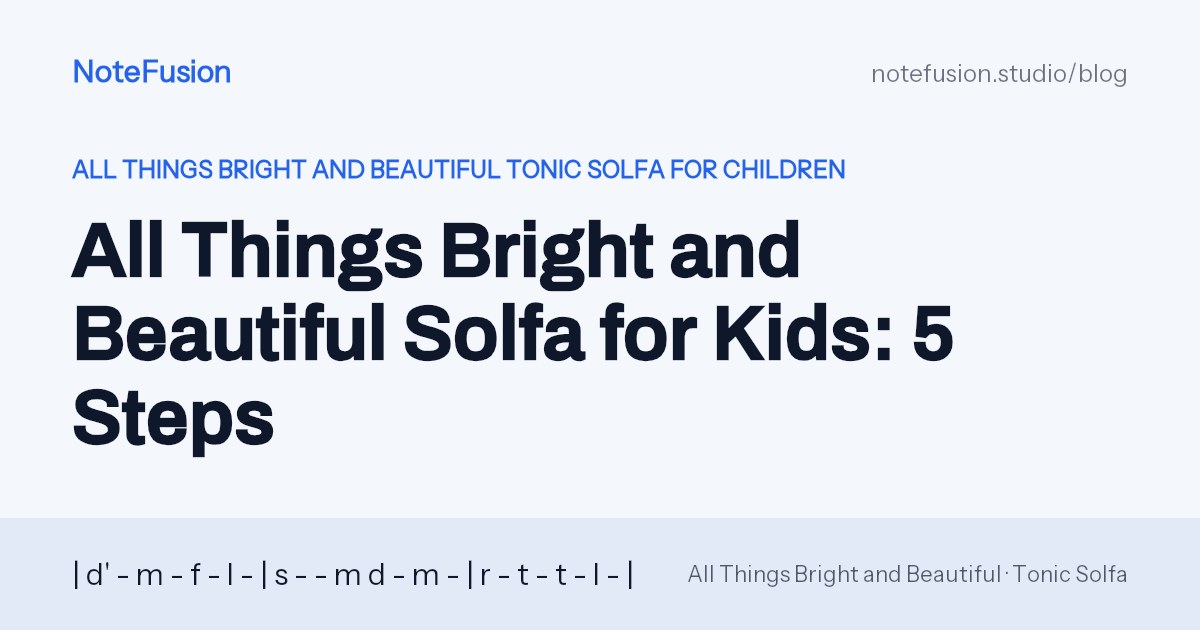
| d'All-mthings-fbright-land- | sbeau---mti-dful,-mAll- |
| rcrea--ttures-tgreat-land- | ssmall,------- |
A few things to notice before you teach it:
- There is no pickup. The song starts on the first beat of the bar, so you can count "one, two, three, four" and the children all come in together on "All".
- The first bar is four even beats. "All things bright and" moves one syllable per beat. It starts on top doh, drops down, then climbs back up. Clap it before you sing it.
- "Beau-ti-ful" has a long-short pattern. The soh on "beau-" is held a little longer, and the note after it is quick. Children tend to even this out, so clap it slowly a few times.
- Te appears on "great". It is the note that leans up towards doh, and it is the one most likely to sag. The hand sign helps: a finger pointing upwards reminds them to keep it bright.
- "Small" is held for a full bar. Four beats on soh. Ask the children to hold it for four silent claps before they breathe.
How do you teach the refrain with hand signs?
Teach only the signs the refrain needs, practise them on the C major scale, then echo the refrain in short chunks with signs first and words second. If you have not used the signs before, my guide to Curwen hand signs describes each one in detail with warm-ups to go with them.
Start with the scale itself:
| dC-rD-mE-fF- | sG-lA-tB-d'C- |
These are the signs you will use:
| Syllable | Hand sign | What to tell the children |
|---|---|---|
| doh | A closed fist | Home base, strong and solid |
| me | A flat hand, palm facing down | Calm and level |
| fah | A fist with the thumb pointing down | Wants to fall a step |
| lah | A relaxed hand, drooping from the wrist | Soft and floppy |
| soh | An open hand, palm facing you | Bright and open |
| ray | A flat hand slanting upwards | On its way up |
| te | Index finger pointing up | Wants to reach home to doh |
Then work through the refrain like this:
- Sing the C major scale up and down with signs. Hold your hand at waist height for doh and lift it a little for each step, so the children see the pitch rise and fall.
- Give the starting note. Play or sing C, sing "doh" with the fist sign, and have them sing it back. If you have no instrument, my notes on giving a choir the starting note will help.
- Echo bar 1 on solfa with signs. You sing and sign; they sing and sign back. Repeat until it is steady.
- Add bar 2, then join bars 1 and 2. Keep the chunks short. Two bars at a time is plenty for a young class.
- Do the same with bars 3 and 4. Make a game of the long soh on "small": whoever lets go before four claps has to start again.
- Play the silent-sign game. You sign without singing; they sing what your hand shows. This is the moment you find out whether the tune is really in their heads.
- Swap solfa for words. Sing the refrain on the words while you keep signing. The signs now act as a map, so when the words slip the tune does not.
That is a full session for most children. Stop while they are still enjoying it.
Adding the verses one at a time
The verses use a different tune from the refrain, but every verse shares that same verse tune. So the hard work happens once, on the first verse. After that, each new verse is just new words.
Hymn books differ in how many verses they print, so check yours and choose the ones you want. Here is a plan that works for a group meeting weekly:
| Session | What to teach | How to finish |
|---|---|---|
| 1 | Refrain only, on solfa then words | Refrain twice, signs only the second time |
| 2 | Verse 1 tune by echo, two lines at a time | Refrain, verse 1, refrain |
| 3 | Verse 2 words on the known tune | Refrain, verses 1 and 2 with refrain between |
| 4 | Verse 3 words | Full run so far |
| 5 | Any remaining verses, or a polish session | The whole hymn, start to finish |
Two tips make the verses stick:
- Use picture cards. One card per verse: a flower and a bird for "Each little flower that opens", a mountain and a river for "The purple-headed mountain, the river running by", a winter wind and a summer sun for the seasons verse. Hold up the card before the verse starts. Non-readers follow the pictures; readers follow the words.
- Always sing the refrain between verses. It gives the children a rest from new material and something they know they can sing well.
If you want to teach the verse tune with signs as well, look it up on the hymn page and work through it two bars at a time, exactly as you did the refrain.
All things bright and beautiful tonic solfa for children at harvest
This is one of the most natural harvest songs for kids in solfa, because the words walk through the whole of creation and the seasons. The verse that begins "The cold wind in the winter, the pleasant summer sun" goes on to the ripe fruits in the garden, which makes an obvious place for the children to carry up their harvest gifts.
A few ways to use it in an all things bright and beautiful children's choir item:
- Children sing the refrain, everyone sings the verses. If time is short, this is the simplest option. The children only need the refrain secure, and the congregation carries the verses.
- One verse per class. In a larger Sunday school or school assembly, give each age group its own verse and have everyone join in the refrain.
- Procession during the harvest verse. Children bring fruit and vegetables to the front while the seasons verse is sung, then return to their places on the refrain.
If you are building a harvest service around it, two other hymns pair well: We Plough the Fields and Scatter and Come, Ye Thankful People, Come. For more songs with small ranges and stepwise tunes that suit beginners of any age, see my list of easy hymns for a new choir.
What if C does not suit your group?
C suits most young voices for this refrain, but listen at the first session. If the children sound growly or quiet on the lower notes, move doh up a step to D. If the older ones in a mixed group are straining, try a step lower. Because solfa is movable doh, nothing changes for the children: the syllables and hand signs stay exactly the same, only the starting note moves.
This is where NoteFusion's "Transpose for my choir" helps. It moves the doh and shows whether each part sits comfortably, so you can try D or B flat before you print anything. The same thinking about key applies to Christmas: in my guide to Away in a Manger tonic solfa for children I use the same echo-and-sign method and look at how to pick a better key for small voices.
Snags I would watch for
- Cutting "small" short. Children breathe as soon as the word is out. Keep counting the four claps until holding it is a habit.
- Ironing out "beau-ti-ful". If the long-short pattern turns into three even notes, go back to clapping it on its own, then sing it on "doo" before adding words.
- A flat te on "great". Point your finger up and ask them to think upwards. Singing te and then resolving to doh a few times as a warm-up helps.
- Shouting on "bright". Excitement makes children push. Ask for a bright sound, not a loud one, and model it yourself.
- Losing the order of the verses. Lay the picture cards out in order on the floor or pin them to a board where everyone can see them.
If your church sings a different version, or you want helpers to practise at home, you can hum the tune or paste a recording link into NoteFusion. It writes the melody in movable-doh solfa with staff notation, plays it back on a piano slower or looped, and lets you share the sheet with a link.
Frequently asked questions
What key is best for teaching All Things Bright and Beautiful to children?
C major works well because doh is C, the key signature has no sharps or flats, and the refrain stays within one octave. If your group sounds growly on the low notes, move doh up to D.
Should children learn the refrain or the verses first?
Teach the refrain first. It comes back after every verse, so the children sing it most often, and confidence on the refrain carries them through new verse words.
Which Curwen hand signs does the refrain use?
The opening of the refrain uses all seven notes of the major scale. Teach the signs on the C major scale first, then use them to echo the refrain bar by bar.
How many sessions does it take to learn All Things Bright and Beautiful?
A workable plan is one session for the refrain, one for the first verse and its tune, then one new verse per session after that. Shorten it by giving some verses to a soloist or the congregation.
Is All Things Bright and Beautiful a good harvest song for children?
Yes. Its verses name mountains, rivers, seasons and the ripe fruits in the garden, which suits a harvest service, and the repeated refrain lets even the youngest singers join in.