Almost Persuaded Hymn Tonic Solfa: Sing It in G
Master Almost Persuaded hymn tonic solfa in G major. Learn the melody, shape pleading altar call phrases, and steady your choir parts.
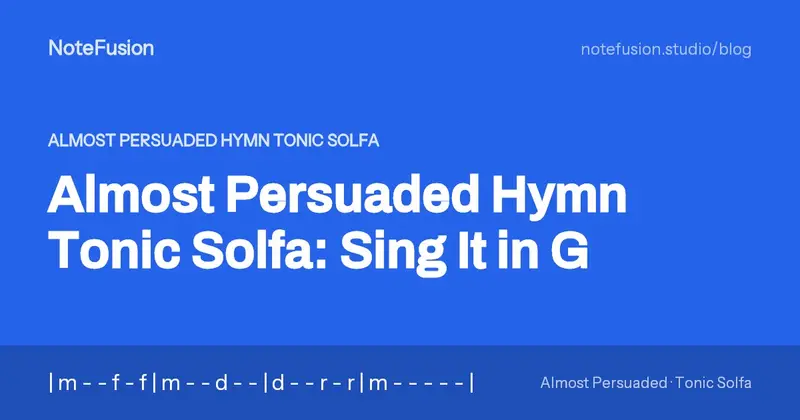
Your pastor closes the sermon, steps down toward the aisle, and signals for the invitation hymn, but your singers hesitate because the tempo drags and the final cadence sounds uncertain. When leading moments of commitment, an insecure entry or breathy phrasing instantly breaks the congregation's focus.
Mastering the almost persuaded hymn tonic solfa gives your ensemble the exact road map needed for Philip P. Bliss’s beloved invitation hymn. With doh set on G, the hymn moves in a gentle 6/8 compound lilt, using simple stepwise phrases that allow singers to convey urgency and warmth without forcing vocal tone.
Here is how to read Almost Persuaded in Tonic Solfa, shape its pleading lines, and prepare your choir to minister effectively on Sunday.
Almost Persuaded Hymn Tonic Solfa: The G Major Opening
To sing this hymn well, you must grasp how the tune establishes its quiet, pleading character from the very first bar.
| m“Al---fmost-fper- | msuad---ded”-- | dnow--rto-rbe- | mlieve;----- |
In standard hymnals, singing almost persuaded in g major places doh directly on G. The melody begins not on the home note, but on me (B). Notice the contour: the first bar leans gently upward from me to fah, before floating down to doh in bar 2. It then rises from ray back to me in bars 3 and 4.
This gentle wave—resting first on doh, then on me—is what gives the hymn its reflective mood. Because 6/8 time carries two primary pulses per measure, your singers should feel each bar as two distinct beats rather than six frantic pulses. The entry on me takes the strong first beat, while the fah sits on the second pulse, creating an unhurried, natural speech rhythm.
Got a recording? Get it in solfa →
How Do You Find Doh in Almost Persuaded?
You find doh by locating the single sharp in the key signature, which marks F sharp as te, placing doh on G.
For church musicians using Tonic Solfa without staff notation, the page simply marks "Key G". When establishing the pitch with your choir, give G on the pitch pipe or keyboard as doh. From there, have all voice sections sing the triad downward and upward:
- Sound doh (G).
- Hum doh – me – soh to tune the chord.
- Have your sopranos isolate me (B) as their starting pitch.
- Check that basses find low doh or low soh so the root of the chord sits firmly in place.
Because the piece is quiet and meditative, choirs often make the mistake of humming the pitch too softly, which leads to singing flat from the first phrase. Ensure the choir hums their starting chord with tall vowels and good breath support before opening into the first word.
Shaping the Slow, Pleading Phrases with Breath and Dynamics
An altar call hymn demands deliberate control. If your choristers breathe whenever they run out of air, the pleading continuity of the text shatters.
Philip Bliss structured each four-bar phrase to mirror spoken persuasion. Consider bars 1 to 4:
- Bar 1–2: “Almost persuaded” now to believe;
- Bar 3–4: “Almost persuaded” Christ to receive;
Choirs frequently take an audible gasp between “persuaded” and “now”. That break ruins the sentence. Instruct your choir to take a full, silent breath before bar 1, sing straight across the two bars on a sustained legato line, and take a quick catch-breath only at the bar line after "believe".
Dynamic shaping in Tonic Solfa works hand in hand with the pitch contour. In bar 1, when the melody steps up from me to fah, encourage a delicate crescendo (m to f). As the line settles down to doh on "believe", drop the volume back to pianissimo. This subtle swelling and receding creates a sincere, persuasive dialogue rather than a monotonous drone.
For clarity in text delivery, review our guide on choir diction tips for clear words to prevent final consonants like "d" and "st" from disappearing during soft singing.
Rehearsing Almost Persuaded Choir Parts
When preparing almost persuaded choir parts, the biggest challenge is balance. In typical four-part harmony, the inner voices—alto and tenor—provide the tender warmth that supports the soprano line.
Here is how each section functions across the arrangement:
| Voice Part | Primary Range | Solfa Role | Common Pitfall | | :--- | :--- | :--- | :--- | :--- | | Soprano | D4 – D5 | Carries the melody from me to doh | Rushing the dotted quavers | | Alto | B3 – G4 | Moves around doh and soh, with sweet thirds | Dropping volume on lower notes | | Tenor | G3 – E4 | Supplies gentle upper harmony around me | Singing too brightly over the melody | | Bass | G2 – C4 | Anchors the roots on doh, fah, and soh | Dragging the compound beat |
During invitation moments, the choir must not overpower the preacher or the quiet reflection of the congregation. Keep the tenor voice covered and warm. Have your tenors rehearse their line on neutral syllables like "noh" or "doo" to eliminate vocal harshness before adding the text.
If you want your choristers to practise their respective harmony lines independently between weekly services, encourage them to read how to learn your choir part at home so rehearsal time can focus entirely on blend and expression.
Why This Hymn Works Best Among Altar Call Hymns for Choir
Churches have long selected specific altar call hymns for choir because of how music interacts with human emotion at pivotal moments. Songs like Just as I Am and I Surrender All offer surrender, but Almost Persuaded addresses hesitation.
The hymn was inspired by Acts 26:28, where King Agrippa tells the Apostle Paul, "Almost thou persuadest me to be a Christian." Bliss captured the tragic weight of delay in the final stanza:
"'Almost' cannot avail; 'Almost' is but to fail!
Sad, sad, that bitter wail—'Almost'—but lost!"
Musically, the tune never strains high into the vocal register. By staying between D4 and D5, the melody invites quiet interior thought. There are no sudden leaps across sixths or octaves, meaning an untrained congregation can join in effortlessly by verse two. When sung with unified vowels and tender restraint, the music underlines the sermon’s appeal without theatrical manipulation.
A 3-Step Plan for Your Next Rehearsal
To teach this hymn cleanly in twenty minutes tonight, use this structured three-step routine:
Step 1: Speak the Solfa in 6/8 Time (5 Minutes)
Have the entire choir clap the two dotted-crotchet beats per measure while chanting the solfa syllables in rhythm:
- Beat 1: me
- Beat 2: fah
- Beat 1: me
- Beat 2: doh
Ensure singers do not clip the held notes. The dash in tonic solfa indicates sustained sound; in bar 4, me is held across both main pulses. Make sure singers count the full value before taking a clean breath together.
Step 2: Unison Pitching on Vowels (5 Minutes)
Have all four sections sing the melody together in unison on the vowel "oh". Listen for clean intonation when stepping between me and fah. A semitone step can easily sag; remind the singers to keep their soft palates lifted so fah does not go flat.
Step 3: Layer the Harmony at a Soft Dynamic (10 Minutes)
Bring in the bass and soprano parts first. When the outer shell is secure, add the altos and tenors. Emphasise that this hymn should never rise above a mezzo-piano. If a singer feels they cannot hear the person next to them, the choir is singing too loudly for an altar call setting.
Refining Your Choir's Music with NoteFusion
If you have an audio recording of your choir or want to generate clear solfa sheets for your singers, NoteFusion can assist. You can paste a song link or hum a melody directly into the app, and it transcribes the tune into movable-doh Tonic Solfa alongside staff notation.
When a hymn sits in a difficult register, the "Transpose for my choir" tool moves doh and checks whether every part sits comfortably for your singers. You can slow down playback, loop difficult bars, and share clean practice sheets directly with your choristers. Try it in your browser or on Android at NoteFusion.
Frequently asked questions
What key is Almost Persuaded usually sung in?
Almost Persuaded is traditionally set in G major, placing doh on G. This keeps the melody comfortably between D4 and D5 for church congregations and choirs.
What is the time signature of Almost Persuaded in tonic solfa?
The hymn is written in 6/8 compound time. In tonic solfa, each bar contains two main dotted-crotchet beats, felt as two gentle pulses of three quavers each.
What is the starting note of Almost Persuaded?
The melody starts on the third degree of the scale, me (B natural in the standard key of G major), moving smoothly to fah on the unaccented pulse.
Why is Almost Persuaded used for altar calls?
Philip Bliss composed the hymn with an intimate, repetitive melodic arch specifically designed for moments of decision, allowing words of warning and invitation to carry clearly over quiet harmonies.