Am I a Soldier of the Cross Tonic Solfa: SATB Plan
Master Am I a Soldier of the Cross tonic solfa in F major. Follow a step-by-step SATB rehearsal plan and steady home practice with audio playback.
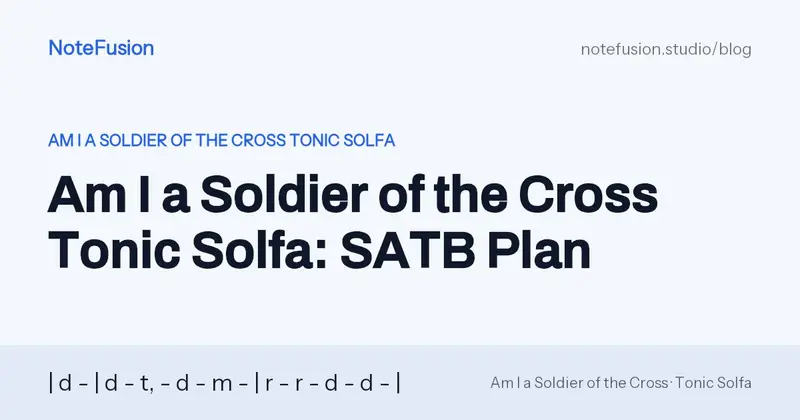
Sunday morning is approaching, your choir is scheduled to minister, and the tenors are still guessing their notes while the altos drift into the soprano line. When you need a resolute hymn that builds confidence across every voice section, turning to am i a soldier of the cross tonic solfa gives your choristers an immediate, pitch-perfect road map.
Learning am i a soldier of the cross tonic solfa in F major sets doh firmly on F, opening with a decisive pickup note on doh before stepping down to te, and climbing smoothly through ray to me. In standard four-part harmony, this hymn uses stable, stepwise movement and predictable cadences, allowing an SATB choir to master every part in a single rehearsal.
You can view the full score, key settings, and solfa grid directly on the Am I a Soldier of the Cross tonic solfa page. In this guide, I will show you how to break the hymn down voice by voice, rehearse each section cleanly, and establish a simple home-practice routine.
What is the tonic solfa for Am I a Soldier of the Cross?
The hymn tune (often paired with the tune Arlington) is set in common time (4/4) with doh on F. Here are the opening bars of the melody:
| dAm- | dI-t,a-dsol--mdier- | rof-rthe-dcross,-dAnd- |
Notice how the melody establishes the tonal centre straight away. Setting am i a soldier of the cross in f places the melody in a comfortable range for congregational singing and choral unison. The pickup note on beat four is doh, which dips to the leading note te, below before returning to doh and rising to me. Because the tune does not leap erratically, choristers who read movable doh can sight-sing the phrase without stumbling.
When teaching this opening to your singers, insist that they do not rush the pickup. The syllable on beat four must be gentle yet firm, leading naturally into the strong first beat of the next bar. If choristers punch the pickup too loudly, the balance of the phrase is lost before the choir even arrives at the word "soldier".
Got a recording? Get it in solfa →
Why is this an ideal hymn for Youth Sunday solfa?
Choosing a hymn for youth sunday solfa requires a balance between strong theological text and manageable part-writing. Isaac Watts' stirring words challenge singers to take up their stand with courage, making it a perennial favourite for youth groups, men's fellowships, and commissioning services.
From a technical perspective, the arrangement offers three clear advantages for developing singers:
- Compact vocal ranges: None of the inner parts stretch to uncomfortable extremes. Altos stay comfortably within their chest and lower middle register, while tenors avoid straining above middle C.
- Clear harmonic rhythm: The harmony moves largely note-against-note (homophonic). This means all four sections pronounce the text together, reducing the risk of rhythmic unraveling.
- Stepwise bass motion: The bass part outlines root notes and fifths with smooth scalar steps, providing a solid foundation that helps the upper voices stay in tune.
For a youth choir learning to hold independent parts against each other, this piece builds harmonic awareness without overwhelming the choristers with dense chromaticism.
How do you build the four parts of an am i a soldier of the cross choir?
To establish clean chord tuning, build your am i a soldier of the cross choir arrangement from the bottom up rather than teaching the sopranos first. If you need a refresher on vocal distributions and part balances, take a look at our guide where SATB parts are explained.
Here is the four-step sequence I use during rehearsals:
Step 1: Secure the Bass Foundation
Have your basses sing their line alone using tonic solfa syllables. In F major, their home note doh sits on low F. Ensure they articulate the descent to low soh, with resonant, relaxed tone. When the bass line lands solidly on root notes, the rest of the choir can tune their thirds and fifths by ear against that pitch.
Step 2: Add the Tenors
Tenors often struggle when their part moves in parallel motion near the alto. Bring the tenors in alongside the basses. Rehearse just the men's voices until the intervals between bass and tenor ring true. Have the tenors sing their solfa slowly, listening for how their notes complete the foundation chords. If your tenors tend to pinch higher notes, remind them to keep their jaw relaxed and vowels tall.
Step 3: Layer the Altos
The alto part provides the crucial harmonic flavour, often singing the third of the chord (me) or holding the dominant (soh). Altos must resist the temptation to jump onto the soprano melody. Have the altos sing their line with the basses first, leaving the tenors out for one pass. Once the alto-bass duet is solid, add the tenors back in so the three lower parts form complete triads.
Step 4: Crown with the Sopranos
Finally, bring in the soprano section. Because the melody is familiar, sopranos will naturally want to dominate the volume. Ask them to sing at a gentle mezzo-forte, floating their line on top of the established harmony rather than covering it. With all four voices singing solfa syllables, stop on the final chord of each phrase and let the choir listen to the locked chord before singing the words.
| Part | Primary Role | Syllables to Watch | Rehearsal Focus |
|---|---|---|---|
| Bass | Tonal anchor | doh, fah, soh, | Keep pitch grounded; do not push volume. |
| Tenor | Harmonic body | me, soh, doh | Tune thirds cleanly against the bass line. |
| Alto | Inner richness | doh, me, ray | Hold independent pitch without drifting to tune. |
| Soprano | Melody line | doh, te,, ray, me | Light pickup entries; match vowels with choir. |
How to overcome common pitch and rhythm traps
Even in a straightforward hymn, small habits can pull a choir off pitch or drag the tempo. Watch out for these three specific danger areas during rehearsal:
1. Sagging on the Leading Note
In the first full bar, the melody steps down from doh to te, before returning to doh. Singers who lack adequate breath support often let te, drop flat. When te, falls flat, the subsequent return to doh drags the entire choir down by a quarter tone. Drill this interval by having the choir sing doh - te, - doh slowly, keeping the te, energetic and high.
2. The Alto Drop to Lower Thirds
Altos frequently encounter leaps down to low soh, or lah,. If an alto section is timid, they will swallow these lower notes, causing the harmonic core of the chord to disappear. Instruct your altos to maintain forward placement on low notes rather than shifting into a heavy, unsupported chest voice.
3. Dragging the Fourth-Beat Pickup
Because common-time hymns feel stately, choirs often pause too long on the bar lines or treat the fourth-beat pickup like a heavy downbeat. Keep your conducting pattern light and precise on beat four. The choir must breathe on beat three and enter cleanly on beat four without hesitation.
How do you practise your part at home with playback?
A choir rehearsal should be for blending voices and shaping musical phrases, not for spoon-feeding notes line by line. To make rapid progress, teach your choristers how to learn your choir part at home before they arrive on Thursday night.
Here is a 15-minute home practice plan you can share with your singers:
- Speak the rhythm on solfa (3 minutes): Tap a steady four-beat pulse on your knee. Speak the solfa names in strict rhythm without singing. This locks the note values into your mind.
- Sing against a reference drone (4 minutes): Play a steady F on a keyboard or phone app to act as doh. Sing your part slowly against the drone, verifying that your syllables align with the pitch centre.
- Isolate difficult intervals (4 minutes): Find the two or three spots in your line where you feel uncertain. Loop those specific bars three to five times until your voice finds the note without sliding.
- Sing along with audio playback (4 minutes): Sing your line alongside an audio track. As explained in our guide on how to use recordings in choir practice, looping tricky sections and slowing down the playback allows your ear to hear how your part interlocks with the rest of the choir.
A practical 30-minute rehearsal outline for tonight
If you have only half an hour of rehearsal time to dedicate to this hymn tonight, use this structured rehearsal schedule to get the hymn performance-ready:
- 00:00 – 05:00 | Warm-Up and Tuning: Warm up voices on gentle arpeggios (d - m - s - d'). Sound an F on the piano and have the entire choir sing doh in unison, checking that everyone matches vowel shape and pure intonation.
- 05:00 – 12:00 | Lower Parts Construction: Take the basses and tenors through the complete hymn on solfa syllables once. Add the altos immediately on the second pass. Resolve any chord clashes by pausing on cadences.
- 12:00 – 18:00 | Full SATB on Solfa: Add the sopranos. Sing all four lines through using solfa syllables only. If a chord sounds murky, stop, sound the bass note, and ask the section with the third of the chord to sing out clearly.
- 18:00 – 25:00 | Text Application: Transition from solfa syllables to the actual hymn lyrics. Insist on crisp consonants at the ends of words like cross, Lord, and cause so the choir releases notes simultaneously.
- 25:00 – 30:00 | Dynamic Shaping and Polish: Run through two verses without stopping. Shape verse one with confident, dignified dynamics, and drop verse two down slightly to create dynamic contrast before building toward the final declaration.
By systematically working through the solfa notation, your choristers will not merely memorise a tune by rote; they will understand where their notes sit within the harmonic framework of F major.
If you want to create custom solfa sheets, check vocal part ranges, or generate rehearsal tracks for your singers, you can use NoteFusion in your web browser or on Android. Simply sing your melody, upload a choir recording, or paste a link to convert any hymn into clear Tonic Solfa and staff notation instantly.
Frequently asked questions
What key is Am I a Soldier of the Cross usually sung in?
The hymn is most commonly sung in F major, placing doh on F. This keeps the soprano melody sitting comfortably between middle C and treble D without straining untrained voices.
What is the starting note of Am I a Soldier of the Cross in tonic solfa?
The melody begins on doh on beat four as a pickup note before stepping down to te, and resolving upward across the bar line.
Can small choirs sing this hymn with only three parts?
Yes. If your choir lacks tenors, the altos can take the higher inner harmony while the men sing the bass line together, preserving the essential harmonic progression.
Why is this hymn popular for Youth Sunday services?
The text focuses on courage, commitment, and spiritual perseverance, while the rhythmic, martial tune is easy for younger choristers and congregations to learn quickly.