Angels We Have Heard on High Gloria Solfa: Drill the Run
Angels We Have Heard on High Gloria solfa in F major, split into short groups to drill slowly, with breathing points and tips to keep the run in tune.
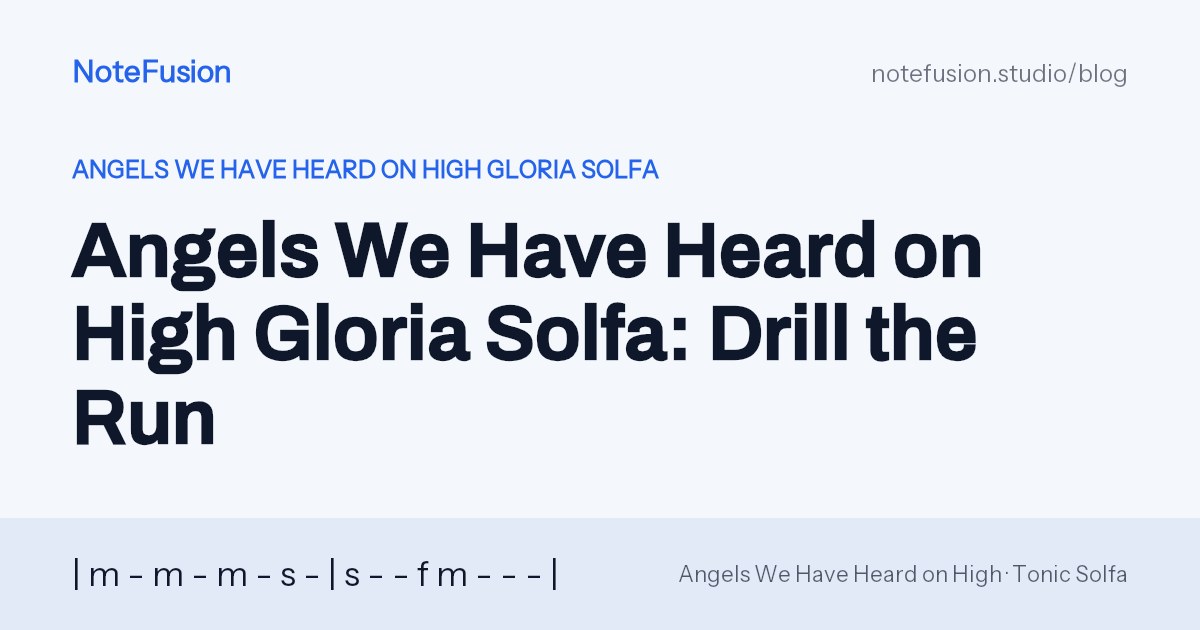
Every December the same thing happens. The verse of Angels We Have Heard on High goes beautifully, then the choir reaches "Glo-" and the whole thing turns into a blur of half-guessed notes and snatched breaths. By "Deo" the pitch has drifted flat.
The angels we have heard on high gloria solfa is easiest to learn in short pieces. In F major (doh is F), the Gloria is a falling sequence: a small pattern of steps is repeated, each time starting a step lower, before it settles towards doh. Drill each group slowly on solfa, join them two at a time, and breathe only before "Glo-" and before "in excelsis".
In this post I will show you the refrain from our Angels We Have Heard on High hymn page in short blocks. I will also tell you how I would drill it in a single rehearsal slot, mark where to breathe, and give you the tuning habits that stop the run sinking.
Why does the Gloria run trip choirs up?
The Gloria trips choirs up because one vowel is stretched across a long chain of quick notes, so the words stop telling you where you are. The verse is the opposite. It is syllabic, with one note per syllable, so the words carry you along. Here is how it opens, so you can feel the difference:
| mAn--mgels-mwe-shave- | sheard--fonmhigh--- |
You start on me, sit there for three beats, lift to soh and fall back. There is nothing to think about.
In the Gloria the "aw" of "Glo-" is spread over a melisma. There are no new consonants to mark your place, so singers lose count, push air out too fast and run out of breath halfway. That gives you three problems:
- Counting. Without syllables, people lose their place in the run.
- Breath. The "aw" is held across many notes, so a big gulp at the start gets spent too quickly.
- Pitch. A falling sequence invites each repeat to sag a little lower than it should.
The fix for all three is the same. Shrink the run into pieces small enough to sing perfectly, then rebuild it.
Got a recording? Get it in solfa →
Angels We Have Heard on High Gloria solfa, group by group
On the hymn page the verse takes the first eight bars and the refrain follows. If your printed copy numbers its bars differently, line the blocks up with your page by ear before rehearsal.
Group 1: the start of "Glo-"
| sGlo----l_s_f_m_ | f_---s_f_m_r_ |
This is where the run begins and where most of the trouble lives. The notes move almost entirely by step. There are no big leaps to find, so the difficulty is accuracy at speed. Look for the point where the pattern repeats a step lower. That is the shape your singers need to hear: the same little figure, starting on a new note.
Group 2: landing on "in excelsis Deo"
| m_---f_m_r_d_ | r_--s,ri-s,a,--- |
Here the run finishes and the words come back. The danger is relief. Singers arrive at "ri-a", relax, and the next phrase comes in under the note. Treat "in excelsis Deo" as its own phrase, with its own breath and its own energy.
The second Gloria uses the same pattern, so once these bars are secure the choir already knows most of the refrain. That is the good news I give every choir: you are really learning one run, twice.
How do you sing the Gloria in excelsis Deo run cleanly?
You sing it cleanly by drilling small groups slowly and joining them in overlapping pairs before you add speed. The plan below shows how to sing the gloria in excelsis deo run with a choir that can spare only a slice of one rehearsal. Keep everything at half speed until step 6.
- Speak the rhythm (2 minutes). Tap the beat and have everyone say "ta" on each note of the run. Many wrong notes are really wrong rhythms.
- Solfa, first group only (3 minutes). Sing just the opening figure of the run on solfa, slowly. Repeat it until it is identical every time. Then move to the next figure, a step lower, and then the one after that.
- Join in pairs (3 minutes). Sing figures one and two together, then two and three, then three and four. Overlapping pairs stop the joins from showing.
- Swap solfa for "aw" (2 minutes). Sing the same notes on a single open vowel. Keep the mouth shape still, so that only the notes change and the vowel stays the same.
- Add the words (2 minutes). Sing "Glo-" across the whole run, then "ri-a", then "in excelsis Deo".
- Bring up the tempo (3 minutes). Increase the speed in small steps. If one group smudges, drop back to that group alone, fix it, and rejoin.
If you split the choir into sections for this, my guide on how to run sectional rehearsals covers how to bring the parts back together without losing what you fixed.
Where should you breathe in the Gloria melisma?
Breathe before "Glo-", before "in excelsis Deo" and before the second "Glo-", and nowhere inside the run itself. Gloria melisma breathing is mostly about planning, so mark these breaths in pencil on every copy:
- Before "Glo-". Take a low, calm breath, not a gasp. Fill from the waist and keep your shoulders still.
- Before "in excelsis Deo". This is the main breath inside the refrain. Take it quickly and come in on the beat.
- Before the second "Glo-". Take the same breath as the first time. Do not let it become a rushed sip just because the first Gloria went well.
Some singers will not reach the end of the run on one breath. Do not let them gasp in the middle of a fast figure. Instead:
- Stagger breathing. Neighbours agree to breathe at different moments, dropping out for a note or two and then rejoining quietly. The congregation hears an unbroken line.
- Spend air slowly. The run is quick, but it does not need much air per note. Sing it lightly and you will find you have breath to spare. Pushing for volume is what empties the lungs.
- Rejoin on a beat. A singer who drops out to breathe should come back in at the start of a figure, not in the middle of one.
Keeping the run in tune
A falling sequence is a classic place for a choir to go flat, so build these habits from the first slow run-through. For the wider skills behind them, see how to sing in tune in a choir.
- Think each new figure slightly high. When the pattern restarts a step lower, aim for the top of that note. Singers rarely overshoot here; they undershoot.
- Keep the vowel bright. A dark, swallowed "aw" pulls the pitch down. Keep a little brightness in it, as if there is a smile behind the sound.
- No aspirates. Avoid singing "ha-ha-ha" on each note. A smooth flow of air through the notes keeps the pitch and the line steady. If the notes are unclear, slow down rather than adding breathiness.
- Check against doh. After the refrain, play F on the piano. If the choir's final doh is under it, the run has sagged, and you know where to look.
- Listen across. Ask altos to listen to sopranos during the run, and tenors to listen to basses. Listening outward pulls a section onto the same pitch.
Angels We Have Heard on High choir parts
The tune carries the famous run, but in most four-part arrangements the lower voices take part in it too. They often move alongside the melody or answer it. When you teach the angels we have heard on high choir parts, give every section the same treatment as above: groups, pairs, vowel, words, tempo.
A few practical points:
- Sopranos carry the melody and sit in the upper middle of their voices through the refrain in F. Keep them light so they are fresh for the second Gloria.
- Altos and tenors often have runs that move with the tune. Once each line is secure, rehearse them with the sopranos so the parts lock together.
- Basses usually have a simpler, steadier line. Use them as the tuning anchor: if the basses hold their pitch, the upper parts have something to tune to.
- Key. If your sopranos tire by the last verse, try moving doh down a tone to E flat. Check the lower parts too. My guide on how to choose the right key for your choir walks through it.
For home practice, send singers a recording of their own line and ask them to loop the run slowly. Learning your choir part at home explains how to make that practice count.
Fitting it into your carol service
This carol usually earns a place near the high point of a service, and the Gloria is the reason. Schedule its drill early in your Advent rehearsals, not the week before, because a melisma needs repetition across several weeks to feel natural. If you are building the whole programme, Christmas carols in Tonic Solfa has more carols laid out for choir. The 7-week carol service plan will help you spread the work.
One last tip: start each rehearsal of this carol with the Gloria, not the verse. Singers are freshest at the start, and the run is the part that needs it.
Your choir may sing a different arrangement or key from the one on the hymn page. If so, paste a recording or a YouTube link into NoteFusion. It will write the melody in movable-doh solfa with staff notation, and it can play it back slower or looped so you can drill one group at a time. "Transpose for my choir" will show whether each part sits comfortably in a new key.
Frequently asked questions
What key is Angels We Have Heard on High in?
The version on the NoteFusion hymn page is in F major, so doh is F. The verse opens on me (A), and the Gloria refrain climbs higher before coming home to doh.
How do you sing the long Gloria in Angels We Have Heard on High?
Break the run into short groups of a few notes and sing each one slowly on solfa, then on a pure 'aw' vowel. Join the groups one at a time, and speed up only when every group is clean at the slow tempo.
Where should you breathe in the Gloria of Angels We Have Heard on High?
Breathe before 'Glo-' and again before 'in excelsis Deo'. If the run is too long for you, stagger your breathing with the person next to you so the choir's sound never stops.
Why does the choir go flat in the Gloria run?
The run is built from a pattern that keeps restarting a step lower, and singers tend to let each restart sag. Aiming each new group slightly high and keeping the vowel bright helps the run stay in tune.
Can I transpose Angels We Have Heard on High for my choir?
Yes. If your sopranos tire on the refrain in F, moving doh down a tone to E flat is a common choice. Check that tenors and basses are still comfortable after you move it.