Awake My Soul Stretch Every Nerve Tonic Solfa: Choir Plan
Master awake my soul stretch every nerve tonic solfa in D major with rhythm drills, tempo tips and range checks for your youth service.
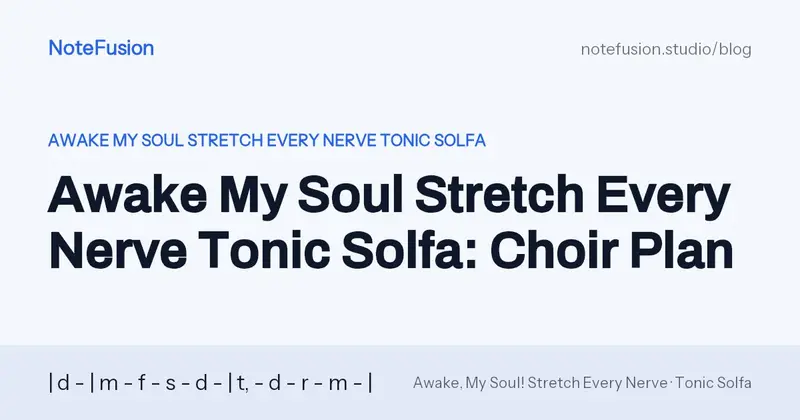
When you are preparing an energetic hymn like awake my soul stretch every nerve for a youth service or a sports-themed Sunday, you need your singers to move with confidence. If your awake my soul stretch every nerve choir tends to drag at the start and rush the cadence by the end, teaching the melody through Tonic Solfa is the fastest way to lock in the tempo. Let us walk through the D major page step by step, run a rhythm drill to keep your momentum steady, and check the vocal ranges before your next rehearsal.
How do you find doh in awake my soul stretch every nerve in D major?
To find doh in awake my soul in D major, look at your key signature of two sharps and set your starting pitch on D. Every time your singers see a note, they relate it back to this home pitch using movable-doh solfa. Let us look at the opening bars from the page to see how the melody climbs right from the first beat:
| dA-- | mwake,-fmy-ssoul!-dstretch- | t,ev--dery-rnerve,-mAnd- |
Notice how the tune steps up cleanly from the pickup note on doh to me, then reaches up through fah and soh. When your sopranos know their exact solfa intervals, they stop guessing and start singing in tune. This initial climb sets the energetic tone for the rest of the stanza, so taking five minutes to drill these first few notes will pay off immediately when the full choir joins in.
Got a recording? Get it in solfa →
How do you keep your choir from rushing the tempo?
A fast-moving hymn often tempts eager singers to speed up, especially when the text speaks of racing and stretching every nerve. To keep your choir from rushing the tempo, separate the rhythm from the notes by clapping the beat patterns outlined in how to read rhythm in Tonic Solfa. This hymn moves in a steady 4/4 meter where every colon marks a pulse and every dash holds the sound across the beat.
Have your choir clap the pulse while speaking the solfa syllables out loud in strict time before any notes are sung on the piano. When singers feel the length of the dashes, they stop clipping short notes and start sustaining their phrases properly. Consistent counting prevents the tenor section from sprinting ahead of the basses during the second line of the verse.
Why is this a great hymn for youth and sports themes?
Finding a suitable hymn for youth sunday in solfa can sometimes feel like searching for a needle in a haystack, but this particular text brings unmatched vigour. The imagery of running a race and pressing toward the heavenly prize resonates deeply with younger congregations and school choirs. Because the tune relies largely on stepwise motion interspersed with clean leaps, young singers find it remarkably intuitive once they master the first phrase.
When working with teenagers or community groups who may not read staff notation fluently, projecting or handing out a clear solfa sheet removes the intimidation factor entirely. They can spot their starting notes instantly and follow the melodic contour without getting bogged down by ledger lines and accidental sharps.
How do you run a sectional rehearsal for the parts?
Dividing your choir into sections helps uncover hidden pitch issues before you bring everyone back together for a full run-through. Start with the sopranos, guiding them through the high points of the melody. Next, take your altos through their harmony line, making sure they do not drift upward into the melody by accident. Finally, work with the tenors and basses to anchor the foundational chords.
If your tenor section feels thin or struggles with the higher intervals, do not hesitate to adjust the voicing or review our practical advice on what to do when your choir lacks tenors. Every section needs to feel secure in their individual solfa syllables before you attempt a cappella singing or push the tempo up to performance speed.
How do you check if the key is too high for your voices?
Before you commit to the printed page, test the highest notes against your singers' comfortable vocal range. If your tenors strain on the upper phrases or your sopranos sound squeezed, you may need to transpose the hymn down a tone or two. If you want to check alternative keys or generate a practice track for your members, you can open NoteFusion in your browser, upload or hum the tune, and instantly transpose it into a key that fits your specific group of singers.
Taking a moment to verify your key choice prevents vocal fatigue and ensures that every member of the congregation can join in the singing without holding back by the final verse.
Frequently asked questions
What key is Awake My Soul Stretch Every Nerve written in?
It is traditionally set in D major, where doh is D. This bright key gives the melody a strong, forward-moving energy that fits youth services and special occasions well.
How do you keep the choir from rushing this hymn?
Use a steady beat grid in 4/4 time and drill the held notes and dashes from the solfa. Practise clapping the rhythm slowly before adding words to maintain control.
Is the range suitable for a volunteer choir?
Yes, but check the high notes for your sopranos and tenors before Sunday. If the melody sits too high for your singers, use our guide on how to choose the right key for your choir.
How can I share these solfa parts with my singers?
You can generate readable Tonic Solfa sheets and audio playback links using NoteFusion at /app, then share them via WhatsApp or email for home practice.