Beautiful Savior Tonic Solfa for Choir: Sing It a Cappella
Beautiful Savior tonic solfa for choir in E flat: find doh, shape the long flowing phrases and keep the hymn in tune a cappella with simple drills.
Your choir has been asked to sing Beautiful Savior unaccompanied, and by the third verse the pitch has slid, the altos are guessing and the long phrases have broken into gasps. It is a hymn that looks simple on paper and exposes every weakness the moment the organ stops.
Beautiful Savior tonic solfa for choir is written in E flat major, so doh is Eb. The melody opens by singing doh three times on "Beautiful", then steps up, dips just below home and settles back on doh for "Savior". Learn those two bars well, keep the repeated notes steady and tune the low te high, and the rest of the hymn stands on the same foundation.
In this post I will walk you through the opening, how to find doh without an instrument, how to shape the long flowing lines, and the habits that keep a choir in tune from the first verse to the last. Everything here is meant to be tried at your next rehearsal.
Beautiful Savior tonic solfa for choir: the opening in E flat
Here are the first two bars as they appear on the Beautiful Savior solfa page:
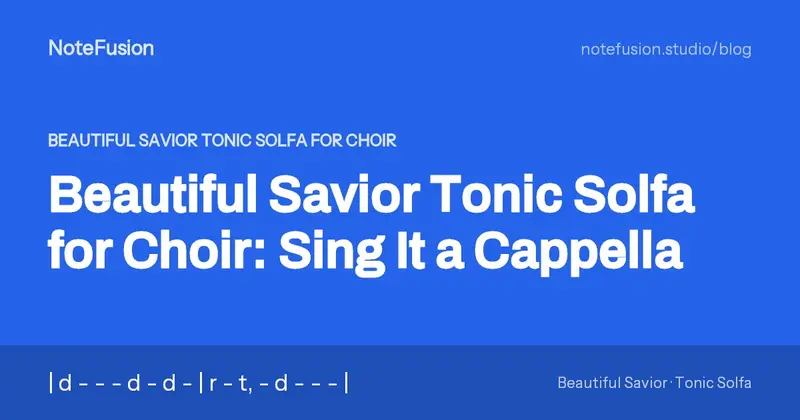
| dBeau----dti--dful- | rSa--t,_-dvior,--- |
Look at what is happening. The first syllable, "Beau-", is doh held for two beats. Then "-ti-" and "-ful" are doh again, one beat each, so the hymn begins with the same note three times. Bar 2 sets "Sa-vi-or": one beat on ray, one beat on the low te (t,) a semitone under home, and then doh held for two beats.
That small shape tells you a lot about how to sing the whole hymn:
- It starts on the home note. There is no pickup and no leap to find. Whoever gives the note gives doh, and the choir sings it straight away.
- It circles doh rather than running away from it. The note above and the note below are both single steps. The melody hugs the tonic, which is lovely for a cappella singing because the choir hears home all the time.
- The danger is in the stillness. Three repeated notes and a held note are exactly where untrained voices sag. Nothing is moving, so nobody is thinking about pitch.
If your choir can sing these two bars perfectly in tune, with the final doh exactly matching the first, you have taught the most important lesson in the hymn.
Got a recording? Get it in solfa →
Is Fairest Lord Jesus the same tune?
Yes. Beautiful Savior and Fairest Lord Jesus are two English translations of the same German hymn, and in most hymn books they are sung to the same melody. If you have been searching for fairest lord jesus solfa, the block above is your tune; only the words underneath change.
This matters for choir directors in two practical ways. First, some of your singers may know the hymn under the other name and bring that text in their heads. Decide which words you are singing and print them clearly, or you will get a mixture on Sunday. Second, the syllable count of the two translations can differ in places, so a note that carries one syllable in one version may carry two in the other. Check your text against the rhythm before rehearsal, and mark any spot where your words need a note split or two notes slurred.
How do you find doh for Beautiful Savior in E flat?
Doh is Eb, the home note of E flat major with its three flats (B flat, E flat and A flat). If you read staff notation, the key signature gives it away; if you only read solfa, the key line at the top of the sheet says "Doh is Eb". For a wider explanation of the method, see how to find the doh of any song.
Here is the scale your choir is singing in, with letter names under the syllables:
| dE♭-rF-mG-fA♭- | sB♭-lC-tD-d'E♭- |
Notice that low te, the note in bar 2, is D. It sits only a semitone under doh. That is the note that pulls hardest back up to home, and it is the note most likely to be sung too low.
To pitch Beautiful Savior in E flat without a piano:
- Play or hum Eb from a tuning app, a pitch pipe or a phone keyboard.
- Have everyone sing doh on "loo".
- Sing the home chord slowly up to soh and back down together, so the key is in their ears, not just the one note.
- Sing the little turn from bar 2 on its own: from doh, down the semitone to low te, and back up. Do it twice.
- Breathe and begin on doh.
That takes under a minute and gives every part a key, not just a starting note. If your basses and altos need their own first notes, the method in how to give a choir the starting note works well here.
Shaping the long, flowing phrases
Beautiful Savior is a hymn of long, gentle lines. The opening alone shows it: the two-beat note on "Beau-" and the two-beat note on "-vi-or" are held notes that need breath behind them all the way through, not just at the start. If singers spend all their air on the first bar, the end of each phrase goes breathy, then flat.
My advice is to plan breaths before anyone sings a note.
- Mark breaths from the words. Take your text and put a breath mark at each comma and full stop. In this hymn the punctuation usually falls at the natural end of a line. Do not let anyone breathe in the middle of a word or between an adjective and its noun.
- Stagger where a phrase is too long. If one line is too long for some singers on one breath, agree that half of each section breathes early and half breathes late. In an a cappella hymn the congregation should never hear the whole choir gasp at once.
- Breathe in the time of the held note. Take the breath out of the last part of a held note, not by shortening the next phrase. The next phrase must start on the beat.
- Sing through the held notes. A held note should keep its energy to the end, as if it were still travelling somewhere. A note that dies is a note that drops.
One simple drill: have the choir sing the first two bars on a single "loo", then on the words, aiming for exactly the same smooth line. Then do the same with each phrase of the hymn. The vowel version shows you where the line breaks; the word version shows you whether consonants are interrupting it.
How do you keep Beautiful Savior in tune a cappella?
You keep it in tune by listening to doh, tuning the low te high, and checking the pitch at the end of every verse. Here are the habits I would build into any Beautiful Savior a cappella choir.
Keep repeated notes rising, not resting
On the three repeated notes of "Beautiful", ask singers to think each repeat as very slightly brighter than the last. They will not actually go sharp; they will simply stop sinking. Repeated notes droop when the singer relaxes, so give them something to do.
Tune the low te upwards
Low te is the leading note. Sing it close to doh, almost leaning into it. Drill the bar 2 turn on its own until the te is clean and high, then put it back into the phrase. If your altos or tenors also have te in their parts, drill it with them too.
Check doh after every verse
At the end of verse one, hold the final chord, then play or hum Eb. If the choir has dropped, everyone hears it immediately, and nobody needs a lecture. Do this every rehearsal for a few weeks and the choir starts to notice the drift before you do. The fuller approach to weaning a choir off accompaniment is set out in how to train a choir to sing a cappella.
Match vowels so the chord rings
Unaccompanied singing stays in tune much better when the choir produces one sound rather than many. In "Beautiful Savior" the vowels in "Beau-" and "Sa-" are long and exposed; agree on one shape for each and sing them on held chords until they lock. My post on how to blend voices in a choir has a sustained-chord listening drill that suits this hymn well, since the melody lives so close to doh.
Watch the tired third verse
Pitch usually drops when energy drops. If verse three is the problem, it is often breath, not ears. Give the choir a moment's pause between verses, re-check the key, and remind them to sing the held notes through. For more causes and fixes, see why does my choir go flat.
Should you sing it lower than E flat?
E flat suits many choirs, but if you are singing late in a long service, or your sopranos are tired, dropping a semitone to D major can make the whole hymn calmer and steadier. In movable-doh solfa nothing in the music changes; only doh moves from Eb to D. Here is the same opening in D:
| dBeau----dti--dful- | rSa--t,_-dvior,--- |
The syllables are identical to the E flat version. Your singers read exactly the same sheet; the only thing that changes is the note you give them at the start. For a cappella hymns this is one of the great strengths of Tonic Solfa: you can pick the key on the day to suit the voices in front of you.
A word of caution: do not go much lower just to protect the sopranos if it buries your basses and altos. Check the lowest note in each part before you settle on a key. My post on how to choose the right key for your choir explains how to weigh the extremes of every part.
A rehearsal plan for tonight
If you have twenty minutes, this is the order I would use:
- Pitch and chord (2 minutes). Give Eb, sing the home chord up and down, then the bar 2 turn.
- Opening drill (3 minutes). Sing bars 1–2 on "loo", then on the words. Check that the final doh matches the first.
- Breath marks (3 minutes). Read the text aloud together and pencil in breaths at punctuation. Agree on any staggered breaths.
- Phrase by phrase (6 minutes). Sing each phrase on "loo", then on words, building the hymn line by line.
- Whole verse unaccompanied (3 minutes). No piano. Hold the last chord.
- Pitch check (1 minute). Hum Eb against the held chord. Celebrate if it holds; note where it slipped if not.
- Repeat the weak phrase (2 minutes). Fix one thing only, then sing the verse again.
By the second rehearsal, try two verses unaccompanied with a pitch check only at the very end.
If your choir learns from recordings, NoteFusion can help between rehearsals: paste a link or upload a recording of Beautiful Savior and it writes the melody in movable-doh Tonic Solfa with staff notation, plays it back slower or looped on a piano so singers can practise the long phrases at home, and its "Transpose for my choir" option shows whether each part sits comfortably if you decide to move doh from Eb to D.
Frequently asked questions
What key is Beautiful Savior in for choir?
The tonic solfa version on NoteFusion is in E flat major, so doh is Eb. It is in 4/4 and runs to 16 bars.
Is Fairest Lord Jesus the same as Beautiful Savior?
Yes. They are two English translations of the same German hymn and are usually sung to the same melody. The solfa for the tune is the same; only the words change.
How do I pitch Beautiful Savior without a piano?
Give the choir Eb as doh, sing the home chord up and down together, then return to doh. The melody starts on doh, so the first note is the one you have just tuned.
Why does my choir go flat singing Beautiful Savior a cappella?
The usual culprits are repeated notes drooping, the low te sung too low, and tired breath at the end of long phrases. Short drills on each, plus a pitch check after every verse, fix most of it.
Can Beautiful Savior be sung in a lower key?
Yes. Moving it down a semitone to D major keeps every solfa syllable the same and makes it easier for tired voices. The choir reads the same solfa; only doh moves.