How to Sing Alto in Christmas Carols: 4 Steps
Learn how to sing alto in Christmas carols without drifting to the tune. Master inner harmonies with Tonic Solfa, slow two-part drills, and part tracks.
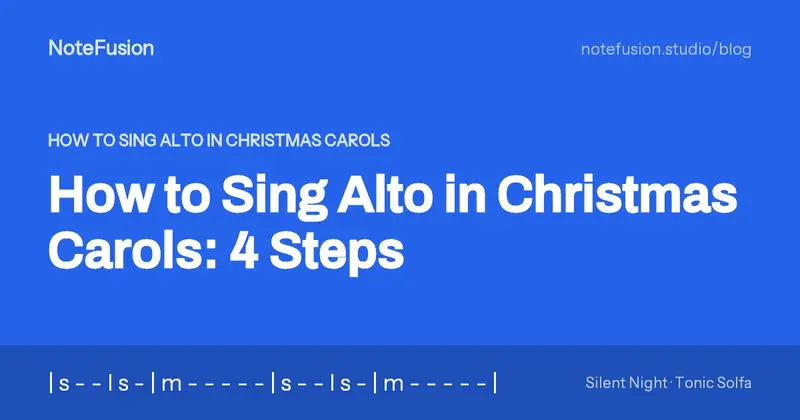
You are standing in a crowded church two weeks before Christmas, the congregation is belting out the melody at full volume, and your alto section suddenly slides straight into the soprano tune. Every choir director has watched it happen, and almost every alto has felt that sinking sensation of losing their harmony mid-verse.
Learning how to sing alto in christmas carols requires overcoming decades of musical muscle memory, because carols are tunes we have hummed since childhood. To sing alto securely without drifting, you must anchor your line in Tonic Solfa from the same doh as the melody, practise your notes slowly against the soprano voice, and rehearse with an audio track where the alto part is boosted.
Whether you are an alto trying to hold your line on Sunday or a director preparing a volunteer choir for an upcoming service, this guide walks you through the exact rehearsal steps needed to make inner harmonies second nature.
Why is singing alto in Christmas carols so difficult?
Singing alto in seasonal music is uniquely challenging because carol tunes are deeply ingrained in your ear long before you ever look at a four-part choral arrangement. When you sing an ordinary hymn during the year, you may only know the tune casually. With carols, your brain has heard the melody hundreds of times since early childhood, making the soprano line an overwhelming gravitational pull.
Beyond familiarity, the alto voice occupies a tricky structural position in standard choral voicing. As explained in our guide to SATB parts explained, while the soprano carries the recognizable tune and the bass provides the harmonic foundation in fourths and fifths, the alto and tenor weave through the middle. Alto lines frequently move by narrow steps, hold static notes across bar lines while the harmony shifts underneath, or double unusual chord tones.
Furthermore, during a Christmas service, the congregation sings unison melody at peak volume. If an alto relies merely on singing by ear or trying to stay "a little bit lower than the sopranos," that wall of sound will swallow their pitch. To hold an inner harmony under pressure, an alto needs an independent harmonic framework, and that is precisely where Tonic Solfa proves invaluable.
Got a recording? Get it in solfa →
How to sing alto in christmas carols using Tonic Solfa
To sing alto securely, you must read your notes from the exact same doh as the melody, rather than treating your part as an isolated sequence of pitches. When you understand how to read Tonic Solfa, every note in your vocal line is defined by its relationship to the home key.
Many beginner singers try to hold harmony by guessing a physical interval below the person standing next to them. If the soprano sings a high note, the alto tries to sing "a third lower." But musical thirds change constantly between major thirds (four semitones) and minor thirds (three semitones). Attempting to calculate those distances by ear while the organ is playing is an exhausting recipe for second-guessing.
When you use movable-doh Tonic Solfa, the guesswork disappears:
- Shared key centre: Both the soprano and the alto establish the exact same doh. If the carol is in B flat major, doh is B flat for everyone in the room.
- Distinct mental targets: If the soprano starts on soh, the alto does not think "two notes lower"; the alto thinks me. Me has a distinct, warm character that feels completely different from soh.
- Independent scale steps: When the chord resolves, the alto knows whether they are stepping to doh, rising to fah, or holding me. You are no longer shadowing another singer; you are navigating your own defined path through the scale.
By grounding your ear in functional solfa syllables, you build an internal compass that resists the pull of neighbouring voices.
Worked example: the alto line in Silent Night
To see this principle in action, let us examine one of the most loved pieces in our Christmas carol collection: Silent Night. In standard hymnbooks, Franz Gruber's melody is set in B flat major in gentle 6/8 time.
Here are the opening four bars of the soprano melody:
| sSi---llentsnight,- | m_----- | sho---llysnight,- | m_----- |
The soprano line begins on soh, rocks upward to lah, returns to soh, and rests down on me. It is a sweet, rocking motif that every person in the congregation knows by heart.
Now consider what the alto sings underneath those same four bars in standard SATB harmony:
- Bar 1: The melody sings
s - - l s -. Underneath, the alto singsm - - f m -. - Bar 2: The melody rests on
m - - - - -. The alto rests ond - - - - -. - Bar 3: The melody repeats
s - - l s -. The alto repeatsm - - f m -. - Bar 4: The melody rests on
m - - - - -. The alto rests ond - - - - -.
Notice the parallel motion. The alto contour mirrors the soprano contour, but sits a third lower throughout the phrase. When singers drift, bars 1 to 4 are where it happens: an uncertain alto hears the soprano sing soh-lah-soh and immediately matches it instead of holding me-fah-me.
By naming the notes as solfa, the alto creates an independent mental target:
- The soprano sings: soh – lah – soh | me
- The alto sings: me – fah – me | doh
Singing me gives the alto a grounded, settled feeling. Resolving to doh in bar 2 gives absolute stability because doh is the home note of the entire key. Once an alto internalises that they are moving from me down to doh, they stop listening to the soprano for cues and begin driving their own phrase.
A 4-step rehearsal routine for altos and directors
If you want your choir's alto section to stand firm on Sunday morning, do not simply run the carol four times from start to finish with all parts singing together. That approach forces inexperienced singers to swim against the current before they know how to float. Use this progressive four-step sequence during your rehearsals.
Step 1: Speak the solfa rhythm together
Before singing a single pitch, have the alto section speak their solfa syllables in strict rhythm while clapping the pulse. For the opening of Silent Night, have them chant:
"me, lah-soh, me | doh" (or "me - - fah me - | doh - - - - -")
Speaking the syllables removes the pressure of vocal production and ensures that every singer's eyes and brain are recognising the syllable names instantly. If a singer hesitates over whether a note is me or ray when speaking, they will certainly drift when singing.
Step 2: Sing the alto line unaccompanied with hand signs
Next, sound your doh on a pitch pipe or keyboard and have the altos sing their line completely alone, without piano accompaniment and without the other three sections. Encourage them to use Curwen hand signs for me, fah, and doh. Physical hand signs reinforce the spatial distance between the scale steps, making the drop from me to doh feel like a deliberate downward step rather than an accidental fall.
Repeat the phrase until the altos produce a clear, ringing tone on their own. They must feel how comfortable their part sounds when it is not competing with other voices.
Step 3: Drill alto against soprano at half tempo
Now comes the crucial test: pairing the alto part against the melody. Do not bring in the tenors or basses yet. Have your sopranos sing their melody softly while the altos sing their harmony at full rehearsal volume, taken at half the normal performance speed.
Slowing the tempo down gives the alto ear time to process the vertical harmony. In bar 1, as the soprano sings soh and the alto sings me, pause and have the choir hold that third. Let both sections listen to the sweet blend of the interval. Then move to the next beat: soprano lah against alto fah. Hold it. Then soh against me, and finally resolve together to soprano me against alto doh.
When singers hear how their part slots into the chord note by note, their fear vanishes. They realise they are not clashing with the melody; they are creating the rich warmth that makes Christmas carols sound festive.
Step 4: Recombine the choir with strategic seating
Once the two-part balance is secure, bring back the full choir, but pay careful attention to where your altos stand. Never isolate an inexperienced alto on the edge of the choir next to loud, confident sopranos. The acoustic spill from the soprano section will overpower them.
Pair newer altos directly beside experienced singers who read well and hold pitch steadily. As detailed in our guide on how to sing alto without drifting to the melody, physical proximity to confident section leaders acts as an acoustic shield, allowing developing singers to blend into a unified section sound.
How to practise alto at home between rehearsals
Choir rehearsals in December are notoriously busy. Between pageant preparations, special services, and extra anthems, directors rarely have enough rehearsal time to drill every carol line by line. Altos who want to excel must spend fifteen minutes practising independently between weekly practices.
Here is an effective home practice routine:
| Stage | Duration | Focus | What to listen for |
|---|---|---|---|
| 1. Solfa Chant | 3 mins | Speaking the solfa names in rhythm | Accurate note recognition without hesitation |
| 2. Unaccompanied Pitch | 4 mins | Singing the line alone from a single doh | Clean intonation on intervals like me down to doh |
| 3. Part Track Playback | 5 mins | Singing along with an alto-dominant recording | Matching pitch effortlessly against a strong guide |
| 4. Harmony Challenge | 3 mins | Singing your part against the pure melody | Holding your line without being pulled into the tune |
For advice on structuring your weekly schedule leading up to Christmas, explore our comprehensive Christmas carol rehearsal plan for choir and our guide on how to learn your choir part at home.
Part tracks are the secret weapon for volunteer choristers. When you listen to a commercial recording of a carol, the alto voice is buried deep in the middle of a massive choral and orchestral texture. Practising with an audio track that isolates the alto line or pans it hard to one ear allows your brain to absorb the part effortlessly.
Common carol pitfalls for the alto section
Even after mastering the notes, certain harmonic traps appear regularly across the Advent and Christmas repertoire. Knowing where these occur will save your choir valuable time.
Pitfall 1: Unison crossings and unisons with soprano
In several traditional carols, the alto line briefly touches the exact same pitch as the soprano melody before diverging again. When the alto hits a unison note with the melody, their subconscious mind assumes, "Ah, I am singing the tune now!" and follows the soprano right up into the stratosphere on the next bar.
When you encounter a unison note in your solfa score, circle it in pencil. Mark the syllable immediately following the unison with an upward or downward arrow. Train your mind to treat the unison not as a destination, but as a brief stepping stone to your next harmony note.
Pitfall 2: Static pedal points
Altos frequently get assigned what choir members jokingly call "the boring notes": repeating doh or soh four times in a row while the sopranos enjoy an expressive melodic run. Inexperienced singers assume that because their pitch is not moving, they can relax their breath support. The moment breath support drops, the pitch sags flat.
When singing repeated notes in an inner part, imagine each repeated syllable as slightly brighter and higher than the one before it. Maintain active abdominal engagement so your pitch stays vibrant and buoyant.
Pitfall 3: Volume intimidation from the congregation
During the final verse of carols like O Come, All Ye Faithful or Hark! The Herald Angels Sing, the congregation often sings at maximum volume. New altos instinctively pull back their sound because they feel they are the only ones singing their particular notes in their corner of the building.
Remind your alto section that harmony does not need to compete with unison congregational singing in volume; it enriches it in colour. A focused, well-supported alto section singing pure vowels will cut through congregational singing cleanly, providing the warm harmonic cushion that makes Christmas worship so memorable.
If you have a mobile phone recording from your last rehearsal or want to generate clear practice materials for your section, NoteFusion can help. You can hum an alto line, upload a voice memo, or paste a song link to get clear Tonic Solfa and staff notation instantly, play the melody back on a virtual piano at slower rehearsal tempos, or check that the vocal range sits comfortably for your choir.
Frequently asked questions
Why do altos drift to the soprano melody in Christmas carols?
Altos drift because carol melodies have been ingrained in their memory since childhood. When singing close inner harmonies, the loud soprano melody pulls the alto ear away from its own pitch unless the singer has an independent mental map of the harmony.
How does Tonic Solfa help an alto hold their part?
Tonic Solfa assigns a distinct syllable to every scale degree from the same key centre as the melody. Instead of trying to guess an interval below the soprano, the alto hears and sings specific relationships like me to doh, locking the harmony in place.
What is the best way to practise alto at home?
Practise speaking and singing your solfa syllables alone at a moderate tempo, then sing along with a part track that features the alto part louder than the other voices. Once secure, test yourself by singing against a recording of the soprano melody alone.
Where should altos stand during carol services?
Place less confident altos directly between experienced altos rather than next to the soprano section. Clustering the alto section together strengthens their collective resonance and prevents the tune from overpowering their inner line.