How to Stop Scooping Notes When Singing: 3 Solfa Drills
How to stop scooping notes when singing: find the exact leaps your choir slides into, like doh to soh, and fix them by hearing each note first.
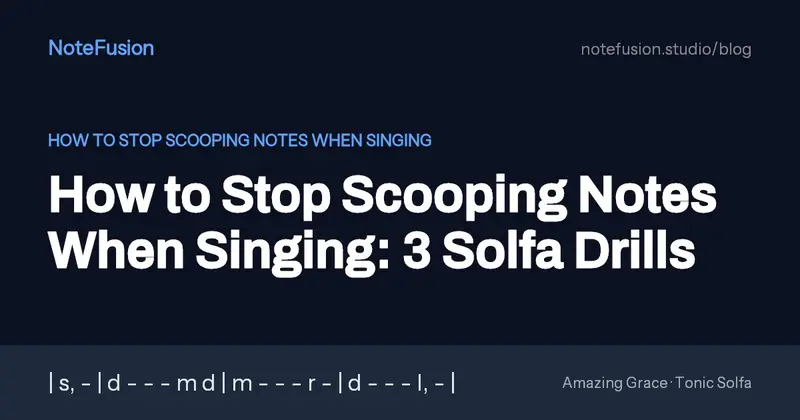
Your sopranos reach "King" in Rejoice, the Lord Is King a fraction late, arriving from somewhere underneath, and the chord sounds smeared before it settles. That is scooping, and once you notice it you hear it in every hymn with a big upward jump.
Here is how to stop scooping notes when singing: hear the target note in your head before you open your mouth, then start the sound exactly on that pitch. Scoops happen when a singer launches the voice and then searches upward for the note. Solfa interval drills show each singer which leaps they slide into, so the fix is aimed rather than general.
In this article I'll show you the specific jumps where scooping hides, three short drills on hymns your choir probably knows already, and a ten-minute plan you can use at your next rehearsal.
What scooping does to a choir's sound
A scoop is a note that starts low and slides up into place. On its own, in one voice, it can pass unnoticed. In a section of eight altos it cannot, because each singer slides at a different speed. For a moment there are several pitches sounding at once where there should be one, and the chord only tunes once the slowest singer arrives.
On long notes the listener hears a smudge and then a settled chord. On short notes it is worse: the singers never quite arrive before the next note, so the whole line sits a shade under pitch. That is why scooping and going flat so often turn up together. If your choir drifts down over a verse, upward leaps are one of the first places to look, alongside the habits covered in how to sing in tune in a choir.
Scooping also costs you rhythm. The real pitch lands late, so the word lands late, and a choir that scoops on every stressed syllable sounds as if it is dragging even when the conductor's beat is steady.
Got a recording? Get it in solfa →
Which leaps do singers scoop?
Scooping is not random. It gathers on upward leaps, especially large ones that land on a stressed word. Small steps, such as doh up to ray, are rarely the problem because the next note is so close the voice finds it without thinking. Here are the jumps I listen for first:
| Leap | Interval | Where you meet it |
|---|---|---|
| s, up to doh | Perfect fourth | The pickup at the start of Amazing Grace and many other hymns |
| doh up to soh | Perfect fifth | "the Lord" in Rejoice, the Lord Is King |
| soh up to doh' | Perfect fourth | "help in" in O God, Our Help in Ages Past |
| me up to doh' | Minor sixth | "King" in Rejoice, the Lord Is King |
| doh up to doh' | Octave | Any tune that springs from home note to top doh |
Notice how many of these land on doh. Singers know doh is the home note, so they aim at it loosely and trust the voice to find it on the way. The voice does find it, but only by sliding.
If your singers are not yet confident about how big each of these jumps is, spend some time with intervals in Tonic Solfa first. A singer who can name the leap as a fifth or a fourth has already half-heard it.
How to stop scooping notes when singing: hear it first
The fix is simple to describe and takes practice to make automatic. You hear the next note before you sing it. Musicians sometimes call this inner hearing: the pitch is sounding in your head a moment before it sounds in your throat. When the voice starts, it starts in the right place because there is nothing left to search for.
The drill that builds this habit has four steps:
- Sing the lower note of the leap on its solfa name and hold it.
- Stop. Leave one full beat of silence.
- In that silence, sing the upper note in your head only. Lips closed, no humming.
- Sing the upper note, starting the sound directly on the pitch you just heard inside.
Once the leap is clean, shorten the silence to half a beat, then to a breath, then to nothing. Most singers find that the silent beat alone removes the scoop on the first try. The work is in keeping it clean once the gap disappears and the words come back.
Three solfa interval drills on hymns you know
Use real hymns rather than abstract exercises, because the scoop belongs to the leap in the context where your choir sings it. Each drill below targets one or two of the leaps from the table.
Drill 1: the pickup in Amazing Grace
| s,A-- | dmaz----mingd_ | mgrace!---rhow- | dsweet---l,the- | s,sound,---s,That- |
The first two notes, s, on "A" and doh on "ma", are a rising fourth, and it is the very first thing the choir sings. Nerves plus a pickup plus an upward leap is the perfect recipe for a scoop. Have everyone sing s, and hold it, take the silent beat, think doh, then sing doh on the syllable. Then sing the whole opening phrase slowly on solfa, then on "noo", then on the words. Listen especially to "ma", because the m can be hummed low before the vowel arrives.
Drill 2: two leaps in Rejoice, the Lord Is King
| dRe-- | mjoice,-dthe-sLord-mis- | d'King!-----tYour- |
This opening has two leaps close together: doh up to soh on "the Lord", and me up to doh' on "King". Drill each separately first. The doh to soh leap catches altos and tenors who are used to stepping, and the l of "Lord" invites a slide. The me to doh' jump on "King" is a sixth, the biggest leap here, and sopranos who are anxious about top doh tend to reach for it from underneath. Use the silent beat on both, then sing the line through at half speed with the gaps removed.
Drill 3: the high note on a weak word in O God, Our Help
| sO- | mGod,-lour-shelp-d'in- | d'a--tges-d'past,-sOur- |
The leap from soh to doh' falls on "help in", and the high note lands on "in", a small unimportant word. Singers relax on weak words and let the pitch drift in. Ask the choir to give "in" the same clean start as "past", without making it louder. Doing the leap on solfa first helps here, because doh as a syllable has a clear vowel that the word "in" does not.
The three-stage test
For every drill, check the leap three ways: on solfa names, on a neutral vowel, then on the words. If the scoop only appears in the third stage, the leap is fine and the consonant is the culprit. If it appears in the first stage, the singer has not yet heard the interval, and the silent-beat drill needs more time.
Why do singers slide up to notes in choir?
Most singers slide up to notes in choir because they start singing before they have heard the note. The other causes usually feed that one:
- Late breath. If the breath arrives at the last moment, the air pushes the sound out before the pitch is set.
- Voiced consonants. Words beginning with l, m, n, r, v or w can be hummed on any pitch. Singers often hum them below the note and slide up into the vowel.
- Fear of the high note. Reaching from below feels safer than committing to a high pitch, so nervous sopranos and tenors scoop most on their top notes.
- Copying recordings. Many choirs learn songs from recordings of soloists who slide for expression. Singers copy the slide without realising it is a style choice.
- Following a leader. If the strongest voice in a section scoops, the others tend to copy the shape of the note as well as its pitch.
Knowing the cause tells you which fix to use. A singer who has not heard the leap needs the silent-beat drill. A singer who has heard it but hums the consonant low needs the next section.
How do you sing notes cleanly without sliding on the words?
You sing notes cleanly without sliding on the words by putting the consonant on the same pitch as the vowel that follows it. On "Lord", the l should already be on soh. On "my", the m should already be on the note of "my". Practise by humming the consonant on the correct pitch for a moment, then opening into the vowel with no change of pitch at all.
A few other habits help:
- Shape the vowel before you start. If the mouth is already in the shape of the vowel, the note can begin cleanly instead of growing into place.
- Think of landing from above. Ask singers to imagine dropping onto a high note rather than climbing to it. The image often removes the upward slide altogether.
- Keep the chin level. Reaching the chin up on a big leap tends to bring a scoop with it. A still head and jaw make the leap feel smaller.
- Breathe a beat early. On a leap after a breath, take the breath slightly sooner so the air is ready before the pitch.
A choir scooping fix for your next rehearsal
You do not need a whole evening. This choir scooping fix fits into ten minutes near the start of rehearsal:
- Warm-up, three minutes. Hold a steady doh, then leap to soh and to top doh, with a silent beat before each leap. Fold this into the routine from vocal warm-ups for choirs so it becomes a weekly habit rather than a one-off.
- Diagnose, two minutes. Sing the opening of the hymn you are rehearsing. Ask singers to raise a hand if they felt themselves slide on any note. Most singers know when they have scooped once they are asked to notice.
- Drill, three minutes. Take the leap that caused most hands to go up and use the four-step drill on it, section by section.
- Put it back, two minutes. Sing the phrase in full. On the long note after the leap, listen for the chord arriving all at once rather than settling. If it arrives together, the section is also blending better, which is the same goal described in how to blend voices in a choir.
Repeat the same leap the following week before moving to a new one. Clean leaps fade quickly if they are drilled once and forgotten.
When is a slide not a fault?
Not every slide is a mistake. Some gospel, spiritual and solo styles use a deliberate slide for expression, and a director may ask for one on a particular word. The test is whether it is chosen and shared. A slide the whole section makes together, at the same speed, on a word the director picked, is style. A slide that each singer makes in their own way on every leap is scooping. In hymns sung in four parts, aim for clean starts by default and add any slide on purpose.
If your choir learns new songs from recordings, it helps to hear each leap's target note on its own before trying to sing it. NoteFusion turns a recording, a song link or a hummed tune into Tonic Solfa with staff notation, and plays the melody back on a piano, slower or looped, so a singer can listen to the top of a leap as many times as they need before they sing it.
Frequently asked questions
What does scooping mean in singing?
Scooping is starting a note below its pitch and sliding up into it. One singer doing it sounds lazy. A whole section doing it at different speeds blurs the chord until everyone arrives.
How do I stop scooping notes when singing?
Hear the next note in your head before you sing it, then start the sound exactly on that pitch. Practise the leaps you scoop slowly, with a silent beat to think the note, and remove the gap a little at a time.
Why do I slide up to high notes?
Usually you have not fully heard the note before you start, so your voice searches for it from below. Late breath, a nervous reach for a high note and humming a consonant like l or m below the pitch all make it worse.
Which intervals are most often scooped?
Upward leaps of a fourth or more, such as soh up to doh, doh up to soh and soh up to top doh. Small steps like doh to ray are rarely scooped.
Is scooping ever acceptable in a choir?
A deliberate slide can be a stylistic choice in some gospel or solo songs. In hymns sung in parts it should only happen if the director asks for it and the whole section does it together.