Write Down a Song You Composed in Solfa in 6 Steps
How to write down a song you composed in solfa: hum it into your phone, find doh, fix bar lines and the pickup, then share a sheet your choir can read.
You hummed a new tune into your phone on the way home, the words fit, and you want the choir singing it next month. The trouble is that it lives only in your head and in a slightly breathy voice memo, and the altos cannot learn from a voice memo alone.
Here is how to write down a song you composed in solfa: record yourself singing it clearly, find doh (the note that feels like home), name every note against that doh, mark the beats and bar lines, and check whether the song starts on a pickup. Then sing it back from the page before you give it to the choir.
That is the whole route. The rest of this post walks through each step, shows you the two places where most home-made sheets go wrong (the bar lines and the first note), and ends with a checklist you can run through before you share anything.
Step 1: Record the tune so it can be written down
A good recording saves you more time than any other step. My advice is to make a fresh one specifically for notating, even if you already have the original memo.
- Sing on words or on a clear syllable. 'Loo' or 'nah' works better than humming with your mouth closed, because each note gets a clean start.
- Keep a steady speed. Tap your foot or tap a pen while you sing. Songwriters often speed up in the exciting bits; your choir will copy whatever is on the page, so decide the speed now.
- Sing the whole song once, then the tricky line on its own. If one phrase moves quickly, a second slower take of just that phrase is gold later.
- Write the words out separately. One line of text per musical phrase. You will hang the notes on these lines.
Record somewhere quiet. A fridge hum or a television in the background makes the pitch harder to hear, for you and for any software.
Got a recording? Get it in solfa →
Step 2: How do you find doh in a song you made up?
You find doh by singing your last note and asking whether it sounds finished. In most songs written in a major key, the final note is doh, and the song keeps leaning back towards it. Hold that note, then sing 'doh' on it and walk up the scale d r m f s l t until you can place the opening notes of your tune.
If your song sounds sad or dark and comes to rest on a note that feels like home but is not doh, you have probably written in a minor key. In Tonic Solfa minor keys are read la-based: home is lah, and doh sits a third above it. A song you composed in A minor has doh on C and lah as home:
| l,A-t,B-dC-rD- | mE-fF-sG-lA- |
Sing that scale from lah and back, then sing your song's final note. If they match, write your melody with lah as the resting note. If your tune leans on a raised seventh just below the home note, that note is se, not soh.
If you are stuck between two possible homes, the fuller method (key signature, ear and checking the tune) is in how to find the doh of a song.
Step 3: Turn a hummed melody into sheet music
Now you name each note. You can do this by ear: play the recording a phrase at a time, sing it back on solfa, and write the syllables above the words. Use a comma below for the octave under doh (s,) and an apostrophe above for the octave over it (d'). The longer walk-through of doing this by hand, including the rhythm grid, is in how to transcribe a song into Tonic Solfa.
If your ear is still developing or time is short, NoteFusion can do the first draft. You hum or sing the tune into it, or upload the voice memo, and it writes the melody in movable-doh Tonic Solfa with staff notation underneath, la-based if the song is minor. When a melody could sit in two keys it asks 'Which doh is it?', which is exactly the question from Step 2, so you answer it with the ending you intended. You can then play the tune back on a piano, slower or looped, and compare it with what you meant to sing.
Either way, treat this as a draft. The software hears what you sang, and what you sang into a phone on a bus may not be quite what you meant. The next two steps are the checks you must do by hand.
Step 4: Check the bar lines against the words
Bar lines go before the strong beats, and in a song with words the strong beats fall on the stressed syllables. This is where home-made sheets most often go wrong, and a choir notices immediately because the music feels as if it is limping.
Try this with your draft:
- Speak the words aloud in rhythm. Clap on the syllables that naturally get weight: 'FOR the BEAUty OF the EARTH'.
- Count how many beats sit between each clap. If it settles into groups of three, the song is in 3/4; groups of two or four suggest 2/4 or 4/4. A lilting group of two that each divide into three is 6/8.
- Put a bar line just before each strong syllable. Every full bar must add up to the same number of beats. Long held notes at the ends of lines often need their dashes counting carefully.
- Check the last bar of each line. Phrases in hymns and worship songs usually end on a held note that fills out the bar.
Here is a song that starts squarely on a strong beat. The first word lands on beat one and the bar fills completely:
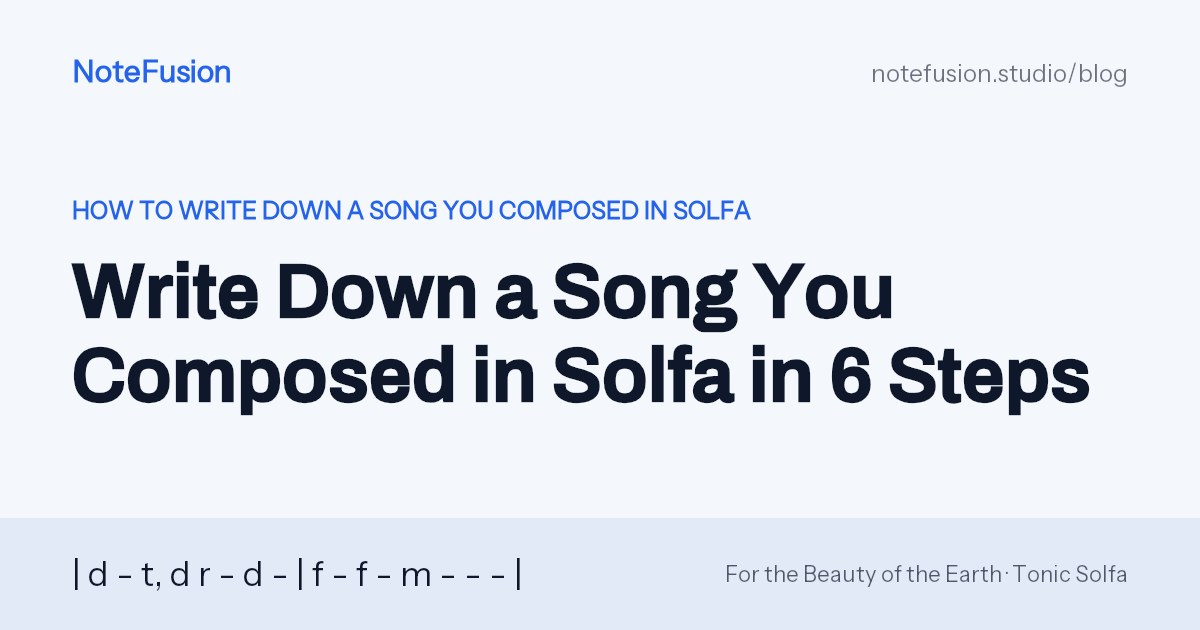
| dFor-t,thed_rbeau--dty- | fof-fthe-mearth,--- |
Notice that each bar has the same length, and the held m at 'earth' fills the end of the second bar. Your own song should look this tidy at the end of each phrase.
Step 5: Does your song start on a pickup note?
Your song starts on a pickup if the first syllable you sing is not a stressed one. 'A-MA-zing', 'the LORD', 'and CAN it BE': the little unstressed word comes before the first strong beat, so it belongs in a short bar of its own before the first full bar.
Amazing Grace shows how it should look:
| s,A-- | dmaz----mingd_ | mgrace!---rhow- | dsweet---l,the- | s,sound,---s,That- |
The first bar holds only the low s, on 'A'. The bar line comes straight after it, so 'maz' lands on d at the start of the first full bar of 3/4. If you wrote that s, as the first beat of a full bar, every stress in the song would fall in the wrong place and the choir would sing 'a-MAZ-ing' with a jolt in every line.
Two things follow from a pickup:
- The last bar is usually short too. The pickup and the final bar together often make one full bar, which keeps verses flowing into each other.
- The conductor needs to know. Mark it clearly so the director gives the right preparatory beat. There is more on timing these entries in what is a pickup note.
To check your draft, sing the opening line while conducting or tapping the beat. If your first stressed word does not land on your strongest tap, move the bar line.
Step 6: Write original church song in tonic solfa the choir can follow
Once the notes and bars are right, tidy the sheet so a volunteer choir can sing from it without you standing over them.
- Show the key at the top. Write 'Doh is F' (or whichever note), plus the time signature. For a minor song, write the doh note and say it is la-based, for example 'Doh is C, A minor'.
- Put the words under the notes, one syllable per note. Where one syllable carries two notes, make it obvious, so nobody fits an extra word in.
- Write repeats once, clearly. A chorus that comes back after every verse should be written out once and labelled, not copied four times with tiny differences. If the chorus is syncopated or the last chorus lifts into a new key, see how to write solfa for praise and worship songs for how to lay those out.
- Check the range for the people who will sing it. You wrote it in your own voice. Look at the lowest and highest notes: if the tune climbs to m' or drops below s, a congregation may struggle, and sopranos or basses carrying the tune may need a different key. Because solfa is movable doh, you can move the whole song to a new doh and every syllable stays the same.
How to write down a song you composed in solfa: a final check before sharing
Before the sheet goes to the choir, run this short check. It takes ten minutes and saves a rehearsal.
- Sing it from the page, not from memory. Cover your recording and sing exactly what is written. Anything that surprises you is a mistake on the page.
- Ask someone else to sing the first line. A chorister who has never heard the song is the best test. Where they hesitate, the notation is unclear.
- Check every bar adds up. Count beats in each bar, allowing for the pickup and the short final bar.
- Confirm the ending. The song should finish on doh for a major song, or on lah for a la-based minor one, unless you have deliberately written something else.
- Give the choir the sound as well as the sheet. Volunteers who learn from recordings will learn faster with a clean playback of the melody alongside the solfa.
If you notate my own song for choir this way, I find the first rehearsal is spent on singing rather than on arguing about which note comes next. The page and the tune in your head finally say the same thing.
If you would like a head start, open NoteFusion, hum or upload your tune, and check the solfa it writes against the steps above. 'Transpose for my choir' moves the doh and shows whether each part sits comfortably, and you can save the sheet and share it with your choir by link.
Frequently asked questions
Can I write a song in tonic solfa if I can't read music well?
Yes. You only need to sing the tune, find the note that feels like home (doh) and name the other notes against it. The bar lines and rhythm can be checked by tapping along to your own recording.
How do I know which note is doh in a tune I made up?
Sing the last note of the song and ask whether it sounds finished. In a major-sounding song that note is usually doh. If the song sounds sad and settles on a note a third below doh, it is la-based minor and lah is home.
What is a pickup note and does my song have one?
A pickup is one or more notes sung before the first strong beat, like the 'A' of 'Amazing grace'. If the first stressed word of your song is not the first syllable you sing, your song starts on a pickup and the first bar should be short.
How do I turn a hummed melody into sheet music?
Record yourself humming or singing it clearly at a steady speed, then write the notes against doh and mark the beats. An app such as NoteFusion can take the recording and write it out in solfa and staff notation for you to check by hand.
Should I write my song in the key I hummed it in?
Not always. You probably hummed it where your own voice is comfortable, which may be too high for basses or too low for sopranos. Because solfa is movable doh, you can move the key without changing a single syllable.