All My Heart This Night Rejoices Tonic Solfa in G Major
All My Heart This Night Rejoices tonic solfa in G major: the opening phrase, a phrase-by-phrase teaching plan and where it fits in a carol service.
Every December the same carols come round, and by the third year your choir can sing the familiar ones half asleep. If you want something fresh that still sounds unmistakably like Christmas, this is the hymn I would hand them.
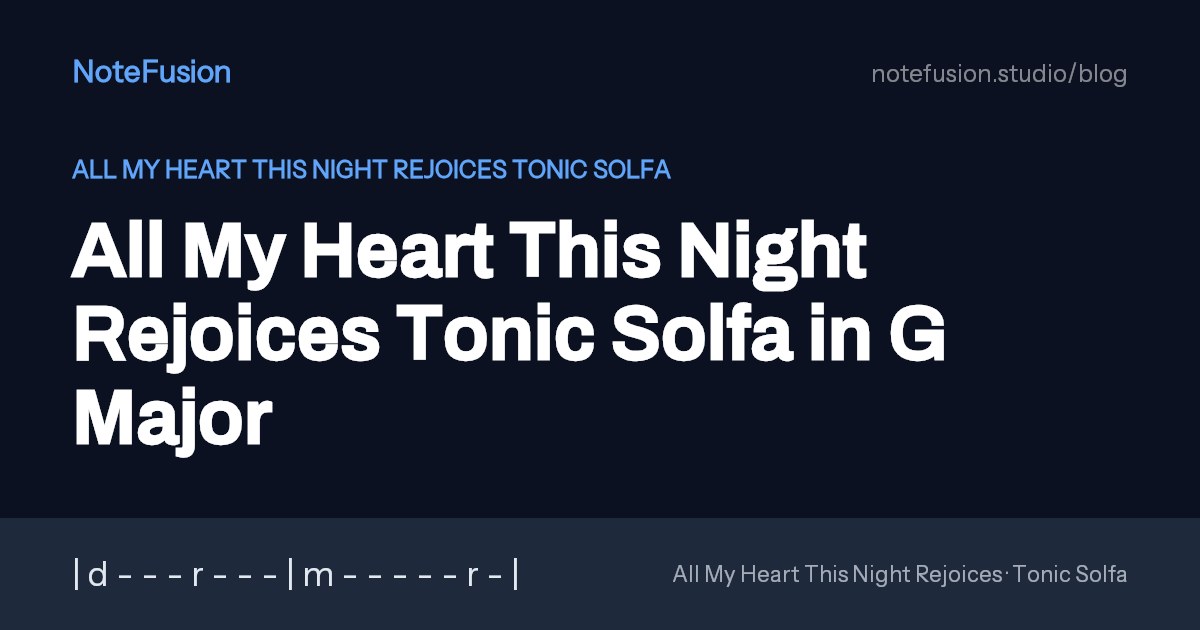
All My Heart This Night Rejoices tonic solfa is in G major with doh on G, in 4/4 over 16 bars. It opens d, r, m on long notes, then steps back to r, so a choir can learn the first phrase in minutes and spend its rehearsal on warm, sustained, joyful tone rather than on note-bashing.
Below I walk you through that opening, show you how to find doh, give you a phrase-by-phrase teaching method, suggest a lower key for tired voices, and show where the hymn sits in a carol service order. Everything here is usable at your next rehearsal.
A lesser-known Christmas hymn for choir that earns its place
The words come from the German of Paul Gerhardt, known in English through Catherine Winkworth's translation. The text is about the night of the birth itself: the singer's heart rejoicing, the angels' song, the Child in the manger. That makes it a natural fit for a Christmas Eve or carol service, yet many congregations have never sung it. Among lesser-known Christmas hymns for choir, it has three things going for it:
- It is stepwise at the start. No awkward leaps in the opening phrase, so newer singers are not left behind.
- It is in a friendly key. G major has one sharp, and doh on G is a comfortable starting pitch for most choirs.
- It gives the choir something to say. Because the congregation probably does not know it, the choir can sing it as an offering rather than as a sing-along, which lets you shape the dynamics.
If you are still building your list, my overview of Christmas carols in tonic solfa covers the well-known carols this one can sit beside.
Got a recording? Get it in solfa →
All My Heart This Night Rejoices tonic solfa: the opening phrase
Here are the first two bars as they appear on the All My Heart This Night Rejoices hymn page:
| dAll---rmy--- | mheart-----rthis- |
Read it slowly and notice the note lengths, because this is where choirs go wrong:
- "All" sits on doh for two beats.
- "my" moves up to ray for two beats.
- "heart" rises to me and is held for three beats. That is the longest note in the opening, and it lands on the most important word.
- "this" steps back down to ray for one beat, leading into the next bar.
The shape is a slow climb, d r m, then a small turn back to r. Because the notes are long, the danger is not pitch but energy: singers let the tone sag in the middle of "heart" and arrive late on "this". My advice is to count the three beats of "heart" aloud the first time through, then silently, so the choir moves to r together on the fourth beat.
How do you find doh in All My Heart This Night Rejoices?
Doh is G, because the hymn is written in G major and G major has one sharp, F sharp. In movable doh, the last sharp in a key signature is te, and doh is the next note up: F sharp is te, so G is doh.
Here is the G major scale with the letter names under the solfa, so your keyboard player and your singers are talking about the same notes:
| dG-rA-mB-fC- | sD-lE-tF♯-d'G- |
To pitch the hymn without an instrument, find a G you trust (a tuning app, a pitch pipe or the first note of another G major carol), sing it as doh, then sing d r m to settle the key in the ear before the choir starts on doh. If you want a fuller method, how to find the doh of a song explains the key-signature rule and checking by ear.
This hymn begins on doh itself, which makes the starting note simple: whatever you play or sing as doh is the note everyone opens on. My post on six carol openings grouped by starting syllable is useful here, because you can put this hymn with the other carols that start on doh and drill all their first notes together.
Teaching the all my heart this night rejoices choir melody phrase by phrase
The sheet is 16 bars long, which is short enough to teach in one sitting if you take it in small pieces. This is the order I use for any new hymn with a volunteer choir:
- Sing bars 1 and 2 to solfa, then have the choir echo. Use the syllables, not the words. Hold each note for its full value and count the three beats on "heart".
- Repeat bars 1 and 2 to the words. Once the pitches are secure, the words go on easily. Ask for a clear "h" on "heart" so the long me does not start with a scoop.
- Take the next two bars from the hymn page the same way. Echo on solfa first, then words. Before you move on, ask the choir to circle the last note of each phrase on their sheet and say its syllable aloud. Knowing where each phrase comes to rest stops the line wandering.
- Join each new pair of bars to the bars before. Do not let a section exist only on its own; always sing back from the start of the phrase so the joins are rehearsed.
- Mark the breaths in pencil. Breathe at the ends of lines of text, not in the middle of a held note. With notes this long, a late breath is easy to hear.
- Sing the whole melody through once to solfa, once to words. Then stop. A clean run is worth more than three tired ones.
If your altos, tenors or basses are learning their own parts at home, point them to how to learn your choir part at home, which covers slow playback and looping a single phrase.
A quick check for held notes
Long notes in a slow hymn tend to go flat. Before the full run-through, have everyone sing the opening d r m on a single sustained "oo", holding each for four slow beats while you listen for the me staying bright. If it sinks, ask them to think the next note up as they hold it. That one exercise usually lifts the whole hymn.
Do you need a lower key for this Christmas hymn in G major solfa?
Usually not, but it depends on your sopranos and how late in the service you sing it. Check the highest note on the full sheet against your choir. If the top feels effortful in the week of the service, when voices are already tired from extra rehearsals, dropping a tone is the simplest fix.
Because tonic solfa uses movable doh, the syllables do not change when you change key. Here are the same two opening bars in F major:
| dAll---rmy--- | mheart-----rthis- |
It is still d r m, then r. Only the pitch of doh has moved, from G down to F. Your choir reads exactly the same solfa; you simply give them a new doh. Tell your accompanist the new key in advance, because their part changes even though the singers' sheet does not.
Where does All My Heart This Night Rejoices fit in a carol service?
It fits best at a point where the service has just arrived at the birth itself, because the words are sung from the night of Christmas. Here are the places I would consider:
| Point in the service | Why it works | What to pair it with |
|---|---|---|
| After the reading of the shepherds and the angels | The text answers the angels' news with joy | Follow with While Shepherds Watched, sung by everyone |
| Choir item in the middle of the service | The congregation can listen to something unfamiliar | Precede with a well-known carol so people are settled |
| Near the end of a Christmas Eve service | "This night" lands best on the night itself | Lead straight into O Come, All Ye Faithful |
That last pairing is worth pointing out. O Come, All Ye Faithful is also in G major on the NoteFusion sheets, so both share doh on G. If you sing them back to back, your choir needs no new starting pitch: the doh they finish on is the doh they begin with. Good King Wenceslas is in G major too, if you want a lighter companion.
For the bigger picture of when to schedule each carol and how many weeks to allow, see how to plan a Christmas carol service for choir. Because this hymn is new to most choirs, I would introduce it early in that plan, not in the final fortnight.
A two-rehearsal plan you can start this week
Rehearsal one (about 15 minutes):
- Pitch doh on G and sing the G major scale up and down once.
- Teach bars 1 and 2 on solfa, then words, counting the held notes.
- Add the rest two bars at a time using the steps above.
- Finish with one run of the melody on solfa only.
Rehearsal two (about 15 minutes):
- Warm up with the sustained d r m exercise on "oo".
- Sing the melody to words, checking the pencilled breaths.
- Add the lower parts if your choir sings in harmony, one section at a time over the melody.
- Run it in its place in the service order, with whatever comes before and after, so the transition is rehearsed.
Between the two rehearsals, share the hymn page link so singers can play it back at home. A week of listening to the tune does more than an extra ten minutes on the night.
Bring your own recordings in too
If your choir has heard this hymn in a different arrangement, or wants to learn another Christmas piece from a recording, NoteFusion can help. Paste a YouTube, Spotify or Apple Music link, upload a recording, or hum the tune, and it writes the melody in movable-doh tonic solfa with staff notation. You can play it back on a piano slower or looped, use "Transpose for my choir" to move the doh and see whether each part sits comfortably, and share the sheet with a link. Try it in your browser at NoteFusion.
Frequently asked questions
What key is All My Heart This Night Rejoices in?
The tonic solfa version on NoteFusion is in G major, so doh is G. It is in 4/4 and runs to 16 bars.
What is the first note of All My Heart This Night Rejoices in solfa?
It starts on doh, which is G in this key. The opening climbs d, r, m on long notes before stepping back to r.
Is All My Heart This Night Rejoices hard for a choir to learn?
The opening is gentle. It moves by step on long notes, so the main work is holding notes for their full value and breathing in the right places, not tricky leaps.
Where does All My Heart This Night Rejoices fit in a carol service?
It works well straight after the reading about the shepherds or the birth, or near the end of a Christmas Eve service, because the words are about rejoicing on the night itself. It also sits comfortably next to O Come, All Ye Faithful, which uses the same doh.
Can I sing All My Heart This Night Rejoices in a lower key?
Yes. In movable doh the syllables stay the same when you change key; only the pitch of doh moves. F major puts every note a tone lower if your sopranos tire.