Write More Blogpost on Christmas: 6 Carol Openings
Write more blogpost on Christmas, done: the first solfa notes of six carols, grouped by starting syllable, so your choir comes in together on every carol.
Every December the same thing happens: the organ plays the opening line, the choir draws breath, and half the room comes in on doh while the carol actually starts on soh. The words are fine, the harmony is fine, but the first note wobbles and it takes a whole line to settle.
My own note to myself this autumn was short: write more blogpost on Christmas, and make it something a choir can use at the very next rehearsal. So this one is narrow and practical. It gives you the first solfa notes of six well-known carols, groups them by the syllable they start on, and shows you how to pitch each group in seconds.
If you only read one paragraph, read this: most carols start on one of three notes, doh, low soh (s,) or the soh above doh. Learn which group each carol belongs to, sing the short path from doh to that note before you start, and your choir will come in together every time.
Why write more blogpost on Christmas carols at all?
Because carols are the music your choir sings most once a year and rehearses least. Many of them feel so familiar that nobody looks closely at how they begin, and the beginning is where the trouble lives. A choir that knows "this one starts on low soh" will find the note; a choir that just hopes will not.
There is a second reason. Christmas is when volunteers join, children sing alongside adults, and people learn carols from recordings at home. A plain list of starting syllables is something everyone can hold in their head, whatever their reading level. For the bigger picture of putting a whole service together, see how to plan a Christmas carol service for choir and the wider list of Christmas carols in tonic solfa. This post deals with the first two seconds of each carol.
Got a recording? Get it in solfa →
Which syllable does each carol start on?
Here are six carols, with the key and doh used on NoteFusion's hymn pages, and the note each one starts on.
| Carol | Key (doh) | Time | First note | Pickup? |
|---|---|---|---|---|
| Good King Wenceslas | G major (G) | 4/4 | doh | No |
| O Come, All Ye Faithful | G major (G) | 4/4 | doh | Yes, one beat |
| While Shepherds Watched Their Flocks | F major (F) | 4/4 | doh | Yes |
| Hark! The Herald Angels Sing | F major (F) | 4/4 | low soh (s,) | No |
| Once in Royal David's City | F major (F) | 4/4 | low soh (s,) | Yes |
| Silent Night | Bb major (Bb) | 6/8 | soh | No |
One thing jumps out of that table. Hark! The Herald Angels Sing, While Shepherds Watched and Once in Royal David's City all have doh on F, and so does Away in a Manger. If your service order puts those carols near each other, the choir keeps the same doh in their ears and only the starting syllable changes. That is worth planning for.
Carols that start on doh
These are the easiest to pitch, because the note you give is the note they sing. But two of the three begin with a pickup, and that is where choirs come unstuck.
Good King Wenceslas
In G major, the opening is four steady crotchets on doh, doh, doh, ray, then back to doh before dropping to s, on "out". There is no pickup, so the first syllable lands squarely on beat one. Give doh, count "one, two, three, four" and the choir is in.
O Come, All Ye Faithful
Also in G major, also on doh, but it starts with a one-beat pickup on "O":
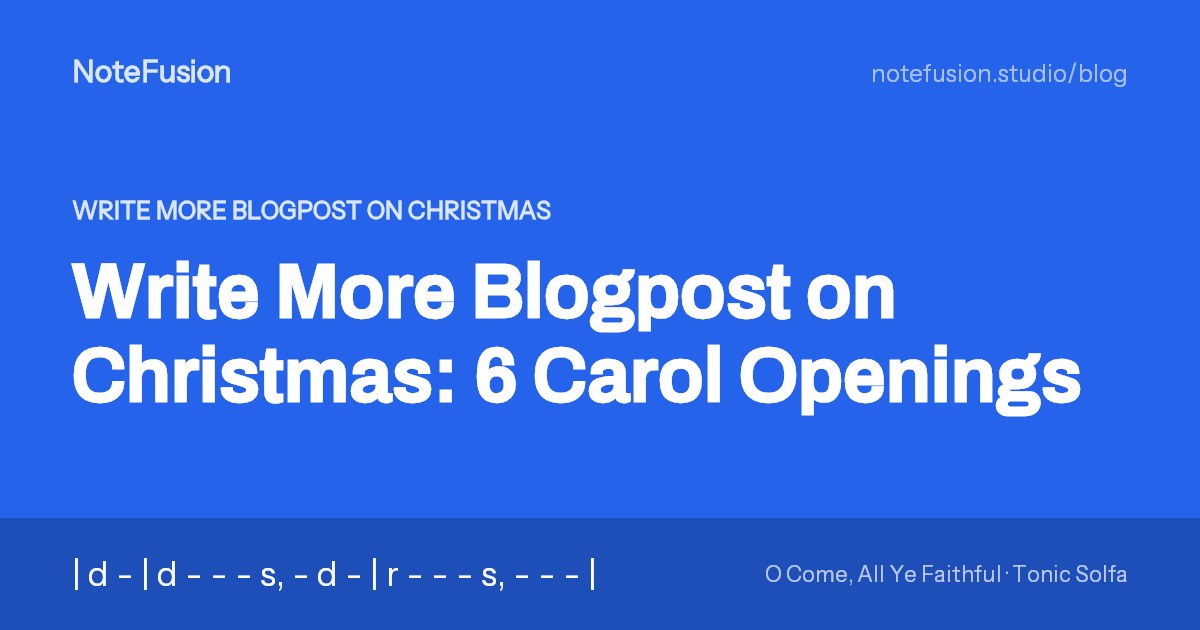
| dO- | dcome,---s,all-dye- | rfaith----s,ful,--- |
Look at what happens next. "O" is a single beat on doh, "come" is held for two beats on the same doh, then the tune drops to s, on "all". The common mistake is to treat "O" as a long note and arrive late on "come". My advice is to count the bar before as "one, two, three, O" so the pickup sits on beat four. If pickups are a regular headache, the post on what a pickup note is covers the counting in more detail.
While Shepherds Watched Their Flocks
In F major, "While" is a pickup on doh, then "shepherds" jumps up to me. Because the first note is doh and the second is me, the choir hears the major third straight away, which steadies the key for everyone.
Carols that start on low soh (s,)
These are the ones I would rehearse first. Starting below doh catches out singers who assume every carol begins on the home note, and basses in particular can find s, sits low if you pitch it carelessly.
Hark! The Herald Angels Sing
| s,Hark!-dthe-dher---t,ald | dan--mgels-msing-r_- |
The opening "Hark!" is on s, (the C below doh, since doh is F), and "the" leaps up a fourth to doh. Then "herald" has a dotted rhythm: doh held for a beat and a half, a quick t, , and back to doh on "an-". So in the space of one bar the choir has to find s, , leap a fourth, and place a dotted note. No wonder it can sound ragged.
Try this: sing doh, then step down "doh, t, , l, , s," so the choir walks down to the starting note. Then sing just "s, doh" a few times on "Hark the" until the leap is clean. The octave marks guide explains why that comma under the s matters: it means the soh below doh, not the one above.
Once in Royal David's City
In F major, "Once in" is a pickup that rises s, to t, , arriving on doh for "roy-". The first note is s, again, but this time the tune climbs straight back up through t, . Because it is often sung by a single treble voice for the first verse, that soloist needs the starting note given clearly and alone. Sing doh, then s, , then let the soloist begin.
Carols that start on soh above doh
Silent Night
| sSi---llentsnight,- | m_----- | sho---llysnight,- | m_----- |
In Bb major and 6/8, Silent Night opens on soh (the F above doh), moves up to lah and back to soh, then settles on me for a long "night". That gentle soh, lah, soh, me shape repeats for "holy night".
Two things to watch. First, the 6/8 swing: "Si-" is longer than "-lent", and the choir should feel two slow beats per bar, not six quick ones. Second, the drop from soh to me is easy to sing flat when people are tired late in a candlelit service. My advice is to sing doh, me, soh as a chord shape before you start, so the me is already in the ears when the tune lands on it.
Away in a Manger and Angels from the Realms of Glory also begin on soh above doh, so the same pitching method works for both.
How do you pitch a carol without an instrument?
Sing doh, then sing the shortest path from doh to the carol's first note, and start. The choir hears the key and the starting note in one breath. In practice it looks like this:
- Starts on doh (Good King Wenceslas, O Come, While Shepherds): sing "doh, me, soh, me, doh" and begin. The chord shape fixes the key.
- Starts on low soh (Hark!, Once in Royal): sing "doh, t, , l, , s," stepping down, or "doh, s," as a leap once the choir is used to it.
- Starts on soh above (Silent Night, Away in a Manger): sing "doh, me, soh" rising, and hold the soh.
If you lead from the front with a pitch pipe or a phone, play doh only and sing the path yourself. Giving the starting note without the key often leaves the altos guessing where they are. The full method is in how to give a choir the starting note.
If a carol's doh is too high or low for your singers, move doh and the starting syllable stays the same. That is the beauty of movable doh: Silent Night still starts on soh in any key. For choosing that key, see how to choose the right key for your choir.
A 10-minute carol-openings drill for your next rehearsal
This fits at the end of a warm-up and pays off for the whole season.
- Minute 1–2: Sing the scale "d r m f s l t d'" in F major and back down to s, . Make sure the basses are comfortable on s, .
- Minute 3–4: Call out a carol title. The choir answers with its starting syllable only: "Hark!" gets "s, ", "Silent Night" gets "soh", "Good King Wenceslas" gets "doh". This is a memory game, not singing.
- Minute 5–7: Give doh, sing the path, and have the choir sing just the first phrase of each carol in the F major group: While Shepherds, Hark!, Once in Royal, Away in a Manger. Same doh throughout, different first notes.
- Minute 8–9: Change doh to G for O Come, All Ye Faithful and Good King Wenceslas. Count the pickup out loud for O Come.
- Minute 10: Change doh to Bb for Silent Night and sing the first two lines, feeling two beats in a bar.
Run this drill twice before the carol service and your openings will stop being a gamble.
Practising the openings at home
Most of your singers will learn carols from recordings in the weeks before Christmas, and a recording rarely tells them the starting syllable. This is where NoteFusion helps. Paste a YouTube, Spotify or Apple Music link, or upload a recording, and it writes the melody in movable-doh Tonic Solfa with staff notation, so a singer can see that the tune starts on s, before they press play. It will play the opening back on a piano, slower or looped, which is a quick way to drill just the first phrase. If your choir needs a different key, "Transpose for my choir" moves doh and shows whether each part sits comfortably. Sheets can be saved and shared with a link, so the whole choir can practise from the same page.
To try it with your own carol list, open NoteFusion, drop in a recording of the first carol you are worried about, and check its starting syllable before Sunday.
Frequently asked questions
What note does Hark! The Herald Angels Sing start on in tonic solfa?
In F major it starts on low soh (s,), the C below doh, then leaps up to doh on "the herald". Give your choir doh first, then the s, beneath it.
Which Christmas carols share the same doh?
In the versions on NoteFusion's hymn pages, Hark! The Herald Angels Sing, While Shepherds Watched Their Flocks, Once in Royal David's City and Away in a Manger are all in F major with doh on F. You can sing them one after another without changing doh.
How do I give a choir the starting note of a carol without a piano?
Sing doh, then sing the short path from doh to the first note, such as doh down to s, or doh up through me to soh. The choir hears the key and the starting note in one breath, and comes in together.
What is the first note of Silent Night in solfa?
In Bb major Silent Night starts on soh, the F above doh, in 6/8 time. It moves soh, lah, soh and then settles on me for "night".
Why does my choir come in wrong at the start of carols?
Usually the starting note is not doh and nobody has been given a path to it, or the carol begins with a pickup before the first strong beat. Name the starting syllable, sing the path from doh, and count the pickup out loud.