All People That on Earth Do Dwell Solfa: 4 Parts in G
All People That on Earth Do Dwell solfa in G major: the Old Hundredth melody line by line, how alto, tenor and bass move under it, and a rehearsal plan.
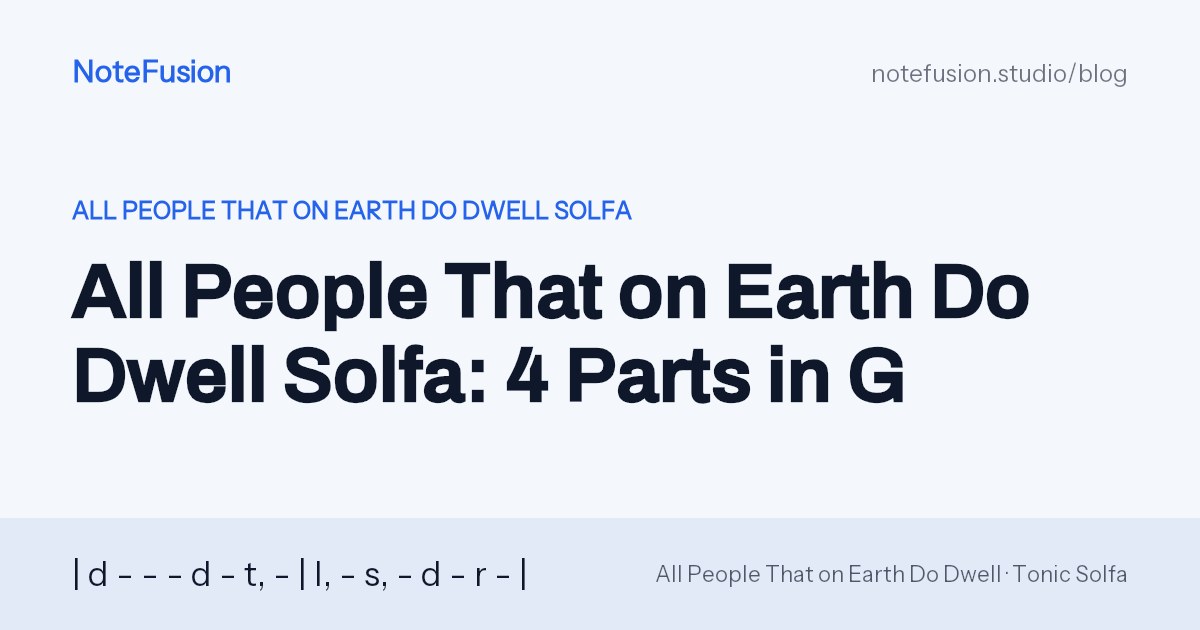
Your choir has sung the Old Hundredth in unison for years, and now you want to try it in harmony, but the altos drift onto the tune and the basses do not know where to start. The good news is that no hymn makes a gentler first step into four parts.
Here is the all people that on earth do dwell solfa in brief: the tune is in G major with doh on G. It opens on a held doh, steps down through t, and l, to low soh (s,), then climbs back up. Each of its four lines has one note per syllable, and the whole melody fits inside one octave, from s, up to s.
Below I walk through the melody line by line, then show how alto, tenor and bass can move underneath it using only three chords, and finish with a rehearsal plan you can use this week.
The all people that on earth do dwell solfa, line by line
The tune is in G major, so doh is G. Here are the opening bars as they appear on our All People That on Earth Do Dwell solfa page:
| dAll---dpeo--t,ple- | l,that-s,on-dearth-rdo- |
Read it slowly and notice three things:
- The first note is long. "All" sits on doh for two beats. That longer note at the start of each line is the signature of the Old Hundredth, and it gives everyone a moment to settle on the pitch.
- The line falls, then rises. From doh it steps down through t, and l, to s, on "that", then turns and climbs through d and r towards "dwell". Those commas below the letters are octave marks: t, l, and s, sit below the doh you started on. If the marks are new to your choir, the guide to octave marks in Tonic Solfa explains them.
- Every syllable gets one note. There are no slurs or melismas to manage, so singers can read the solfa and the words at the same time.
Here is the whole melody, all ten bars, so you can see the four lines together:
| dAll---dpeo--t,ple- | l,that-s,on-dearth-rdo- |
| mdwell,---mSing--- | mto-mthe-rLord-dwith- |
| fcheer--mful-rvoice;--- | dHim---rserve-mwith- |
| rmirth,-dhis-l,praise-t,forth- | dtell,---sCome--- |
| mye-dbe--rfore-fhim- | mand-rre--djoice.--- |
What makes this tune so easy to teach is how much of it repeats. The third line ("Him serve with fear, his praise forth tell") uses the same notes as the first. The second line sits higher and ends on ray, which leaves the music hanging. The fourth line starts on soh, the highest note of the hymn, and works its way down to finish on doh. Once a choir knows lines one and two, it effectively knows three quarters of the hymn.
Got a recording? Get it in solfa →
Why is the Old Hundredth the ideal first harmony hymn?
The Old Hundredth is the ideal first harmony hymn because its rhythm is almost completely even, so every part moves at the same moment and no one has to count. When all four voices change note together on every syllable, the singers can listen to the chord instead of worrying about where the beat is.
A few other features help:
- A narrow range. The melody stays between s, and s. Sopranos never strain, and the lower parts can sit in their most comfortable notes.
- Mostly stepwise movement. The tune moves to the next note up or down far more often than it leaps. Inner parts written underneath it can move by step too.
- Clear line endings. Each line finishes on a long note, which gives the choir a held chord to tune before breathing.
- You already know it. The same melody is widely sung to "Praise God, from Whom All Blessings Flow", so many singers carry it in their ears already. That frees their attention for their own part.
If you are choosing a short list of first-term repertoire, this sits naturally alongside the others in easy hymns for a new choir.
Old Hundredth four parts: how each voice moves
You do not need a printed harmony to start singing the Old Hundredth in four parts. With three chords built on doh, fah and soh, you can give every voice a sensible line. Here is the G major scale with letter names, so you can match each syllable to its pitch:
| dG-rA-mB-fC- | sD-lE-tF♯-d'G- |
The three chords you need are:
| Chord | Syllables | Notes in G |
|---|---|---|
| Doh chord | d m s | G B D |
| Fah chord | f l d | C E G |
| Soh chord | s t r | D F# A |
The rule is simple: for each tune note, pick a chord that contains it, then give the other voices the remaining notes of that chord, moving each part as little as possible.
Soprano: the tune
Sopranos sing the melody exactly as written. Their job in harmony is to keep it steady and not to push the long first notes, because everyone else is tuning to them.
Bass: the foundation
The bass carries the chord roots. On the opening doh, basses sing doh too, an octave or more below. When the tune reaches r at the end of line two, the music is resting on the soh chord, so basses sit on s, underneath. At the very end, where the tune moves from ray to doh, basses move from s, to d. That soh-to-doh step in the bass is what makes the final chord sound finished, and it is the first thing I would teach the basses.
Alto: just below the tune
Altos take a chord note below the soprano. On the opening doh, a natural choice is s, or m below. Where the tune moves by step, altos can often move in parallel a third or sixth lower, which sounds sweet and is easy to hear. Warn altos about one thing: when the tune drops to s, on "that", they will be very close to it, so they must hold their own note and not slide onto the melody.
Tenor: the middle
Tenors fill whichever chord note is missing. Often that means repeating a note for several syllables while the tune moves, which is a gift for a nervous tenor section. Tenors who struggle to find their first note can take it from the basses: if the bass is on doh, the tenor is usually on m or s above.
For a full walk-through of choosing chords and avoiding the common mistakes, such as letting two parts cross or leaping awkwardly in the tenor, read how to harmonise a hymn in four parts with solfa. The method there works line by line on the Old Hundredth too.
How do you teach All People That on Earth Do Dwell in parts in one rehearsal?
You teach it in parts by building from the bottom up: tune first, then bass, then the inner voices, and only then all four together. Here is the order I would use.
- Everyone sings the tune on solfa. Pitch doh (G), sing the scale down to s, and back, then sing line one on solfa. Repeat until the long first note is confident.
- Add the words. Sing the whole melody to verse one. Point out that line three repeats line one.
- Basses alone. Teach the bass line on solfa while everyone else hums doh quietly. Spend extra time on the closing s, to d.
- Sopranos and basses together. The outer parts give you the shape of the harmony. If these two are secure, the inner parts have something to lock onto.
- Add altos. Have altos sing their line against the sopranos only, then add basses.
- Add tenors last. By now the chord is three-quarters built, so tenors can hear where their notes fit.
- Hold the line endings. Stop on the last chord of each line and let the choir listen for a full two or three seconds. Ask: does it sound settled?
If your rehearsal time is short, do steps one to four this week and leave the inner parts for next week. Sopranos and basses alone already sound fuller than unison.
Choosing a key for your all people that on earth do dwell choir
G major works for many choirs, but it is not the only option. Because Tonic Solfa uses movable doh, changing the key does not change a single syllable. Here are the same opening bars written in A major:
| dAll---dpeo--t,ple- | l,that-s,on-dearth-rdo- |
The solfa is identical; only the pitch of doh moves from G to A. Use this to your advantage:
- Low basses, few tenors? Try F major. The bass s, to d at the end sits lower and more comfortably, and tenors are not pushed upwards.
- Bright young voices or a lively festival service? A major lifts the tune and gives it more ring.
- Unaccompanied? Choose the key where your weakest section is most comfortable, then pitch doh carefully before you begin.
Whichever key you choose, the top note of the melody is soh and the bottom is s,, so check those two pitches against your sopranos and altos before you commit.
Where the Old Hundredth fits in your services
The words of All People That on Earth Do Dwell are a paraphrase of Psalm 100, a psalm of thanksgiving and praise. That makes it a strong opening hymn for almost any service, and especially suitable for harvest and thanksgiving celebrations. If you are planning one of those, it pairs well with the hymns in thanksgiving hymns for church choir in solfa.
It also gives you a quick win with other texts. Because the same tune carries the Doxology and "Be Present at Our Table, Lord", a choir that has learned its harmony for this hymn can sing those in four parts with no extra rehearsal. That is a real encouragement for a new choir: one tune learned well, three uses on Sunday.
If some of your singers prefer staff notation, the guide to converting staff notation to tonic solfa uses this same hymn as its worked example, which makes it easy to put both versions side by side.
Practising your part at home
Volunteer choristers rarely have time for extra rehearsals, so give them a way to practise between sessions. My advice is to ask each section to learn just its own line for lines one and two. Because lines three and four reuse so much of the material, that covers most of the work.
If you have a recording of your choir, or of another choir singing the Old Hundredth, you can put it into NoteFusion and it will write out the melody in movable-doh Tonic Solfa with staff notation underneath. You can play it back on a piano more slowly or on a loop, and "Transpose for my choir" moves the doh and shows whether each part sits comfortably before you settle on G, F or A.
To try it with your next hymn, open NoteFusion in your browser, hum or upload the tune, and share the finished sheet with your choir using a link.
Frequently asked questions
What key is All People That on Earth Do Dwell in?
It is usually sung in G major, so doh is G. The melody spans one octave, from low soh (s,) up to soh, which suits most congregations and choirs.
What is the first note of the Old Hundredth in solfa?
The tune begins on doh, held for two beats. Pitch doh firmly and the rest of the first line steps down to low soh and back up.
Is the Doxology the same tune as All People That on Earth Do Dwell?
Yes. 'Praise God, from Whom All Blessings Flow' is very often sung to the Old Hundredth, so a choir that learns one has learned the melody of the other.
Is the Old Hundredth a good first hymn for singing in four parts?
It is one of the best. It has one note per syllable, mostly stepwise movement, four short lines and a narrow range, so each part can concentrate on its own line instead of on the rhythm.
Can I sing the Old Hundredth in a different key?
Yes. In movable doh the syllables stay the same and only the pitch of doh changes. Choirs with low basses often drop it to F; choirs with bright sopranos can lift it to A.