Are You Washed in the Blood Tonic Solfa: Refrain Drills
Are You Washed in the Blood tonic solfa in A flat major: find doh, read the pickup and dotted rhythm, and drill the refrain so every part enters together.
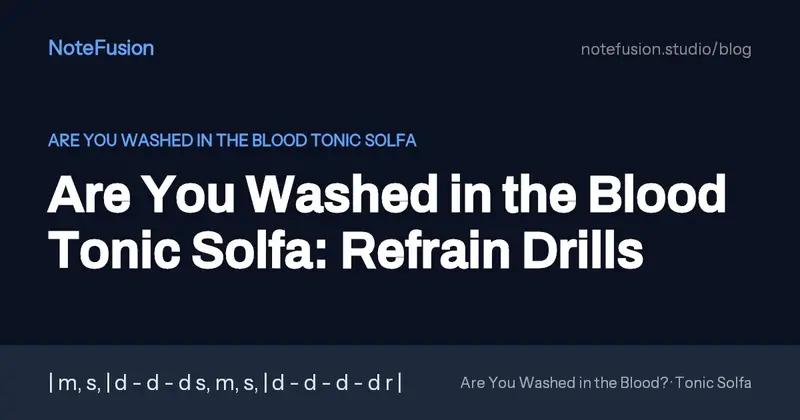
Your choir sings the verse of Are You Washed in the Blood? well enough, then the questions arrive and half the voices come in a beat late on "Are you", while the other half rush ahead. By the third verse nobody is quite sure who is asking and who is answering.
Here is the direct answer. The Are You Washed in the Blood tonic solfa on our hymn page is in A flat major, so doh is A flat. The tune opens with a pickup that starts on low me and climbs to low soh before landing on doh, and every "Are you" falls on the two halves of beat four, leading into the next bar.
This post walks through the opening bars as they are written, shows how a dotted rhythm looks in solfa, and gives you a drill to run at your next rehearsal so the refrain works as a proper call and response and every part comes in together.
Are You Washed in the Blood tonic solfa: the opening bars
These are the first three bars on the page: the pickup plus two full bars.
| m,Haves,you | dbeen-dto-dJe-s,susm,fors,the | dcleans--ding-dpow’r?-dAreryou |
Three things are worth pointing out to the choir before anyone sings.
- It starts low. "Have you" begins on low me and steps up to low soh. The comma below each syllable is the low octave mark, so these notes sit underneath doh. Sopranos often start too high here because they expect to begin on doh.
- Doh is repeated again and again. Look at how many times doh appears in bars 2 and 3. Repeated notes are where choirs sag in pitch, because nobody feels they are "doing" anything. We will come back to this.
- "Are you" is a pickup inside the bar. At the end of the third bar on the page, "Are you" takes the last beat, split into two halves: doh and then the note one step above it. That little lift is the question starting. It belongs to the next bar musically, even though it is printed before the bar line.
You can open the full melody on the Are You Washed in the Blood? hymn page and follow along with the rest of this post.
Got a recording? Get it in solfa →
How do you find doh for Are You Washed in the Blood in A flat?
Doh is A flat, and you can confirm it from the key signature in any staff copy. Four flats (B flat, E flat, A flat, D flat) mean A flat major. The quick rule is that the last flat in the signature is fah, so count down four notes from D flat and you arrive at A flat, which is doh.
Here is the scale with letter names under each syllable, so your accompanist and your singers are talking about the same notes:
| dA♭-rB♭-mC-fD♭- | sE♭-lF-tG-d'A♭- |
A few practical notes on singing Are You Washed in the Blood in A flat:
- Pitch from doh, not from the first note. Give the choir A flat, have them sing doh, then let them find low soh and low me underneath it. Starting from doh fixes the key in their ears before they sink down.
- Watch the low start. Basses will be happy. Sopranos and tenors may sound weak and breathy on low me. If the opening sounds muddy every time, try it a step higher. Our guide on choosing the right key for your choir explains how to check the top note of the refrain before you commit.
- Altos need doh as an anchor. With so many repeated dohs in the tune, altos who are singing a harmony line can drift onto the melody. Tell them which bars they sit on a note different from the sopranos.
Where does the pickup fall, and why does "Are you" trip choirs?
The pickup falls on beat four. In the opening, "Have you" fills beat four before bar one proper; in the verse, "Are you" fills beat four before the question "washed in the blood". In both places the words come before the strong beat, and singers who wait for a downbeat arrive late.
If the idea of an anacrusis is new to some of your singers, send them our explanation of pickup notes before rehearsal. For this hymn the fix is simple:
- Count "one, two, three, four" out loud.
- Everyone breathes on three.
- "Are" goes on four, "you" on the and after four.
- "Washed" lands on the next one.
Say it in rhythm before you sing it. A choir that has spoken "three-breathe, four-Are-you, ONE-washed" five times will not come in late on Sunday.
Conducting helps too. Give a clear breath on beat three with your hand, not just a nod on beat four. The breath is the entry signal; the beat is too late.
How is the dotted rhythm written in solfa?
A dotted figure inside one beat is written as a note, a dash, a comma and then the short note. The first note lasts three quarters of the beat; the comma marks where the final quarter begins. Gospel hymns of this period use the figure constantly, and When the Roll Is Called Up Yonder, also in A flat, shows it clearly in its first bars:
| dWhen-,rthe | mtrum--,mpetmof-,mthemLord-,rshalldsound,-,dand | rtime-,dshalldbe-,l,nos,more,-dAnd-,rthe |
Read each beat as a long-short pair. In the first full bar almost every beat follows the same pattern: a held me, then a quick me tucked onto the end of the beat. Clap it as "taa-a-fe" or speak the words; the long note should feel lazy, the short note crisp.
Two things to watch when you carry this into Are You Washed in the Blood?:
- Even half-beats are not dotted. In the opening bars of our hymn, the half-beat pairs (such as "Are you") are written evenly, one note per half-beat. A dotted figure would show the dash and comma inside the beat. Sing what the page shows.
- Recordings vary. Some singers lean even half-beats into a dotted lilt, especially in the refrain. That is a style choice, not a mistake, but your choir must make the same choice. Decide once, mark it in everyone's copy, and sing it that way every verse.
For a fuller walk through dashes, dots and commas, see how to read rhythm in tonic solfa and our post on what a comma means in tonic solfa.
Drilling the Are You Washed in the Blood refrain as a call and response hymn for choir
The refrain is built on questions: "Are you washed in the blood, in the soul-cleansing blood of the Lamb? Are your garments spotless? Are they white as snow? Are you washed in the blood of the Lamb?" Each question starts on a pickup, and each one leaves a gap for an answer. That shape is what makes it work so well as a call and response hymn for choir, whether or not your copy prints an echo part.
Run this drill at your next rehearsal. It takes about fifteen minutes.
- Speak the words in rhythm. Whole choir, no pitch. Conduct, and insist on the breath on beat three before every "Are".
- Clap only the pickups. Speak the refrain again but clap on every "Are you" and "Are your". Singers hear how often the pickup comes round.
- Sing it on solfa, slowly. Use the hymn page or a printed copy and sing syllables, not words, at about half speed. Correct the repeated dohs here, while there are no words to distract.
- Add the words at half speed. Then at full speed.
- Split question and answer. See below.
- Swap and recombine. Everyone sings both halves once, then return to the printed parts.
Splitting question and answer
If your hymn book prints an echo for the lower voices, use it as written. If it does not, you can still rehearse the Are You Washed in the Blood refrain as call and response:
- Group A (sopranos and altos) sing the question: "Are you washed in the blood".
- Group B (tenors and basses) answer with the next phrase: "in the soul-cleansing blood of the Lamb".
- Carry on alternating phrase by phrase to the end of the refrain.
The point is not to perform it this way on Sunday (though you may). The point is that each group must hand over cleanly. Group B has to come in exactly on time without Group A carrying them, which shows you at once who is waiting for someone else to start. After two runs, swap the groups so the men sing the questions.
Then put the parts back together. Singers who have sung both halves alone hear the shape of the refrain, and the entries tighten up immediately.
Keeping the repeated dohs in tune
The verse sits on doh for long stretches, and repeated notes go flat when singers stop listening. Three quick fixes:
- Think up on every repeat. Ask singers to aim each doh at the top of the note, as if the next one is a little brighter than the last. It is a mental trick, but it stops the sag.
- Sustain one doh. Before singing the verse, hold doh for eight slow beats on "oo" with the piano silent, then check against the piano. If it has drifted, you have found your problem.
- Mark the step up. When the melody finally moves from doh to the note above at "Are you", make it a real step, not a smear. A lazy step up is the most common reason the question sounds flat.
A 20-minute rehearsal plan
| Minutes | Task | Focus |
|---|---|---|
| 0-3 | Pitch doh on A flat, sing the scale | Fix the key before anything else |
| 3-6 | Speak the opening in rhythm | Breath on beat three, pickup on four |
| 6-10 | Sing the verse on solfa, slowly | Low me, low soh, repeated dohs in tune |
| 10-16 | Refrain drill, steps 1-5 | Every "Are you" on time |
| 16-18 | Swap groups | Everyone knows both halves |
| 18-20 | Full hymn with words, one verse | Same rhythm choice every time |
If you have more time, spend it on the refrain, not the verse. The refrain comes back after every verse, so ten extra minutes there pays off four times on Sunday. The same approach works for other blood hymns with refrains, such as There Is Power in the Blood and Nothing but the Blood.
Practising at home between rehearsals
Most volunteers will learn this from a recording during the week, so give them something that matches what you will sing. Point them to the hymn page for the solfa, tell them the key is A flat, and ask them to practise only the refrain pickups until they can come in without thinking.
If your choir learns from a recording, NoteFusion can help. Paste a YouTube, Spotify or Apple Music link, or upload a recording, and it writes the melody in movable-doh Tonic Solfa with staff notation. Members can play the tune back on a piano, slower or looped, to drill the refrain entries, and "Transpose for my choir" shows whether each part sits comfortably if you decide to move the hymn up from A flat. You can save the sheet and share it with a link. Try it at /app.
Frequently asked questions
What key is Are You Washed in the Blood in tonic solfa?
The NoteFusion hymn page has it in A flat major, so doh is A flat. The key signature has four flats, and the last flat, D flat, is fah.
What is the first note of Are You Washed in the Blood in solfa?
The tune starts below doh on low me, steps up to low soh on 'you', and lands on doh for 'been'. Those first two notes are a pickup, so the choir starts on beat four, not beat one.
Why does my choir come in late on 'Are you'?
'Are you' sits on the two half-beats of beat four, so it is a pickup into the next bar. Singers who wait for a strong beat arrive late. Have everyone breathe on beat three and sing on the 'and' of the count.
How is a dotted rhythm written in tonic solfa?
A dotted figure inside one beat is written as a note, a dash and a comma, then the short note. The first note lasts three quarters of the beat and the comma marks where the last quarter begins.
How do I teach the refrain as call and response?
Learn the whole refrain in unison on solfa first, then give the question to one group and the answer or echo to another. Swap the groups so everyone knows both halves before you put the parts back together.
Is A flat a good key for my choir?
The verse dips below doh to low me, which can be dull for sopranos and fine for basses. If your choir sounds muddy on the opening, try the hymn a step higher and check that the top of the refrain stays comfortable.