Asleep in Jesus Tonic Solfa: Learn It in One Rehearsal
Asleep in Jesus tonic solfa in D major: find doh, count the slow 3/2, learn the nine-bar tune line by line and sing it at a funeral this week.
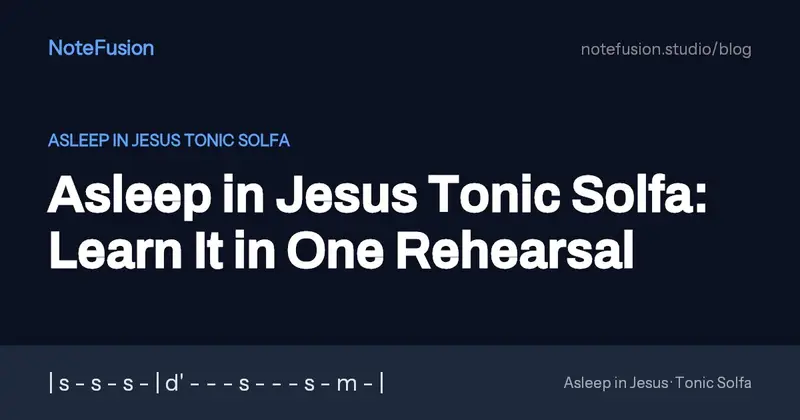
You have just been asked to sing Asleep in Jesus at a burial later this week, and most of your choir has never sung it. There is one rehearsal, maybe two, and the family is counting on you to sing it gently and well.
The Asleep in Jesus tonic solfa is written in D major, so doh is D, in 3/2 time with three slow minim beats to a bar. The whole tune is only nine bars long and every verse uses it. It opens with a pickup on soh, sung three times, then leaps up to top doh on "Jesus".
That shortness is your friend. In this post I take the D major page line by line, show you how to pitch it without fuss, how to count the slow 3/2 so the choir does not drag or hurry, and when to drop the key for tired voices at a graveside. At the end you will know exactly where it sits in the rest of the service.
What is the Asleep in Jesus tonic solfa?
The Asleep in Jesus tonic solfa is a nine-bar melody in D major with doh on D. Here are the opening bars as they appear on the Asleep in Jesus solfa page:
| sA--ssleep-sin- | d'Je----ssus!---sBless--med- | rsleep,-----fFrom-fwhich-fnone- |
Read it slowly and notice three things:
- The pickup. "A-sleep in" sits on soh three times. Nothing moves, so the only job is to place the notes evenly and softly.
- The leap. On "Je-" the tune jumps up a fourth to top doh, written d' with the apostrophe above. This is the one moment in the opening where a choir can go sharp by shouting, or flat by reaching timidly.
- The fall and the hold. After top doh the line drops back to soh for "-sus! Bless-", slips down to me on "-ed", and comes to rest on ray for "sleep", which is held. Then fah repeats on "From which none" and carries the line on.
That held ray on "sleep" is worth pointing out to the choir: the word and the music both pause there. Let it sit without a swell.
Got a recording? Get it in solfa →
How do you find doh for Asleep in Jesus?
Doh is D, because the hymn is in D major (two sharps, F sharp and C sharp). But the choir does not start on doh. They start on soh, which in D major is A.
| dD-rE-mF♯-fG- | sA-lB-tC♯-d'D- |
My advice for a funeral, where you may have no piano at the graveside:
- Sound D on whatever you have (a keyboard, a pitch app, a tuning fork).
- Sing doh, then step up through the scale to soh so the choir hears the key, not just a single note.
- Give the starting note as "soh" and sing "A-sleep in" on it once, quietly, before you bring them in.
If you often struggle to give a confident first note outdoors, the guide on how to pitch a song for choir without an instrument walks through it step by step.
How do you count 3/2 time so the hymn stays calm?
Count three slow minim beats in each bar and conduct a simple three pattern: down, out, up. The minim is the beat, not the crotchet, so the music should feel spacious rather than busy.
Two habits keep it steady:
- Treat the first bar as a lift-in. The opening is a pickup, so the first strong downbeat lands on "Je-". Give your preparatory gesture on the beat before, and let "A-sleep in" lead into your downbeat.
- Count through the held notes. The long ray on "sleep" is where choirs either cut short or wander. Have everyone count the beats silently on their fingers the first few times until the length is in their bodies.
If 3/2 is new to some of your singers, time signatures explained for singers shows how it differs from 3/4.
Learning the D major page line by line
Because every verse uses the same nine bars, you are really learning one short tune and then laying several sets of words on it. Here is the whole melody:
| sA--ssleep-sin- | d'Je----ssus!---sBless--med- | rsleep,-----fFrom-fwhich-fnone- |
| r'ev----ter---lwakes-tto- | d'weep;-----sA-scalm-sand- |
| sun----mdis----fturbed-sre-- | lpose,-----lUn--d'bro--lken- |
| sby-mthe-rlast---fof--- | mfoes.----- |
This is the order I would use for a single rehearsal of about twenty minutes:
- Sing the opening on solfa, not words. Bars 1 to 3, slowly, with you singing first and the choir echoing. Point to the d' so they see the leap coming.
- Add the words for verse one on those same bars. Check that "sleep" is held its full length.
- Take the next three bars the same way: solfa first, you sing, they echo, then words.
- Then the last three bars. The end of a hymn tune is usually where it settles back towards doh, so listen for the choir arriving together and staying in tune on the final note.
- Join all nine bars on verse one only. Stop once at the end and check pitch against your D. If it has sunk, the leap to top doh is the first place to look.
- Run every verse straight through without stopping. At a funeral the choir will not get a second go, so the last run in rehearsal should feel like the real thing.
- Agree the breaths. Mark them in pencil on the words: a breath after "sleep" is natural, and nobody should breathe in the middle of a word because the tempo is slow.
Send the page link home the same evening so people can look over it before the service.
Asleep in Jesus choir parts when time is short
If your hymn book prints four parts, it is tempting to teach them all. With one rehearsal, I would not. Asleep in Jesus choir parts are worth learning when you have a week; when you have a day, a confident unison is far more moving than an uncertain harmony.
A workable middle path:
- Everyone learns the melody first. All sections sing the tune through once in unison, so anyone who loses their part can fall back on it.
- Basses next, from the hymn book. A firm bass line steadies the choir more than any other part, especially outdoors.
- Altos and tenors only if time allows. If they are not secure by the end of rehearsal, ask them to sing the melody on the day.
- Sopranos lead the leap. Put your steadiest sopranos in the middle so the top doh on "Jesus" is clear for everyone around them.
Singers who want to learn their own line between now and the service should read how to learn your choir part at home. If someone has only a recording of the hymn, NoteFusion can take that recording and write the melody out in solfa and staff notation, then play it back slower or on a loop so they can drill the opening bars on their own.
Is D major the right key at a graveside?
D major puts the top doh on the D near the top of the treble stave. In a warm church after a proper warm-up, that is comfortable for most sopranos. At a graveside in the cold, early in the day, with voices tight from emotion, it can feel high.
If you hear strain on "Jesus" in rehearsal, lower the hymn by a tone. In C major doh becomes C, the starting soh becomes G, and the solfa does not change at all, which is the whole beauty of movable doh:
| sA--ssleep-sin- | d'Je----ssus!---sBless--med- | rsleep,-----fFrom-fwhich-fnone- |
The choir reads exactly the same syllables; only your starting pitch moves. Tell the organist or keyboard player the new key in good time. If you want to check how every section copes before you decide, NoteFusion's "Transpose for my choir" moves the doh and shows whether each part sits comfortably. For the wider reasoning, see how to choose the right key for your choir.
Where Asleep in Jesus fits in a funeral service
Asleep in Jesus as a hymn for funeral use works best near the committal: either at the graveside itself or as the coffin leaves the church for burial. Its words speak of death as rest and of waking again, and the short, slow tune means mourners who do not know it can still follow by the second verse.
A few practical points:
- Outdoors, sing fewer verses well rather than all of them thinly. Agree the number with the minister beforehand.
- Stand close together. Sound disappears in open air; a tight group keeps the choir hearing itself and staying in tune.
- Have the words printed large. Choir folders blow about at gravesides.
You will usually need more than one hymn. My list of funeral hymns in tonic solfa gives twelve choices with gentle keys and a two-day rehearsal plan for the whole service. If the family has asked for a well-known hymn in church as well, Abide with Me for choir takes that one line by line too, and the two sit well together: Abide with Me in church, Asleep in Jesus at the burial. As burial hymn solfa goes, this pairing gives a small choir one familiar tune and one short new one, which is a realistic load for a week's notice.
A short checklist for the day
- Starting note checked: soh, which is A in D major or G if you lowered to C.
- Verses agreed with the minister.
- Breaths marked after "sleep" and at the ends of lines.
- Sopranos briefed on the leap to top doh.
- Words printed and clipped down.
- One quiet run of the opening bars before you leave for the graveside.
If a family hands you a song you have only heard on a recording, you can hum it, upload it or paste a YouTube, Spotify or Apple Music link into NoteFusion and get the melody in movable-doh tonic solfa with staff notation, ready to transpose for your choir and share with a link before the next rehearsal.
Frequently asked questions
What key is Asleep in Jesus in tonic solfa?
The NoteFusion page has it in D major, so doh is D. The first sung note is soh, which is A, and the line rises to top doh, the D an octave above.
What is the first note of Asleep in Jesus?
It starts on soh, sung three times as a pickup on 'Asleep in', before leaping up to top doh on 'Jesus'. In D major that soh is A.
How do you count 3/2 time in Asleep in Jesus?
Count three slow minim beats in each bar and conduct a three pattern. The opening bar is a short pickup, so the first strong beat falls on 'Je-' of 'Jesus'.
Can a small choir sing Asleep in Jesus in unison?
Yes. The tune is only nine bars and sits well in unison, so with one rehearsal it is better to sing the melody together than to rush four parts.
Is Asleep in Jesus a good burial hymn?
Its words speak of death as rest and waking, which suits the committal or the graveside. The short, slow tune is easy for mourners to follow even if they do not know it.