How to Get Tonic Solfa from a YouTube Song in 5 Steps
How to get tonic solfa from a YouTube song: paste the link, check the melody by ear, fix busy-recording errors, pick a choir key and share the sheet.
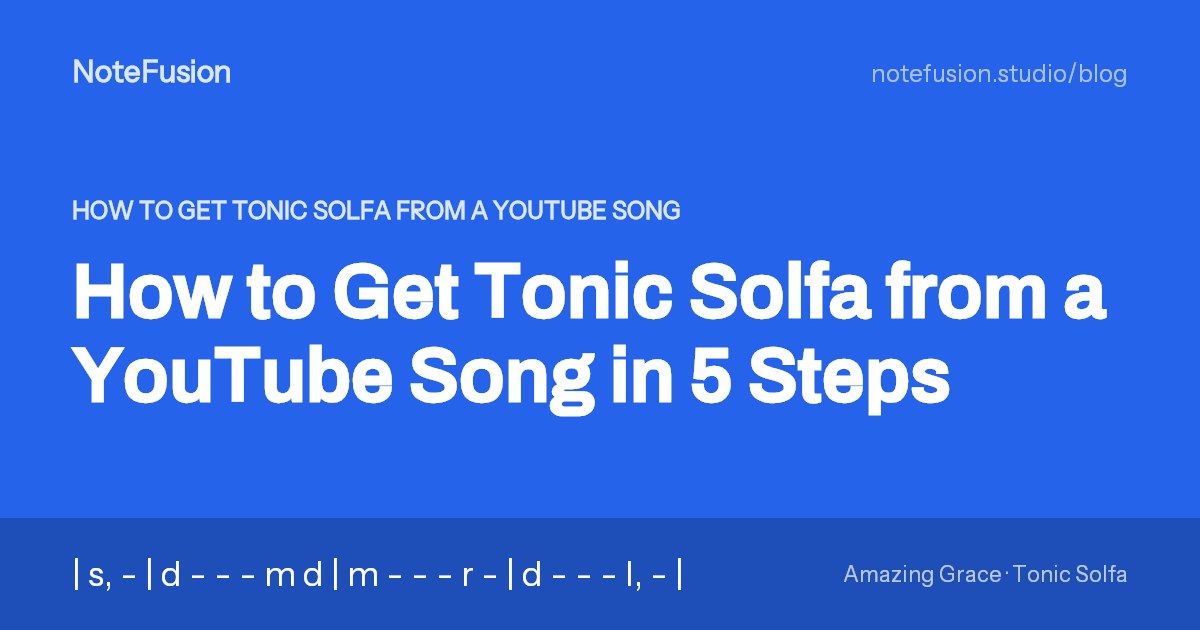
The music director has sent a YouTube link, the song is on Sunday, and nobody in the alto row has the solfa. You can play the video twenty times and still not be sure whether that note is ray or me.
Here is the short answer to how to get Tonic Solfa from a YouTube song: paste the video link into a transcription app such as NoteFusion, let it write the melody in movable-doh solfa with staff notation, then check it by ear at a slower speed, correct anything a busy recording confused, choose a key your choir can sing, and share the sheet.
That is the whole process, but each step has a trap in it. In this post I will walk you through it the way I do it for my own choir: which version of the song to pick, how to check the result in ten minutes, what to fix by hand when the band is loud, and how to land on a key that the tenors will thank you for.
How to get Tonic Solfa from a YouTube song, step by step
This is the routine. The rest of the article explains each step in more detail.
- Choose the clearest video. One voice singing the tune, little or no crowd noise.
- Paste the link. NoteFusion accepts YouTube, Spotify and Apple Music links, so copy the address from your browser or the share button and paste it in. It writes the melody in movable-doh Tonic Solfa, with staff notation alongside, and reads minor keys la-based.
- Answer the doh question. If the melody could sit in two keys, you will be asked "Which doh is it?" Pick the one where the tune comes to rest on doh (or on lah for a minor song).
- Check it by ear. Play the sheet back on the piano, slower or looped, and compare it phrase by phrase with the video.
- Fix, transpose, share. Correct the octave and rhythm slips, move the doh to suit your voices, then save the sheet and send the link.
If you would rather understand what the transcriber is doing under the bonnet, or you want to do one by hand, my guide on how to transcribe a song into Tonic Solfa covers the manual method.
Got a recording? Get it in solfa →
Which YouTube version should you use?
Use the version where the tune is easiest to hear on its own, not necessarily the one your church plays. A youtube song to solfa notation conversion is only as good as the audio it hears, and a stadium recording gives a transcriber the same headache it gives your altos.
In order of preference:
- A solo voice with piano or guitar. The melody sits clearly on top.
- A congregational or choir recording sung in unison. Many voices on one line is still one line.
- An official lyric video of the studio track. Usually clean, but watch for harmonies doubling the lead.
- A live concert video. Last resort. Crowd singing, drum fills and the lead singer improvising all compete with the tune.
One more thing to check before you paste: is this the same arrangement you will sing? Worship songs often appear in several versions with different bridges, extra choruses or a key change near the end. Five minutes spent matching the video to your order of service saves an argument at rehearsal.
How do you check the solfa is right?
You check it by singing the solfa against the recording, one phrase at a time, at a speed where you can actually hear each note. Do not read the whole sheet and nod; that is how mistakes reach rehearsal.
This is the check I use:
- Find the first strong beat. Many songs begin with a pickup note before the first full bar. Look at how Amazing Grace opens:
| s,A-- | dmaz----mingd_ | mgrace!---rhow- | dsweet---l,the- | s,sound,---s,That- |
The word "A-" falls on s, before the first bar line, and "-ma-" lands on doh on the strong beat. If the transcriber has put the bar lines in the wrong place, the solfa will look odd even when the notes are right. Tap your foot to the video and make sure the bar lines fall where your foot stresses.
Loop the first phrase. Play the piano playback slowly and on a loop, and sing the syllables over it. Then play the video and sing the same syllables. If they agree, move on.
Listen for the resting notes. The ends of lines are where errors show most. In a major-key song, lines usually settle on d, m or s. If a phrase ends on a syllable that sounds unfinished to you but finished on the video, look again.
Spot-check the leaps. Large jumps such as d up to l, or s, up to m, are where a busy recording most often fools a transcriber. Sing each leap slowly against the playback.
For more on getting the most from slowed-down and looped audio, including how singers can practise their own line at home, see how to use recordings in choir practice.
What to fix by hand when the recording is busy
Even a good transcription of a full-band track can need a few corrections. These are the ones I see most often, and each takes a minute once you know what to look for.
The tune is in the wrong octave
If the lead singer is a man singing low, the melody may come out sitting around s, and l, when your sopranos will sing it an octave higher. The syllables are fine; only the octave marks need changing. Move s, to s, or d to d', across the whole line. My explainer on octave marks in tonic solfa shows how the comma and apostrophe work if you are unsure.
A backing vocal or instrument got in
When harmonies are loud, a phrase may suddenly jump to a note a third or sixth away from where you expected, then jump back. That is usually the harmony line stealing the melody for a few beats. Sing the phrase with the video and keep the notes the lead singer actually sings.
The soloist decorated the tune
Runs, slides and extra notes on long words are lovely from one singer and chaos from twenty. If the solfa shows a cluster of quick notes on a single syllable, decide what the plain tune is and write that. Your choir sings the song, not one performer's version of it.
The rhythm is more complicated than the song
Singers often push notes slightly ahead of the beat. Sometimes that is the real rhythm and sometimes it is style. Ask: would the congregation sing it this way? If not, straighten it. My post on solfa for praise and worship songs covers syncopation, repeated choruses and how to write them so a choir reads them first time.
The key changes near the end
A last chorus that lifts by a step or a semitone means doh moves. If the solfa suddenly looks wrong for the final section, check whether the song has changed key, and mark where. The article on modulation in tonic solfa explains how to read and write that change.
Which doh is it? Major, minor and two-key tunes
Some melodies genuinely could sit in two keys, especially short tunes that use only a handful of notes. That is why the app asks "Which doh is it?" rather than guessing. The rule of thumb: choose the doh that makes the tune feel at home at the end. If you are still not sure, my guide on how to find the doh of a song gives three reliable ways to decide, by key signature, by ear and by testing the tune.
Minor songs are where choirs get confused, so it helps to know what you will see. Tonic Solfa reads minor keys la-based: lah is home, and doh sits three semitones above it. Here is the opening of Bread of Heaven, in G minor:
| m,Bread-l,of-l,heav’nse,_fe,onm,_ | l,Thee-t,we-dfeed,--- |
Doh is Bb, but the tune circles round l, which is G, the true home note. You will also see se, and fe, the raised seventh and sixth that give minor tunes their pull upward. If a transcription of a minor song shows lots of d and very little l, the doh has probably been placed wrongly. Pick the la-based option and the syllables will make sense.
Choosing a key your choir can actually sing
The key on the YouTube video was chosen for that singer's voice, not your choir's. A key that sits nicely for a professional tenor may leave your sopranos straining or your basses inaudible.
The good news is that in movable doh, transposing never changes the syllables. Only the doh moves. Here is the same Amazing Grace opening moved from G down a tone to F:
| s,A-- | dmaz----mingd_ | mgrace!---rhow- | dsweet---l,the- | s,sound,---s,That- |
Every syllable is identical; only the letter names and the doh have shifted. Your choir learns the same solfa whichever key you finally choose, which is why I always decide the key after checking the transcription, not before.
To pick a key:
- Find the highest and lowest notes of the melody in the transcribed sheet.
- Ask who sings them. Sopranos carry the tune in most choirs, so the top note must sit comfortably for them, not just reachably.
- Try two candidate keys and see which suits the inner parts too.
"Transpose for my choir" in NoteFusion moves the doh and shows whether each part sits comfortably, which saves a lot of trial and error at the piano. For the full method, including how to talk to your accompanist about the new key, read how to transpose a song.
Sharing the sheet before rehearsal
Once the solfa is checked and in the right key, save the sheet and share it with a link. Send it to the choir group with three short instructions:
- Which key you are singing in, so nobody practises along to the original video in a different key.
- Which version of the song you followed, especially if the YouTube recording had an extra chorus or a different ending.
- Where to start practising. Point people to the trickiest phrase so they loop that first, slowly, rather than singing the easy verse ten times.
The sheet doubles as a practice tool: singers can play the tune back on the piano slower or on a loop, so the altos who cannot read staff notation and the tenor who cannot find his first note both have something to hold on to. When you arrive at rehearsal, everyone has seen the same solfa notes of the song online, and you can spend your limited time on blend and words instead of teaching pitches line by line.
If you have a YouTube link waiting and Sunday is coming, open the NoteFusion app, paste the link, and check the first phrase against the video tonight. It works in your browser and on Android, and by the end of the evening you can have a checked, choir-friendly sheet in your singers' hands.
Frequently asked questions
Can I get Tonic Solfa from a YouTube link without reading music?
Yes. A transcription app can write the melody for you in solfa and staff notation from the link. You still need to listen back and check it against the recording, but you do not need to work out the notes from scratch.
Why does my solfa look an octave too low or too high?
The transcriber has probably followed a low male lead, a backing singer or an instrument instead of the tune your choir sings. Keep the syllables and move the octave marks, so s, becomes s or d becomes d', until it matches where your sopranos sing.
How do I convert a YouTube video to sheet music for a choir?
Paste the link into a transcriber that writes both Tonic Solfa and staff notation, check the melody by ear at a slower speed, then transpose it to a key that suits your voices. Save the sheet and share the link with your singers.
What if the YouTube song is in a minor key?
In movable-doh solfa a minor key is read la-based, so lah is the home note and doh sits three semitones above it. A song in G minor has doh on Bb, and the tune will settle on lah rather than doh.
Which YouTube version of a song is best to transcribe?
Choose the clearest version with one voice singing the tune: an acoustic, piano or congregational recording usually works better than a concert video with a band, crowd noise and a soloist improvising.