Lent Hymns for Church Choir in Tonic Solfa: 8 Picks
Lent hymns for church choir in tonic solfa: eight picks with keys, which need la-based minor or D flat reading, and a January-to-Easter plan.
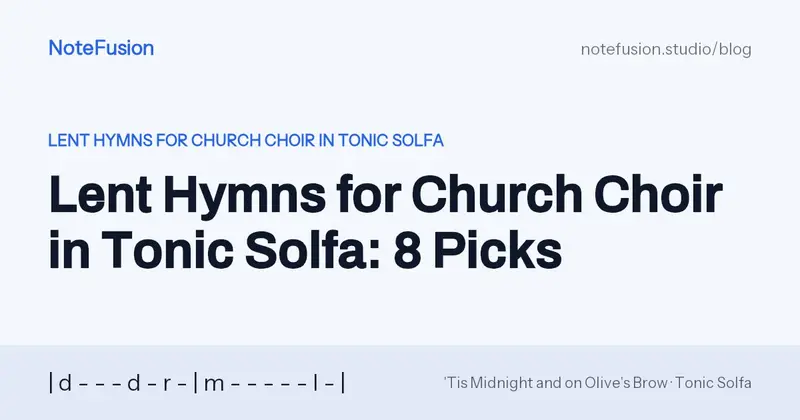
Ash Wednesday arrives before most choirs have packed away the Christmas folders, and the Passion hymns are the ones with the awkward keys: a minor tune the altos never quite settle into, a hymn in five flats that makes the keyboard player sigh. If you start in January, neither has to be a Sunday-morning surprise.
The best Lent hymns for church choir in tonic solfa are Forty Days and Forty Nights, 'Tis Midnight and on Olive's Brow, Beneath the Cross of Jesus, At the Cross, When I Survey the Wondrous Cross, There Is a Green Hill Far Away and All Glory, Laud, and Honor. Two need la-based minor reading and one needs a D flat doh, so teach those first.
Below you will find each hymn with its key and doh, the reading skill it asks for, where it fits in the season, and a week-by-week plan from January to Easter. Every hymn here has its own solfa page in our hymn library, so you can print or share the full sheet once you have chosen.
Lent hymns for church choir in tonic solfa: the shortlist
I have grouped these by what they ask of your singers, because that decides your rehearsal order more than the calendar does.
| Hymn | Key and doh | Skill to check first | Where it fits |
|---|---|---|---|
| Forty Days and Forty Nights | D minor, doh F, lah D | La-based minor | First Sunday of Lent |
| 'Tis Midnight and on Olive's Brow | D minor, doh F, lah D | La-based minor | Holy Week, Maundy Thursday |
| Beneath the Cross of Jesus | D flat major, doh Db | Five flats, fe | Passiontide, Good Friday |
| At the Cross | E flat major, doh Eb | Refrain entry | Any Lent Sunday |
| When I Survey the Wondrous Cross | D major, doh D, 3/4 | None special | Good Friday |
| There Is a Green Hill Far Away | E flat major, doh Eb | None special | Good Friday, all-age services |
| Near the Cross | F major, doh F, 6/4 | Six slow beats in a bar | Lent devotions |
| All Glory, Laud, and Honor | C major, doh C | Sopranos reaching high me | Palm Sunday |
The last four are comfortable for most choirs. The first three are where January rehearsals pay off. If your tradition sings a hymn specifically for the forty days, Lord, Who Throughout These Forty Days is also in the library and makes a good partner for Forty Days and Forty Nights.
Got a recording? Get it in solfa →
Which Lent hymns need la-based minor reading?
'Tis Midnight and on Olive's Brow and Forty Days and Forty Nights both need la-based minor reading, because both are in D minor. In movable doh, D minor shares its notes with F major, so doh sits on F and lah sits on D, the home note. If you or your section leaders are shaky on this, read la-based minor explained before your first rehearsal; it takes ten minutes and saves a month of confusion.
Here is the opening of 'Tis Midnight:
| d'Tis---dmid--rnight,- | mand-----lon- |
Notice what it does not do: it does not start on lah. The first note is doh, which in this key is F, a minor third above the home note. That catches choirs out every year. Someone hears "D minor", hums a D, and the sopranos start a third too low.
My advice for pitching it:
- Play or hum D and have everyone sing it to lah. That is home; let them hear it first.
- Have them step up from lah to doh, so they feel the minor third.
- Sing doh on its own, then start the hymn from there.
Forty Days and Forty Nights is the gentler of the two, so teach it first. It opens on me and drops to low lah within the first bar, which puts the home note in the ear straight away. Once your choir has sung it for two weeks, 'Tis Midnight feels like familiar ground rather than a new puzzle.
One more check while you have the parts open: look through the alto and tenor lines in your hymn book for se, the raised seventh. Where a minor-key hymn has se in an inner part, that is usually where the part wobbles, so mark it in pencil and sing it slowly against lah before you put the four parts together.
How do you read Beneath the Cross of Jesus in D flat?
You read it exactly like any major hymn once you have put doh on D flat. Five flats look frightening on a stave, but in tonic solfa the syllables do not change, only the pitch you start from. The walkthrough on how to read a hymn in D flat major solfa covers finding doh from the key signature; here I will stick to the two places this hymn trips singers up.
| sBe-- | sneath--sthefecross-lof- | sJe----msus-dI- |
First, the pickup is on soh, not doh. Give the choir doh, then soh, and count them in so "Be-" lands before the bar line. Second, the word "cross" sits on fe, the raised fourth. In D flat, fe is G natural, which is exactly the note a tired keyboard player is most likely to play as a G flat. Sing that bar slowly a few times with your section leaders until the fe feels like a lean upwards towards soh rather than a wrong note.
If your accompanist really dislikes five flats, move the hymn up a semitone to D major or down to C major. The solfa stays the same, so the choir loses nothing. In NoteFusion, "Transpose for my choir" moves the doh and shows whether each part sits comfortably in the new key, which is a quick way to see whether your basses or your sopranos win from the change. There is a fuller teaching plan in our Beneath the Cross of Jesus solfa guide.
The easy wins: At the Cross, When I Survey, A Green Hill
Not every one of your hymns for Lent choir work should be a battle. These three let a volunteer choir sound settled while you work on the harder ones.
| dA-- | mlas!--randddid-mmy- | sSa---fviourmbleed,-sAnd- |
At the Cross sets Isaac Watts's "Alas! and did my Saviour bleed" with a refrain the choir sings after every verse. It opens on a doh pickup in E flat and moves by small steps around the doh chord, so most singers can read it at sight. Because the refrain comes back each time, teach it first; the At the Cross refrain-first plan shows how to do that in a single rehearsal.
When I Survey the Wondrous Cross is in D major and 3/4 on our page. Its line is mostly stepwise, which makes it a good hymn for practising soft, even singing without the parts drifting. There Is a Green Hill Far Away sits in E flat, opens on doh and climbs gently by step; it works well with children or an all-age congregation joining in.
Near the Cross, in F major, is written in 6/4. Count six slow beats in a bar, felt as two big pulses, and the long held notes will stop sounding rushed.
Palm Sunday: All Glory, Laud, and Honor
All Glory, Laud, and Honor is the processional hymn for Palm Sunday, and it is the one Lent hymn where the challenge is range rather than key.
It is in C major with doh on C. After a doh pickup the tune rises steadily to top doh and then to high me in the third bar. That high me is E at the top of the treble stave, which is fine for a warmed-up soprano section and hard work for a cold one at the start of a procession. Two things help:
- Warm up on that exact climb before the service, not just a general scale.
- If your sopranos are few or tired, try the hymn a tone lower. The solfa is unchanged, and your altos and basses will usually be happier too.
If you want a second Palm Sunday hymn, Ride On! Ride On in Majesty is also in the library and turns the mood towards the week ahead.
Good Friday hymns for choir and the rest of Holy Week
Good Friday hymns for choir need a different kind of preparation: quieter singing, slower tempos and often no accompaniment for at least one verse. This is where the passion week hymns solfa work you did in January really shows.
A simple Holy Week shape:
- Palm Sunday: All Glory, Laud, and Honor; Ride On! Ride On in Majesty.
- Maundy Thursday: 'Tis Midnight and on Olive's Brow; Go to Dark Gethsemane.
- Good Friday: When I Survey the Wondrous Cross; There Is a Green Hill Far Away; Beneath the Cross of Jesus; O Sacred Head, Now Wounded.
For any verse you plan to sing unaccompanied, give the choir lah (for the minor hymns) or doh (for the major ones) and check the pitch again at the end of the verse. Minor hymns sung slowly tend to sag, and a held home note at the end tells you at once whether it has.
A January-to-Easter rehearsal plan
In 2027 Easter falls on 28 March, so Ash Wednesday is 10 February. Count back from your own Easter date if you are planning for another year. This plan assumes one rehearsal a week.
- First two weeks of January: Teach the D minor scale to lah and doh as a warm-up. Learn Forty Days and Forty Nights in unison.
- Weeks three and four: Add parts to Forty Days. Begin 'Tis Midnight, pitching from lah up to doh every time.
- Early February: Learn At the Cross, refrain first. It gives the choir an easy success while the minor hymns settle.
- Through February: Teach Beneath the Cross of Jesus. Decide by mid-month whether you keep D flat or transpose, and tell your accompanist.
- Early March: When I Survey and There Is a Green Hill. Practise one verse of each unaccompanied.
- Mid-March: All Glory, Laud, and Honor with the high-me warm-up, plus a run-through of the Maundy Thursday hymns.
- Holy Week rehearsal: Sing through each service in order, starting pitches and all, with no new learning.
Between rehearsals, send each section the solfa sheet and a recording of its own line. Singers who have heard the fe in Beneath the Cross or the opening doh of 'Tis Midnight at home walk in ready to sing it.
If you have a recording of the arrangement your church uses, NoteFusion can turn it, a pasted YouTube link or a hummed tune into movable-doh Tonic Solfa with staff notation, la-based for the minor hymns, and play it back slower or looped so each section can drill its tricky bar. Save the sheets and share them with your choir by link from the NoteFusion app.
Frequently asked questions
What are good Lent hymns for a church choir?
Forty Days and Forty Nights suits the start of Lent. Beneath the Cross of Jesus, At the Cross and When I Survey the Wondrous Cross carry the middle weeks. 'Tis Midnight and on Olive's Brow suits Holy Week, and All Glory, Laud, and Honor suits Palm Sunday.
Which Lent hymns are in a minor key?
Of the hymns in this set, 'Tis Midnight and on Olive's Brow and Forty Days and Forty Nights are both in D minor. In tonic solfa they are read la-based, with doh on F and lah on D as the home note.
What key is Beneath the Cross of Jesus in?
The version on our hymn page is in D flat major, so doh is D flat. It opens on a soh pickup and has a fe on the word 'cross'. Some choirs move it up a semitone to D or down to C so the keyboard player has fewer flats.
When should a choir start rehearsing for Lent and Easter?
Start in January. That gives you time to teach the minor-key and five-flat hymns before Ash Wednesday and to save the final weeks for Palm Sunday and Good Friday. In 2027 Easter falls on 28 March, so Ash Wednesday is 10 February.
What hymns are sung on Good Friday by a choir?
Common choices include When I Survey the Wondrous Cross, There Is a Green Hill Far Away, Beneath the Cross of Jesus, O Sacred Head, Now Wounded and At the Cross. Pick quieter, slower hymns and plan where the choir sings unaccompanied.